
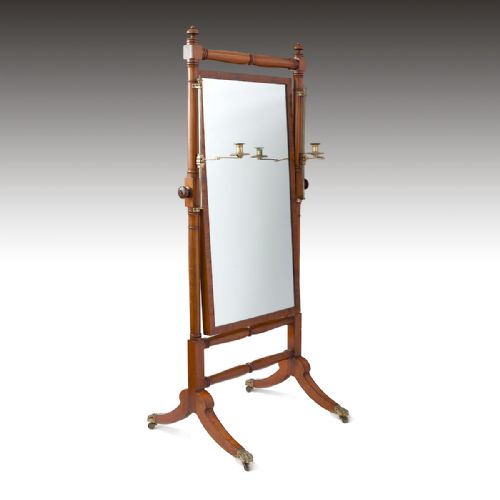
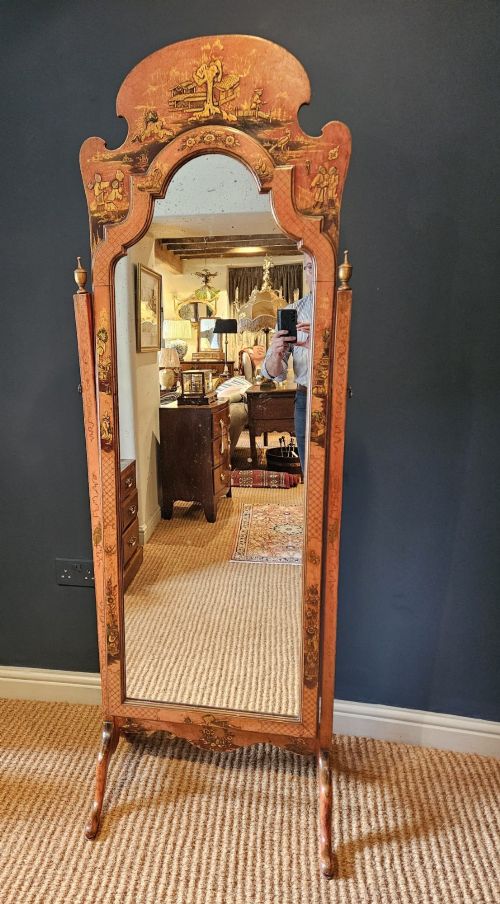


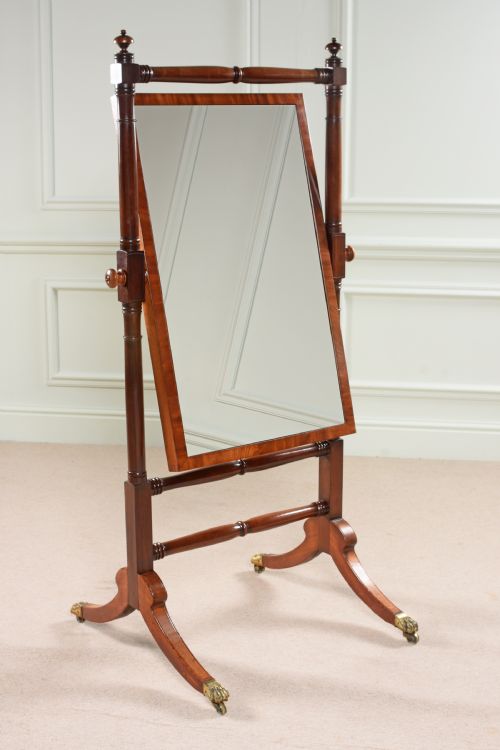


Edwardian Style Cheval Mirror
These edwardian style cheval mirror pieces offer adjustable full-length reflections, bringing period elegance and practical dressing utility to a room.
Edwardian Style Cheval Mirror
An edwardian style cheval mirror stands independently on a frame, allowing the glass to tilt on pivoting side pins. Buyers seeking this phrase encounter free-standing floor-length glasses as well as smaller toilet mirrors meant for tabletops.
The selections span genuine Edwardian pieces alongside revivals from the nineteen-twenties, alongside earlier Georgian, Regency, and Victorian formats. Mahogany and satinwood form the core timber choices across these offerings, often enhanced with marquetry inlay.
Certain examples draw on specific historical aesthetics like George III, Chinese Chippendale, Sheraton, and Adam styles. Other variations lean towards Chinoiserie decoration or French Rococo Revival and Neoclassical ornamentation.
Materials and construction
Cabinetmakers utilised solid timbers and veneers such as mahogany and satinwood, frequently embellishing surfaces with marquetry inlay. Brass fittings secure the pivoting mechanisms that hold the glass frame within its upright supports.
Giltwood and gesso elements appear on ornate frames, alongside lacquered wood finishes found on decorative Chinoiserie examples. Glass plates provide the reflective surface, mounted within timber or gilded housings.
Design influences span George III, Regency, Chinoiserie, French Rococo Revival, Neoclassical, Victorian, and Edwardian styles.
Distinctions in quality
Quality reveals itself in the crispness of timber inlay and the depth of carved or gilded enrichment on the frame. Heavier supporting structures and robust pivot brasses ensure stability when the glass tilts.
Refined proportions and historically faithful stylistic references separate superior pieces from simpler utilitarian versions. The choice of figured mahogany or carefully executed satinwood marquetry elevates the visual impact.
The Edwardian Style Cheval Mirror Glossary
- Cheval mirror
- A floor-standing mirror suspended in a frame on pivots, allowing it to swing. This design lets a person view their entire outfit.
- Toilet mirror
- A smaller dressing table mirror designed to sit on top of a surface rather than stand on the floor. These often include small drawers in the base.
- Marquetry
- Decorative woodwork where pieces of veneer are fitted into a background to form geometric or floral patterns. Satinwood and mahogany frequently serve this purpose.
- Gesso
- A plaster-like material applied to wood surfaces as a base for gilding or painting. It is often moulded into ornamental details on ornate frames.
Edwardian Style Cheval Mirror: Frequently Asked Questions
What is a cheval mirror?
A cheval mirror is a full-length dressing glass mounted on a frame with side pivots. This allows the mirror plate to tilt back and forth.
Such mirrors stand directly on the floor and do not require wall attachment.
Where should I place one?
These mirrors suit bedrooms, dressing rooms, or large hallways where full-length reflections are useful. Their freestanding nature means they require adequate floor space to tilt safely.
Positioning them near natural light helps maximise their reflective function in a room.
How do I date an Edwardian mirror?
Dating relies on timber selection, construction methods, and stylistic cues recorded across the piece. Edwardian examples often feature satinwood with marquetry inlay or light mahogany frames.
Comparison with documented pieces from the nineteen-hundreds helps confirm the era.
What is the difference between Edwardian and Georgian styles?
Georgian pieces originate from the eighteenth century, showing classical proportions and hand-carved details typical of that era. Edwardian revivals from around nineteen hundred often re-interpret these earlier designs with machine-cut veneers and specific inlay techniques.
Makers of the later period drew heavily on Sheraton and Chippendale vocabularies.