

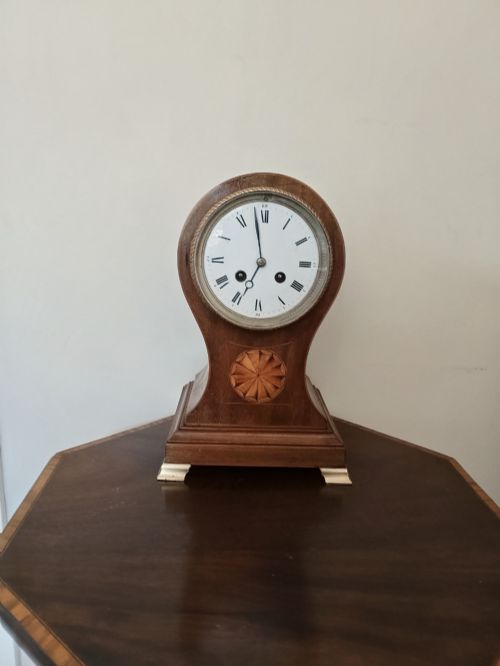


Edwardian Striking Clock
An edwardian striking clock marks the hours with audible resonance, bringing mechanical precision and traditional craftsmanship into a room.
Edwardian Striking Clock
The horological output of this era draws upon Victorian traditions while incorporating simpler neoclassical revival lines and arts and crafts forms. Many pieces utilise movements imported from continental Europe, particularly Germany and France, housed in timber cases built by British cabinetmakers or retailed through major London establishments.
How They Were Made
Cabinetmakers constructed the wooden housings of an edwardian striking clock using solid or veneered mahogany, oak, and walnut, frequently embellishing surfaces with fine brass inlay or contrasting stringing. Glass panels protected the dial faces while allowing visibility of internal pendulums and escapements.
Mechanical movements relied on brass gear trains driven by coiled springs or hanging weights, operating eight-day or fourteen-day durations. Enamel dials carried Arabic or Roman numerals, matched with delicate steel hands and accompanied by gongs, bells, or rods to produce the striking sound.
The listings show movements originating from England, France, and Germany encased in mahogany, oak, walnut, and black slate.
What Varies in Quality
Horological excellence rests upon the complexity and finish of the movement, distinguishing standard time-and-strike mechanisms from intricate quarter-chiming or repeating systems. High-tier examples often house movements produced by specialised German makers or signed by prominent retailers.
Cabinet quality establishes the visual distinction between mass-produced items and superior pieces, seen in the selection of figured mahogany or satinwood and the crispness of brass mounts. The integration of original keys, well-fitted bezels, and clean dial enamelling preserves the integrity of the object.
Winterhalder and Hofmeier·Goldsmiths and Silversmiths London·Maple and Co of London·Harrods
The Edwardian Striking Clock Glossary
- Striking movement
- A clock mechanism that audibly signals the passage of hours or quarters using gongs or bells. This function requires an additional gear train separate from the timekeeping mechanism.
- Fusee
- A conical pulley connected to the mainspring by a chain or cord that ensures even tension as the spring unwinds. This device improves timekeeping accuracy across the duration of the wind.
- Carriage clock
- A portable spring-driven timepiece fitted with a carrying handle, originally designed for travelling. These pieces often feature brass and glass cases enclosing platform escapements.
- Bracket clock
- A portable table clock traditionally placed on a bracket or shelf. These autonomous timepieces frequently possess elaborate wooden cases and striking or chiming trains.
Edwardian Striking Clock: Frequently Asked Questions
How do I wind my clock?
Most spring-driven models require a matching key inserted into the winding holes on the dial face to tension the mainsprings every eight days. Care must be taken not to over-wind the mechanism.
Weight-driven longcase clocks involve pulling chains or winding cords to elevate the internal weights. Following the correct rotational direction prevents damage to the gear train.
Why does the clock strike incorrectly?
Discrepancies between the hand position and the acoustic count usually occur if the minute hand has been manually moved past striking points too quickly. Allowing the mechanism to complete its sequence restores synchronisation.
If the issue persists, the strike-retainer lever may require adjustment by a professional horologist. Internal components can shift slightly during transport or relocation.
Where should I place a striking clock?
Mantel and bracket clocks require a stable, level surface away from direct heat sources and damp environments to protect the wood and internal metal components. Vibrations from heavy traffic can disturb pendulum operation.
Placing the piece against an interior wall helps project the acoustic chime clearly through the room. Longcase clocks require securing to the wall for vertical stability.
How do I identify the period?
Stylistic cues such as inlaid mahogany cases, neoclassical motifs, and specific dial designs help distinguish Edwardian pieces from earlier Victorian examples. Maker signatures on the backplate provide definitive dating evidence.
Archival records and retailer stamps on movements or dials offer further verification of manufacturing origin and decade. Subtle shifts in woodworking fashion mark the transition between eras.