
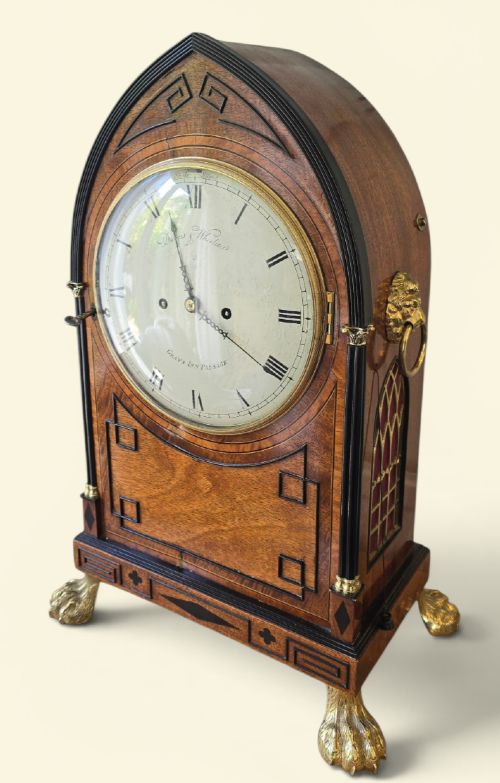


Lancet Arch Mantel Clock
These lancet arch mantel clock pieces bring architectural form and precision timekeeping into a room, shaped by the distinctive pointed profile.
Lancet Arch Mantel Clock
A lancet arch mantel clock stands as a formal timekeeper defined by its pointed architectural silhouette, reminiscent of gothic church windows. These domestic clocks range from substantial bracket clocks designed for library tables to smaller mantel pieces intended for domestic sitting rooms.
The versions most commonly met on this page span the Georgian, Regency, Victorian, and Edwardian eras, reflecting changing tastes in domestic decor over more than a century. Cabinet makers and clockmakers utilised classic architectural proportions to frame the enamel dials.
Makers adapted the lancet profile across various periods, producing both plain wood cases and highly decorated examples featuring brass inlay and boxwood stringing. Each piece unites timekeeping utility with the distinct vertical emphasis of the arched top.
How they were made
Cabinet makers built the primary carcass using mahogany, oak, or ebony, often shaping the distinctive pointed arch from solid timber or carefully fitted veneers. The timber surface received polishing to highlight the natural grain.
Craftsmen applied brass inlay and boxwood stringing to embellish the mahogany cases, creating contrasting geometric or floral borders around the dial face. Enamel dials were fitted behind protective glass doors to secure the moving parts.
Some nineteenth-century London makers signed their clock cases so firmly into the timber that the dial remains the last place you look.
What varies in quality
The distinction between standard domestic pieces and top examples rests upon the precision of the cabinet work and the reputation of the maker. Master clockmakers of London signed movements that demonstrate finer mechanical execution than unmarked workshop versions.
Materials selection dictates the visual depth of the case, where carefully selected mahogany veneers and intricate brass inlay distinguish superior productions from simpler utility clocks. The crispness of the arched silhouette and the balance of inlaid details determine the overall refinement.
Desbois and Wheeler·Cording of London·W and H·Wilkinson Leicester·Ganthony of London
The Lancet Arch Mantel Clock Glossary
- Lancet arch
- An architectural term describing a pointed arch resembling a lancet window, applied here to the characteristic shape of the clock case top.
- Bracket clock
- A portable domestic clock historically designed to sit upon a matching wall bracket or a sturdy piece of furniture.
- Fusee
- A conical pulley connected to the mainspring by a chain or cord, designed to equalise the driving force as the spring unwinds.
- Stringing
- A narrow inlay of contrasting wood, such as boxwood, used to create delicate linear borders on cabinet furniture and clock cases.
- Enamel dial
- A clock face formed by fusing powdered glass onto a metal plate, providing a smooth white background for painted numerals.
Lancet Arch Mantel Clock: Frequently Asked Questions
What is a lancet arch mantel clock?
A lancet arch mantel clock is a domestic timekeeper housed in a wooden case featuring a pointed, arched top inspired by gothic architecture.
These pieces were produced across several centuries, evolving from functional table clocks into decorative focal points for period interiors.
How do I date a mahogany mantel clock?
Dating relies on examining the cabinet style, the materials used for inlay, and the construction methods of the wooden case.
Earlier examples from the Georgian and Regency periods often feature cleaner lines and fine brass work, while Edwardian and Victorian versions introduce heavier proportions or distinct decorative motifs.
Where should I place a bracket clock?
Bracket clocks look best on stable, flat surfaces such as mantelpieces, sideboards, or dedicated wall brackets at eye level.
Because many of these pieces incorporate delicate mahogany veneers and glass doors, placing them away from direct sunlight and damp environments preserves the wood and finish.