


Edwardian Oak Barograph
An Edwardian oak barograph records atmospheric pressure on paper charts inside a glazed wooden case, offering both practical weather tracking and period charm.
Edwardian Oak Barograph
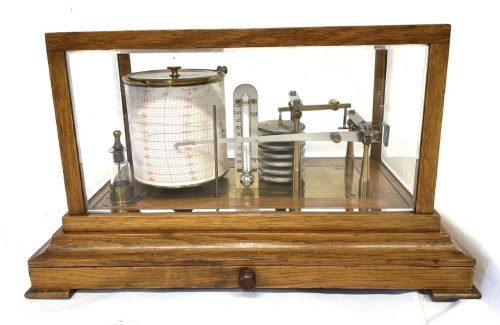
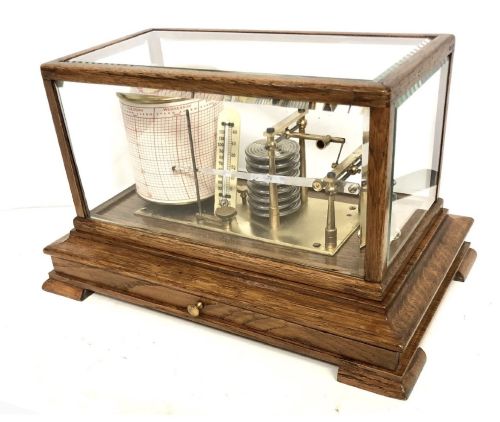
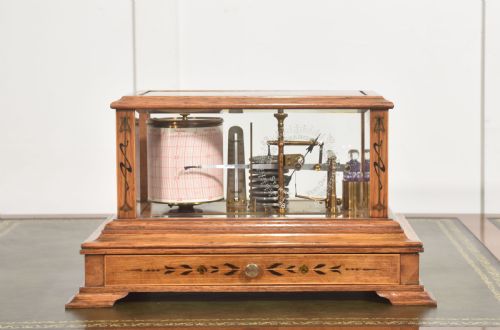
When you search for an edwardian oak barograph, you encounter scientific weather instruments housed in wooden housings constructed mainly during the Edwardian period, alongside Victorian and later twentieth century examples. These instruments typically combine a recording mechanism with brass components, glass panels, and a drawer for storing paper charts.
The pieces appearing in our inventory span several decades, reaching from the nineteenth century through the nineteen-forties. While many bear the distinct stylistic markers of the Edwardian era, others reflect Victorian manufacture or early twentieth century scientific instrument design.
What varies in quality
Quality differences emerge in the precision of the brass mechanism and the joinery of the oak case, where tighter cabinetwork and crisper bevelling on the glass panes distinguish finer examples. Maker signatures from prominent scientific instrument firms also influence distinction.
The presence of integrated thermometers, barometer dials, or lower chart storage drawers adds complexity to the piece, separating standard weather recorders from more elaborate multi-instrument weather stations.
These instruments quietly watched a century of changing skies while families argued about whether to carry an umbrella.
Hezzanith·Short and Mason·Negretti and Zambra·Baines Harrogate·Jules Richard·Dobbie Son and Hutton·J Hicks London
The Edwardian Oak Barograph Glossary
- Barograph
- A self-recording barometer that graphs barometric pressure over time onto a rotating paper drum. This mechanical instrument uses sealed metal vacuum boxes to track atmospheric changes.
- Bevelled glass
- Glass panes with edges cut and polished at an angle, commonly fitted into the hinged lids of instrument cases. This technique adds structural depth and visual clarity.
- Chart drawer
- A small compartment built beneath the main instrument platform designed to hold replacement recording paper. These drawers help keep spare charts stored safely near the mechanism.
- Weather station
- A combined instrument assembly housing multiple meteorological devices such as barometers and thermometers within a single case. These multi-function units provided comprehensive domestic forecasting.
Edwardian Oak Barograph: Frequently Asked Questions
How do barographs work?
Inside the oak case, a stack of corrugated metal vacuum chambers expands and contracts as air pressure rises and falls. A system of brass levers magnifies this movement.
Connected to the final lever, a pen arm traces these continuous fluctuations onto a specialised paper chart secured around a clockwork rotating drum.
Where should I place a barograph?
Choose a stable interior surface away from direct sunlight, radiators, and heavy vibrations that might interfere with the delicate mechanical linkages. Placing the instrument in a principal living room allows easy daily observation of the changing weather trace.
Ensure the location is dry, as excessive humidity can affect both the wooden case and the internal brass and steel components over time.
How do I change the paper?
Lift the glass lid or remove the cover to access the brass drum, then gently release the pen arm so it rests away from the paper surface. Lift the old weekly chart from its retaining clip and slide a fresh one into place around the cylinder.
Wind the internal clockwork gently if needed, and lower the pen back onto the paper to resume recording.