


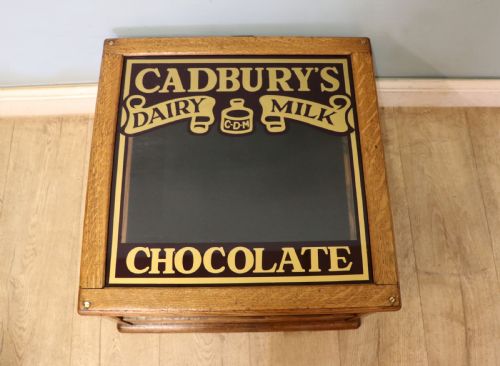


Edwardian Advertising Display Cabinet
These edwardian advertising display cabinet pieces are glazed commercial vitrines and showcases that bring period retail character into a room.
Edwardian Advertising Display Cabinet
An edwardian advertising display cabinet brings together the functional form of a shop counter display cabinet, corner cupboard, or wall cabinet with branded retail lettering. The examples on this page span the Victorian period, the Edwardian era, and the early twentieth century, including Art Deco and industrial commercial styles. You will find countertop display cases, larger vitrine types, and specialised cigar cabinets or pencil showcases.
Many of these cabinets feature later hand sign-written decoration for chocolate, cocoa, and other confectionery makers such as Fry's, Cadbury's, Rowntree's, and Terry's of York. Others carry period advertising for tobacco, cigars, and apparel, reflecting how merchants promoted their stock directly to the public. These commercial pieces bridge domestic furniture and shop fittings.
Materials and construction
The framework of these cabinets relies on timber construction, utilising oak, mahogany, cedar, walnut, and general hardwood alongside glass panels for viewing. Brass fittings often secure doors and hinges, while select pieces incorporate satinwood inlay and gold leaf detailing.
Glazing forms the primary enclosure for product visibility, paired with hand sign-written lettering applied to the glass or wood surfaces. Structural elements range from wall-mounted solid oak frames to large freestanding shop counters and countertop showcases.
Listings span the Victorian era, Edwardian period, and the 1920s and 1930s, utilising oak, mahogany, cedar, glass, and brass.
Variations in quality
Quality in these commercial cabinets rests upon the choice of timber and the execution of the glazing and framing. Cabinets built with solid mahogany, oak, or walnut and fine brass hardware sit above simpler hardwood or mixed timber frames.
The execution of the advertising lettering and decorative painting distinguishes one piece from another. Original or well-executed sign-writing with clean typography contributes more to the character of an advertising display than plain or poorly lettered surfaces.
The Edwardian Advertising Display Cabinet Glossary
- Vitrine
- A glass-fronted cabinet or display case used for exhibiting fine objects or merchandise. These enclosures protect contents while offering full visibility from multiple angles.
- Countertop display cabinet
- A smaller showcase designed to sit upon a shop counter for direct customer engagement. Merchants utilised these units to present small goods, confectionery, and tobacco.
- Sign-written
- Painted lettering applied by hand to glass, wood, or metal surfaces for commercial branding. This technique gives advertising cabinets their distinct period lettering.
- Aneroid barometer
- A non-liquid weather forecasting instrument housed within a decorative case. Some commercial versions incorporated branding for weatherproof clothing companies.
- Inlay
- A decorative technique where contrasting materials such as satinwood are embedded into the primary wood surface. This adds fine linear detail to the frame of the cabinet.
Edwardian Advertising Display Cabinet: Frequently Asked Questions
What are edwardian advertising display cabinets?
These pieces are glazed commercial showcases and wall cabinets that originally served in shops to display goods. They combine period woodwork with branded lettering for products like chocolate, cigars, and cocoa.
Today, they function as display furniture for collectors who want to incorporate retail history into a home interior.
How were these cabinets used?
Merchants placed them on counters or mounted them on walls to showcase confectionery, tobacco, and small wares securely. The glass protected the merchandise while keeping the stock visible to buyers.
In a domestic setting, collectors utilise them to exhibit small items, curiosities, or collections behind glass.
Are the advertising inscriptions original?
Many cabinets feature later hand sign-written decoration applied to the glass or wood after the initial period of manufacture. This practice revitalised older display cases with vintage commercial branding.
Both period lettering and later sign-writing contribute to the decorative character of commercial display furniture.
How do I identify the period?
Dating relies on timber selection, construction methods, and stylistic cues such as Edwardian proportions or Art Deco geometric lines. Reference to specific early twentieth century dates helps anchor the piece.
Cabinet forms also shift from Victorian walnut frames to Edwardian mahogany and later industrial commercial styles.