Jason Clarke Antiques has dated this Antique Shop Display Barometer to the 1920s.
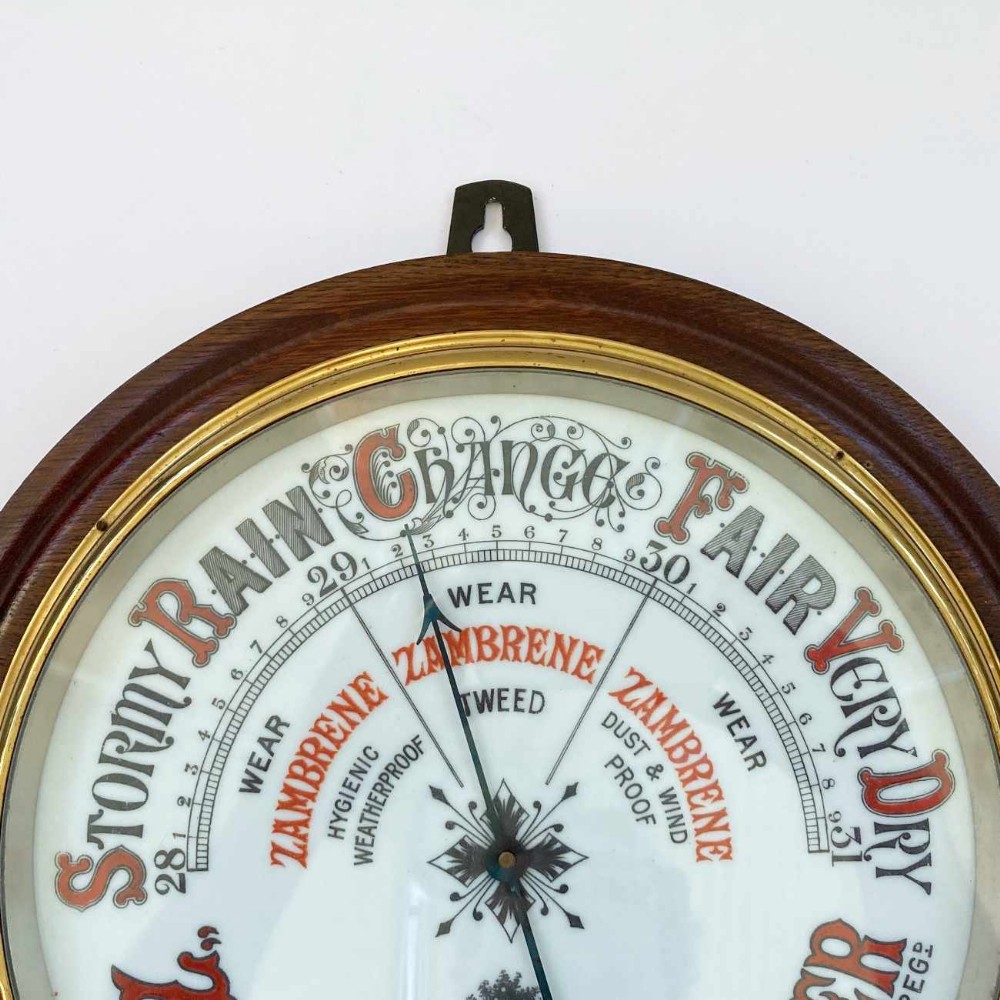
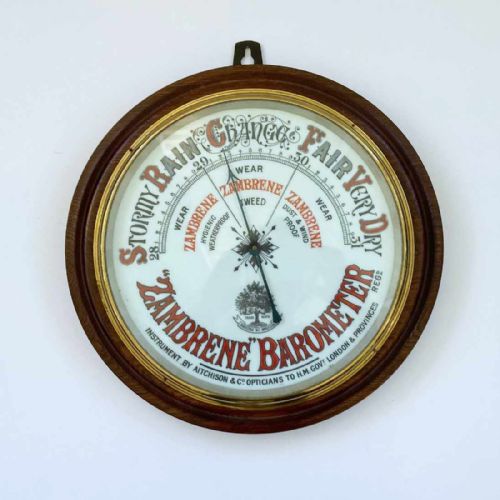
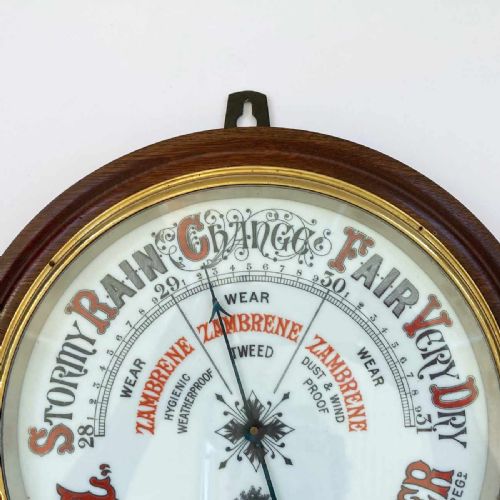
The outer scale is provided with weather indications in decorative Victorian font and accentuated in red, black and grey colours. The inner dial has dividing lines at the 29 and 30 points. The three sections of the dial created are then provided with suggestions of which type of Zambrene clothing product would suit the expected weather associated with the barometer reading. A large blue steel arrowhead pointer marks the current weather.
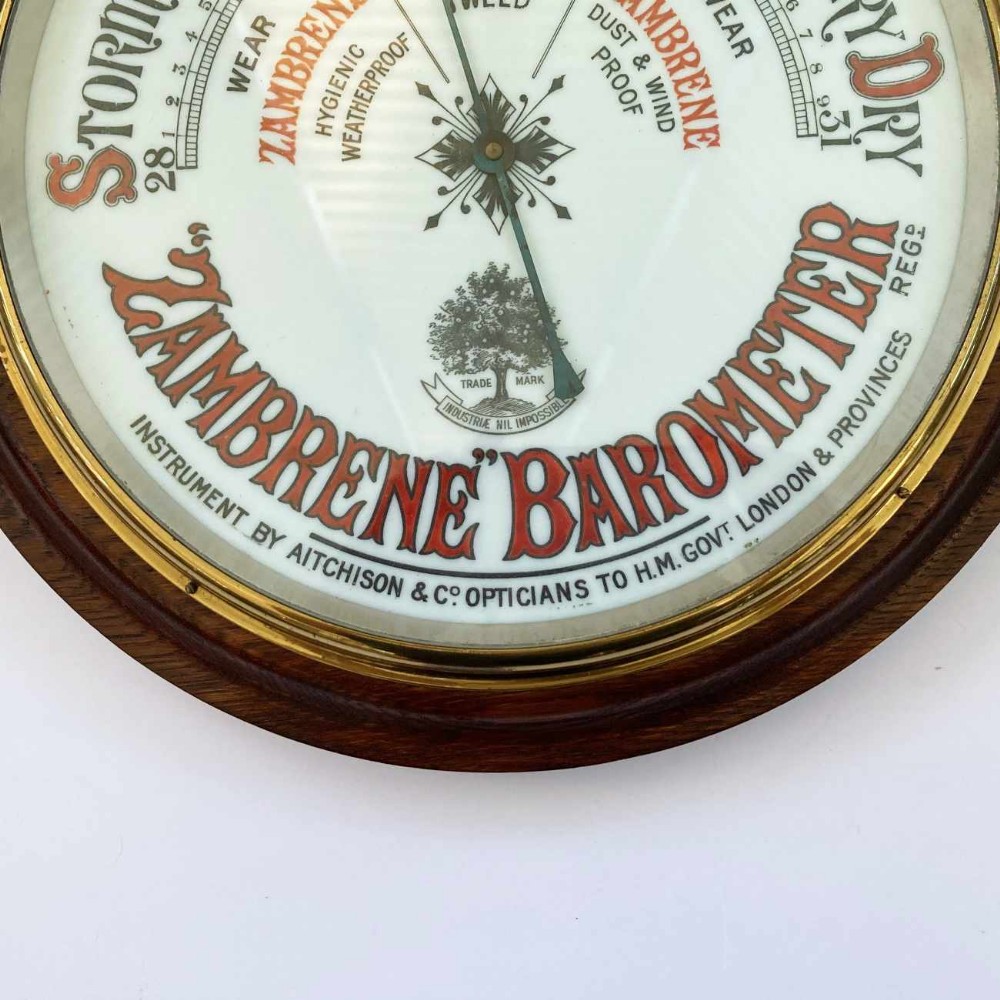
The lower half is entirely dedicated to the company’s trademark, displaying the words “Zambrene Barometer” in bright red painted lettering, and with the company’s trademark tree emblem and the words “industriae nil impossible” (with industry nothing is impossible).
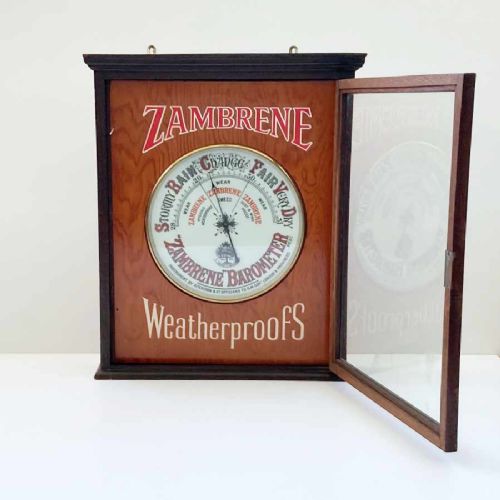
At the base, in smaller but distinct lettering is the barometer maker’s name, stating “Instrument by Aitchison & Co Opticians to HM Govt London & Provinces”.
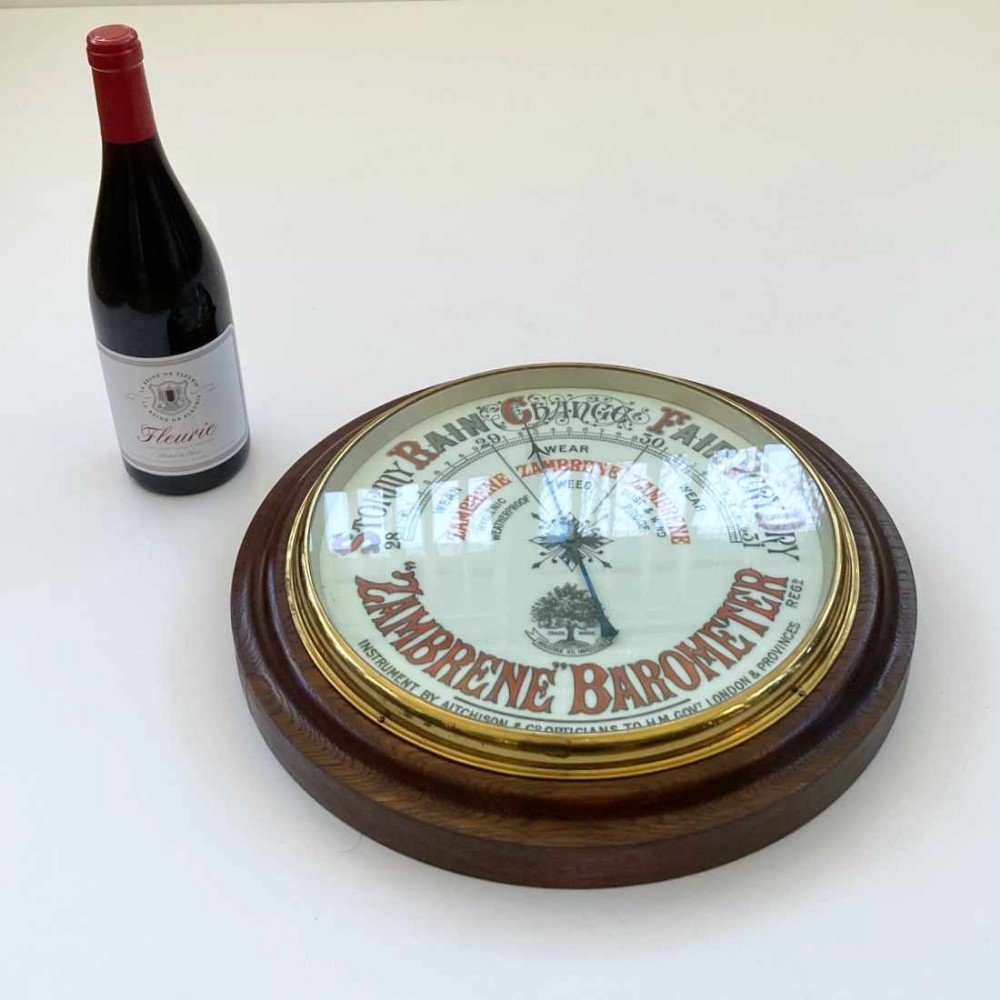
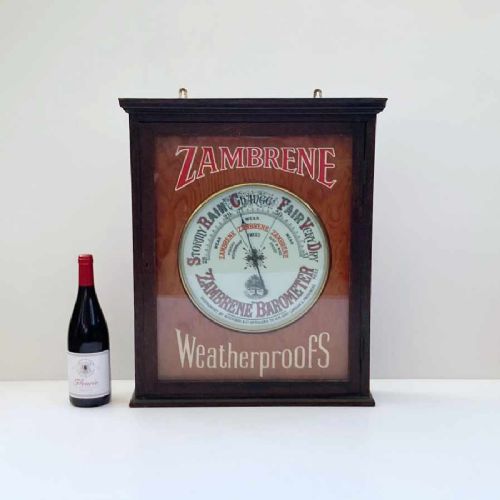
The barometer is completed with a simple graduated oak surround and brass spun bezel fitted within a large glazed fronted oak case with hinged door to the front and a short pediment top. Inside is a stained pine surround with central cutaway which covers everything but the barometer dial. The front is sign written to Zambrene Weatherproofs.
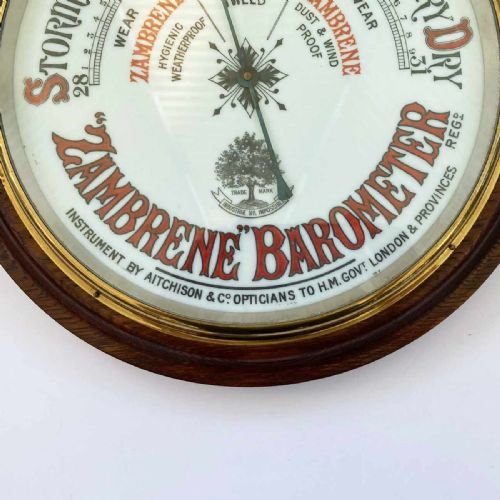
An ingenious and clever use of advertising combined to make a very scarce and very pleasing example of its kind. I have seen a few examples of this barometer before but none that retain the original case and insert. This is a rare and complete survivor.
Aitchison’s firm was founded in 1889 at 47 Fleet Street, he undertook his apprenticeship with an optician’s firm in High Holborn before setting up in business initially with Alexander Thomas Clarkson (of Broadhurst Clarkson fame). He is said to have been uncomfortable with the very basic methods that his previous employers used to examine and test patient’s eyes and in a time where glasses were becoming common place across all classes in Britain, he quickly carved himself a niche for supplying very good, high quality lenses at reasonable rates which appealed to the varying pocket sizes providing the public with gold, silver and steel frames for spectacles, lorgnettes, monocles and pince-nez.
Given his reasoning for leaving his previous employment, the subject of standards within the industry continued to be an issue close to Aitchison’s heart, the Worshipful Company of Spectacle Makers was, by then, purely a means of apprenticeship and for gaining practical skills in manufacture rather than for gaining an understanding of the science of optics. They showed little interest when in 1890, Charles Hyatt-Wolf proposed changes to the process which would include examination and certification and having received his re-buff, Wolf sought to organise a separate body to try to tackle the standards of practice. The journal “The Optician” was created in 1891 and in 1895 when Hyatt-Wolf created The British Optical Association (BOA), Aitchison was an enthusiastic founding member and supporter. By this time, he had dissolved his partnership with Clarkson (Gazette 1891) and opened two further branches at 6 Poultry (close to Robert Brettell Bates old premises) and at 428 The Strand. Little is known of Aitchison’s early partnership; Clarkson had owned his own company since 1873 which seems to have remained distinct throughout. As a result, or as a precursor to the decision, Robert Henry Broadhurst joined Clarkson in 1892 and went on to form an equally famous partnership.
The Spectacle Maker’s Company were slow to respond to pressure but in 1898 they began an initial set of examin
Jason Clarke Antiques has dated this Antique Shop Display Barometer to the 1920s.

You can view the stock and full dealer information on the Jason Clarke Antiques Profile Page

Large Shop Display Aneroid Barometer by Aitchison for Zambrene Weatherproof Clothing