






Ebony Inlaid Wooden Box
An ebony inlaid wooden box offers dark contrasts and crisp detailing, holding small treasures with timeless utility.
Ebony Inlaid Wooden Box
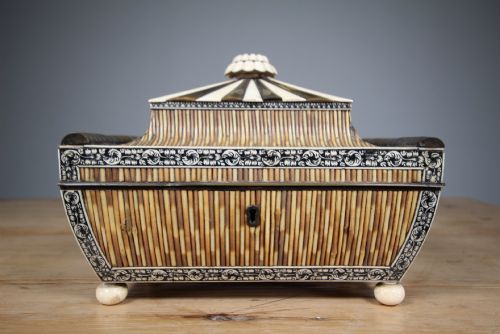
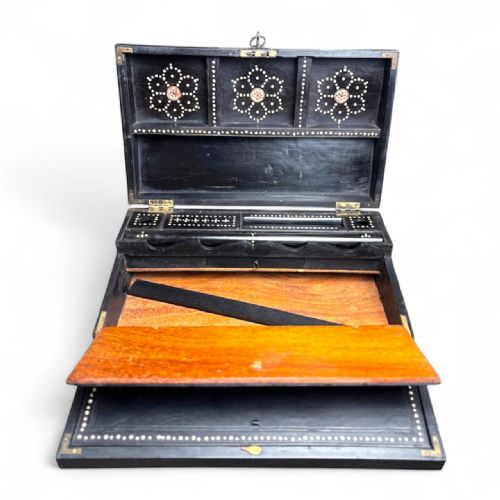
An ebony inlaid wooden box brings together deep dark timbers and contrasting lighter insertions for desktop storage and personal organisation. These containers serve as tea caddies, writing slopes, jewellery caskets, and decorative chests across several distinct design movements.
The Regency and Victorian eras dominate the selection, showing both British craftsmanship and colonial production from Ceylon and Anglo-Indian workshops. Buyers encounter forms ranging from sarcophagus tea caddies to large brass-mounted trunks on stands, all featuring prominent dark ebony framing.
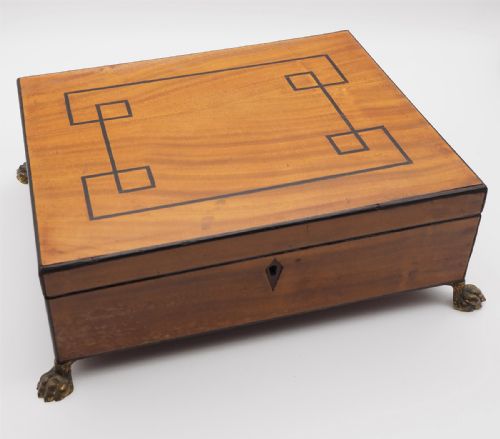
Lighter secondary timbers such as satinwood, mahogany, walnut, and teak provide the background canvas for intricate ebony stringing and geometric panels. Artisans also integrated bone, ivory, fruitwood, and porcupine quill work to create complex surface patterns on these storage pieces.
How they were made
Cabinetmakers constructed the foundational carcase from native or exotic hardwoods like mahogany, teak, and walnut before applying fine veneers and solid ebony mouldings. Precision sawing allowed makers to sink contrasting stringing and geometric fillets flush into the primary timber surfaces.
Surface ornamentation frequently relied on contrasting organic materials such as bone, ivory, and porcupine quill secured into channelled recesses. French polishing or wax finishing sealed the wood while enhancing the natural lustre of the dark ebony borders against lighter fields.
The object forms include tea caddies, writing slopes, table caskets, jewellery boxes, and large colonial chests.
What varies in quality
Excellence in an ebony inlaid wooden box lies in the precision of the joinery and the tightness of the contrasting stringing. Superior examples maintain perfectly flush surfaces where different timber species meet, showing no shrinkage gaps or raised edges.
The sophistication of the design and the choice of secondary woods also separate standard production from master craftsmanship. Elaborate multi-material compositions involving porcupine quill, bone, or intricate Tunbridge mosaic work demand advanced skill that elevates the stature of the piece.
The Ebony Inlaid Wooden Box Glossary
- Sarcophagus
- A monumental box shape featuring a domed or peaked lid and a flared base, popular during the Regency period for tea caddies and workboxes. This classical silhouette echoes ancient stone tombs.
- Stringing
- Thin lines of contrasting wood inlaid into channels cut into the surface of a box to create borders and geometric panels. It defines the structural outlines of the piece.
- Tea caddy
- A specialised container designed to store loose tea leaves securely, often featuring internal lidded compartments and mixing bowls. They were key social objects in period drawing rooms.
- Writing slope
- A portable slant-topped desk that opens to reveal a slanted writing surface, inkwell compartments, and storage for stationery. Many incorporate secret drawers beneath the primary writing boards.
- Boulle
- A form of marquetry utilising brass and tortoiseshell or dark wood, named after French cabinetmaker André-Charles Boulle. It creates shimmering metallic patterns across the surface.
Ebony Inlaid Wooden Box: Frequently Asked Questions
What are ebony inlaid wooden boxes?
These are decorative and functional containers built from various timbers and ornamented with dark ebony borders, stringing, or geometric panels. They include writing slopes, tea caddies, jewellery caskets, and small chests.
Craftsmen across the Regency, Victorian, and Edwardian periods produced these items using both domestic and colonial workshops. The dark framing provides a strong visual contrast against lighter background woods.
How do I identify a Regency box?
Regency boxes often display architectural forms such as sarcophagus shapes, brass lion paw feet, and ring handles. The inlay work tends to be restrained and geometric.
These pieces frequently utilise rich mahogany or satinwood carcasses framed by fine ebony stringing. The proportions generally follow classical revival design principles.
What is porcupine quill work?
Porcupine quill work involves arranging natural quills into intricate geometric mosaics across the surfaces of boxes. Ceylonese and Anglo-Indian makers specialised in this technique during the nineteenth century.
These quills combine with ebony and satinwood framing to create highly textured exterior patterns. Such pieces represent distinct colonial trade aesthetics of the period.
How do I care for inlaid wood?
Maintain stable humidity levels and keep wooden boxes away from direct sunlight and heat sources to prevent timber movement. Gentle dusting with a dry cloth preserves the finish.
Occasional application of microcrystalline wax helps protect the polished surface and the inlaid materials. Avoid using liquid polishes or moisture on antique veneer.