






Ebonised Slip Wall Mirror
An ebonised slip wall mirror brings intense focus to a room, framing a distorted, wide-angle view of the interior.
Ebonised Slip Wall Mirror
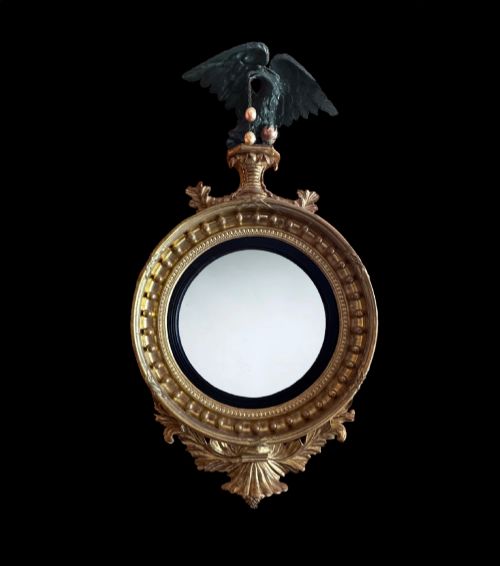
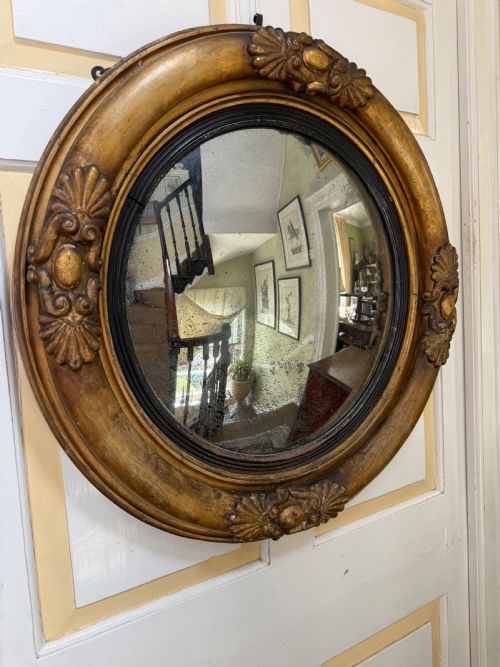
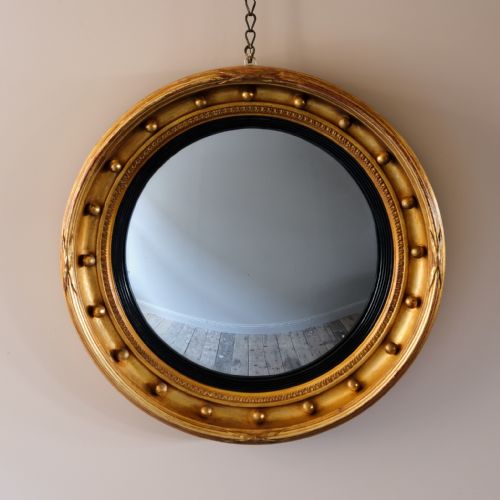
An ebonised slip wall mirror is primarily represented on this page by convex plates set within circular frames, often dating from the Regency period through to the late nineteenth and early twentieth centuries. These circular glasses, frequently termed butler's mirrors or convex wall mirrors, project a wide, curved reflection that encompasses an entire room.
The defining feature of these pieces is the ebonised slip, a dark, blackened inner moulding that sits directly against the glass and creates a sharp visual boundary. This dark inner ring contrasts with the outer frame materials, which span from the Regency era up to later revivals.
While many examples appear under broader designations such as wall mirrors or overmantel mirrors, the specific inclusion of the ebonised slip separates these particular circular frames from standard gilded designs. Their forms range from modest wall-hanging pieces to larger scaled overmantel versions.
How they were made
The construction of these mirrors relies on traditional timber framing, predominantly utilising pine as a base carcase for the carved wooden elements. Gesso is then applied over the wood to build up decorative surfaces, particularly where giltwood finishes or moulded details are required.
The ebonised slip itself is achieved by staining or painting the inner wooden moulding to imitate ebony, providing a dense black border that frames the curved glass plate. Mirrored glass of this period is typically convex, requiring specialist blowing or casting techniques to achieve the spherical distortion characteristic of these plates.
Current listings span the Regency period, Victorian era, and early twentieth century, utilising materials such as giltwood, ebonised wood, gesso, and pine.
What varies in quality
The quality of an ebonised slip wall mirror is largely determined by the depth and crispness of the surrounding frame carving, particularly on pieces featuring crests such as eagles. Finer examples display masterly hand-carved details in the gesso and wood, whereas simpler versions rely on plainer mouldings.
The condition and clarity of the convex mirrored glass also dictate the standing of a piece, along with the preservation of the original giltwood and the blackened finish on the slip. Uniformity in the ebonising and the integrity of the original backing boards further distinguish superior examples from later revivals.
The Ebonised Slip Wall Mirror Glossary
- Ebonised slip
- A blackened inner moulding or rebate surrounding the mirror plate. This dark border creates a distinct optical separation between the glass and the outer frame.
- Convex mirror
- A circular glass plate curved outward to reflect a wide-angle, panoramic view of the room. These are often historically referred to as butler's mirrors.
- Giltwood
- Timber, usually pine, coated with gesso and gold leaf or gilt finish. It forms the primary decorative exterior of many convex frames.
- Gesso
- A plaster-like mixture applied to wooden frames as a base for carving and gilding. It allows for sharp, intricate decorative relief work.
- Overmantel mirror
- A large mirror designed specifically to hang above a fireplace mantel. These can incorporate convex glass plates within their broader formats.
- Girandole
- A decorative mirror fitted with candle branches attached to the frame. The polished metal or glass sconces reflect the candlelight into the room.
Ebonised Slip Wall Mirror: Frequently Asked Questions
What is an ebonised slip?
An ebonised slip is the dark, blackened inner ring of wood that sits directly against the mirror glass. It provides a stark visual contrast that draws the eye toward the centre of the plate.
This dark border separates the reflective surface from the gilded or carved outer frame, a technique commonly found on nineteenth-century convex mirrors.
Why are convex mirrors curved?
Convex mirrors are curved outward to capture a wide-angle, panoramic view of an entire interior space. Historically, this allowed servants to monitor activity across a large room from a single vantage point.
Today, they remain popular for the distinct spatial depth and distorted reflection they introduce to hallway and living room walls.
How do I date a convex mirror?
Dating a convex mirror involves examining the construction methods of the pine carcase, the composition of the gesso, and the style of any crests like eagles. Regency examples often feature crisp, high-relief carving and specific classical proportions.
Later nineteenth-century and early twentieth-century revivals typically exhibit slight variations in timber preparation, backboards, and the formulation of the gilding.
Where should I hang a convex mirror?
These mirrors suit principal reception rooms, hallways, or above a fireplace mantel where their wide-angle reflection can open up the space. Because they pull light from all corners of an interior, positioning them opposite a window maximises their brightness.
Ensure the wall fixings are secure, as the combined weight of the timber frame, gesso, and glass can be substantial.