

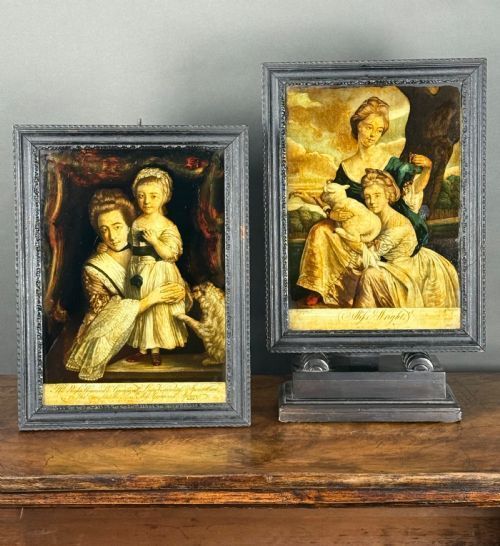


Ebonised Frame Glass Print
These ebonised frame glass print pieces combine dark wood moulding with delicate imagery transferred directly beneath glass, offering an authentic Georgian or Regency wall art accent.
Ebonised Frame Glass Print
An ebonised frame glass print represents a distinct form of historical wall art where engravings, mezzotints or paintings are fixed beneath glass. These works predominantly date from the Georgian and Regency periods, carrying the visual culture of the eighteenth and early nineteenth centuries.
Buyers will encounter various subjects within these listings, ranging from royal portraits of figures like King George III and Queen Caroline to pastoral and domestic scenes such as The Match Boy and Feeding the Poor. The presentation relies on dark wood frames that contrast sharply with the luminous details captured under the glass surface.
Most examples found here fall under the classification of reverse glass prints, mezzotints or reverse paintings on glass. The format showcases delicate craftsmanship from 1800 and the wider eighteenth century, offering wall art that has survived centuries largely intact.
Materials and Techniques
The construction of these pieces relies on glass, paper, and wood, combined with oil paint, pigment, gold leaf, and gilt detailing. Makers transferred or applied printed imagery directly onto the reverse side of the glass plate before sealing the assembly within a wooden housing.
Wood frames received an ebonised finish to create a deep, dark border that focuses attention on the delicate mezzotint or engraving beneath the glass. Pigments and gold leaf were often applied by hand to the reverse of the glass to add colour and illumination to the monochrome print beneath.
The listings encompass works from the Georgian and Regency periods, featuring materials such as glass, wood, oil paint, and gold leaf.
Assessing Quality
Quality in these works is defined by the crispness of the original mezzotint or engraving beneath the glass and the precision of any hand-applied pigment or gold leaf. Finer examples display meticulous attention to detail in portraits and narrative scenes, whereas simpler pieces show broader application.
The preservation of the glass and the integrity of the ebonised wood frame contribute significantly to the overall standing of an individual piece. Stronger examples retain their original pairing of print and frame from the Georgian or Regency era without extensive modern restoration.
Fletcher·Sebastiaan Vrancx·W. Bishop
The Ebonised Frame Glass Print Glossary
- Ebonised
- Wood treated to resemble dense, dark ebony wood. This finish provides a stark, formal border typical of Georgian and Regency frames.
- Mezzotint
- A printmaking process where the image is worked from dark to light, producing rich tonal gradations. These prints were frequently utilised for portraiture under glass.
- Reverse glass painting
- An artwork created by painting or applying pigment directly onto the back of a glass sheet. When viewed from the front, the glossy surface protects and enhances the colours.
- Regency
- The stylistic period spanning the early nineteenth century. Pieces from this era often feature refined classical motifs and distinct framing styles.
Ebonised Frame Glass Print: Frequently Asked Questions
What is a reverse glass print?
A reverse glass print is an artwork where an engraving or mezzotint is transferred onto the underside of a glass sheet. The image is often hand-coloured with pigments or gold leaf from behind.
This technique protects the delicate paper and pigments from atmospheric damage, giving the finished wall art a unique glossy depth.
How do I date these pieces?
Dating relies on the style of the frame, the subject matter, and the specific printmaking techniques used. Pieces on this page generally originate from the Georgian and Regency eras.
Subjects such as portraits of King George III or Queen Caroline help anchor the timeline to the late eighteenth and early nineteenth centuries.
How should I hang them?
These framed works require secure wall mounting away from direct sunlight and excessive moisture. The combination of glass, paper, and wood makes them sensitive to extreme environmental shifts.
Ensure the ebonised frame is hung using appropriate hardware that supports the combined weight of the glass plate and wooden housing.
Are the frames original?
Many pieces retain their period ebonised wood frames, which form an integral part of the historic presentation. The dark finish was standard for displaying delicate works on paper during the Georgian period.
Examining the construction of the wood and the fitting behind the glass helps determine whether the framing dates back to the eighteenth or early nineteenth century.