
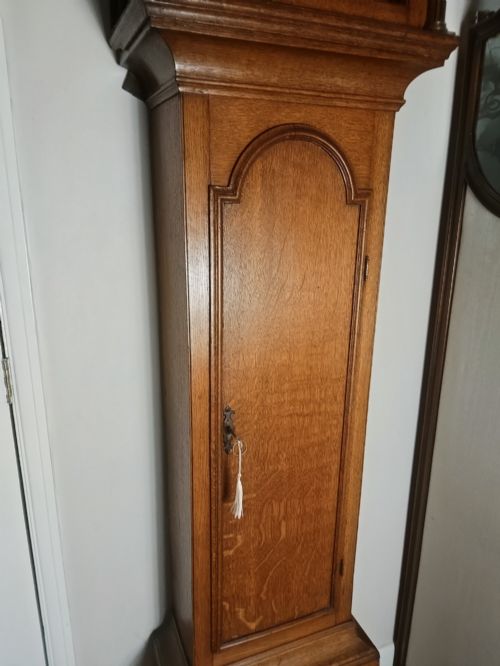


Early Georgian Oak Clock
An early georgian oak clock brings monumental presence and provincial craftsmanship into a room.
Early Georgian Oak Clock
An early georgian oak clock typically takes the form of a longcase or grandfather clock, standing tall in domestic spaces. These pieces span the eighteenth century and the early nineteenth century, alongside occasional wall clock variants.
Provincial makers constructed these floor-standing timepieces with tall wooden cases housing weights and swinging pendulums. The proportion of the trunk and the dial arrangement define the character of each individual piece.
Assessing Quality and Merit
The integration of the brass dial with the fitted oak case reveals the competence of the regional maker. Engraved details, maker signatures, and the overall state of preservation elevate certain pieces above standard workshop production.
One resourceful maker signed their work at the sign of the clock, leaving a permanent landmark inside the wooden case.
Thomas Webbe of New Quay·Mercer Hythe Kent·George Adams·John Bishop of Sherborne Dorset·E Sanders of Poole Dorset·Henry Smith of Petersfield·Kirk of Kibworth·Ebenezer Handscomb of Newport Pagnell·Peter Bower of Redlench Somerset·John Stancliffe of Halifax·Thomas Hampson of Wrexham
The Early Georgian Oak Clock Glossary
- Longcase clock
- A tall pendulum clock enclosed in a wooden case designed to stand directly on the floor. These timepieces are frequently referred to as grandfather clocks.
- Count wheel
- An internal mechanical component that regulates the striking sequence of the clock hours. This circular locking plate determines when the bell sounds.
- Fusee
- A conical pulley used in spring-driven clocks to ensure even tension as the mainspring unwinds. This mechanism helps maintain consistent timekeeping accuracy.
- Brass dial
- The metal face of the clock where the hours and minutes are displayed. These surfaces often feature engraved ornamentation and the signature of the maker.
Early Georgian Oak Clock: Frequently Asked Questions
What is an early georgian oak clock?
An early georgian oak clock is a tall floor-standing timepiece housed in an oak case, originating from the eighteenth century or early nineteenth century. These clocks rely on weights and pendulums to measure time.
Most examples function as longcase or grandfather clocks, though wall-mounted versions also exist. Provincial makers across Britain built these items to serve as both functional timekeepers and household furniture.
How do these clocks work?
These timepieces operate through a weight-driven mechanism suspended inside the wooden trunk, regulated by a swinging pendulum. The energy transfers through a train of brass wheels to move the hands across the dial.
Depending on the specific movement, the clock requires manual winding either daily, weekly, or at thirty-hour intervals. Many models also include a bell-striking train that chimes the hours.
How do I care for an oak longcase clock?
Placing the clock in a stable environment away from direct sunlight and damp conditions protects both the timber case and the internal metal mechanics. Regular professional servicing keeps the gear trains functioning correctly.
The oak housing benefits from occasional dusting and the preservation of its natural finish without harsh chemical polishes. Ensuring the case stands level on the floor also allows the pendulum to swing evenly.