
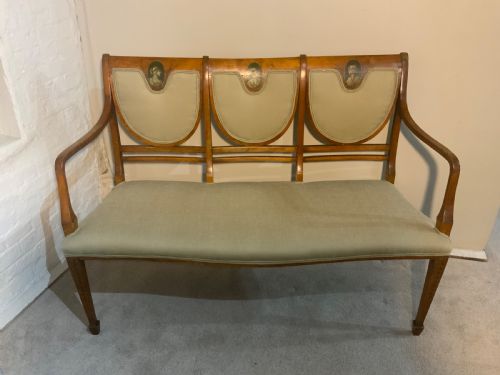
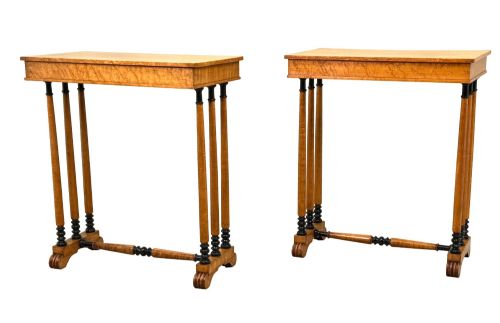
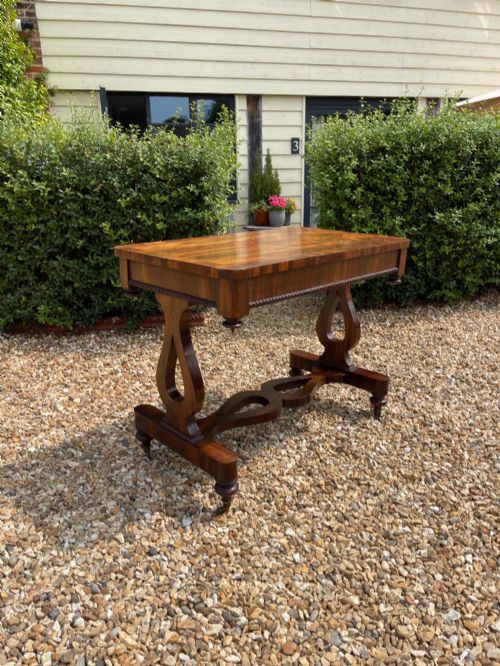
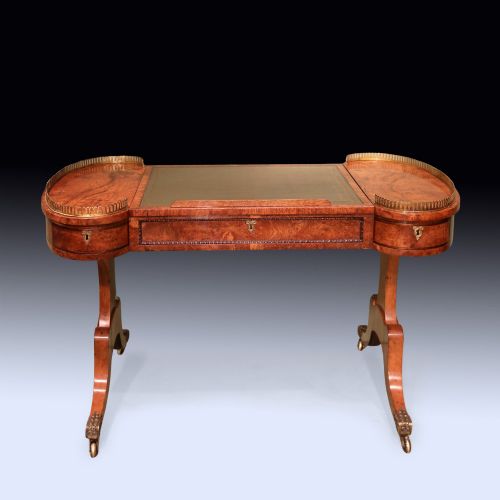
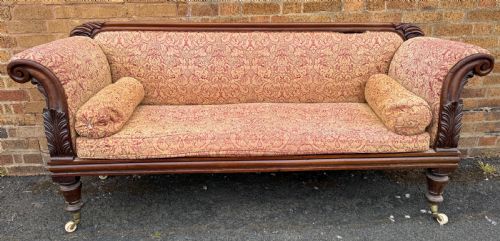




Early 19th Century Sofa
An early 19th century sofa brings grand proportions, scroll arms and rich timbers into a modern room.
Early 19th Century Sofa
When searching for an early 19th century sofa, buyers encounter pieces spanning the Regency, William IV and Early Victorian periods, alongside continental examples in French Empire and Italian styles. The selections range from substantial country house three-seaters upholstered in fabric, leather or velvet to elegant double-ended settees and scroll-end designs.
Makers and workshops of the era favoured substantial mahogany, rosewood and walnut frameworks, sometimes enhanced by simulated rosewood finishes, gilding or polychrome paint. These seating forms developed from classical revival principles, prioritising deep seating and carved wooden frames that display the natural grain of the timber.
How they were made
Cabinet makers and joiners constructed these frames using dense hardwoods like mahogany, rosewood and walnut, frequently applying decorative veneers such as flame mahogany or burr yew across prominent surfaces. Structural stability relied on traditional joinery, supported by brass castors on the feet of heavier frames.
Upholstery techniques involved webbed bases and coil springing or horsehair stuffing, covered in durable fabrics, leather or silk velvet. Decorative enrichment often included hand-carving along the scroll ends, cross-banding in contrasting timbers, and subtle gilding highlights.
Early 19th Century Sofa Retail Price Guide 2026
Typical asking prices for early 19th century sofa among the pieces listed under this phrase on Sellingantiques today, from the lower quarter to the upper quarter. They describe what is for sale here now, not the wider market.
Listings feature early 19th century seating in mahogany, rosewood, walnut and painted finishes, spanning English, French, German, Italian and Swedish origins.
What varies in quality
The distinction between standard examples and the finest productions lies in the selection of timbers and the crispness of the carved details. Superior items utilise highly figured veneers, such as well-matched rosewood or birdseye maple, paired with deeply carved scroll arms and substantial framing.
Provenance and attribution also elevate certain pieces, with items linked to prominent cabinet makers commanding greater attention. The integrity of the timber, the subtlety of any inlay or marquetry, and the overall balance of the proportions determine the standing of each piece.
Williams and Gibton·Jean-Joseph Chapuis·Gillows
The Early 19th Century Sofa Glossary
- Regency
- A style and period spanning the early 19th century characterised by classical motifs drawn from ancient Greece and Rome. It is frequently associated with sweeping scroll arms and dark woods.
- Scroll-end
- A furniture design feature where the wooden arms curl outwards in a tight spiral. This shape defines many English and continental settees from the period.
- Veneer
- A thin layer of figured timber applied over a secondary wood base to provide a decorative surface. Craftsmen used mahogany, satinwood and rosewood for this purpose.
- Cross-banding
- A decorative border technique where strips of veneer are laid perpendicular to the main grain. It frames tabletops and structural panels.
- Double-ended sofa
- A seating form featuring matching raised ends rather than a conventional back and single arm arrangement. This allows the user to recline from either direction.
Early 19th Century Sofa: Frequently Asked Questions
How do I identify a Regency period sofa?
Regency sofas are marked by classical architectural influences, featuring scrolled wooden arms, sabre legs or brass castors, and dark polished timbers like mahogany and rosewood. They often incorporate restrained brass mounts or carved drapery motifs inspired by ancient antiquity.
Later Victorian iterations tend to be heavier in scale with more exuberant carving, whereas true Regency pieces maintain a lighter, more balanced neoclassical line.
What is a double-ended sofa?
A double-ended sofa is a seating form designed with two identical raised ends instead of a traditional backrest and asymmetric arms. This symmetrical arrangement allowed occupants to recline comfortably from either side.
These pieces were typically positioned away from walls to showcase the carved framework and continuous wooden or upholstered curves from every angle.
Are these sofas suitable for daily use?
These historical seating pieces can handle daily domestic life provided they have been structurally stabilized and correctly reupholstered. Many examples feature robust hardwood frames that easily rival modern construction standards.
Buyers should consider the depth of the seat and the firmness of the traditional horsehair or modern sprung interior to match their personal comfort preferences.
What wood types should I expect to see?
Mahogany and rosewood predominate across English examples from this era, complemented by decorative veneers such as satinwood, burr oak and birdseye maple. Continental pieces frequently utilise walnut or feature painted and gilded finishes.
Alternative treatments like simulated rosewood were also employed to mimic expensive timbers using more accessible hardwood bases.