
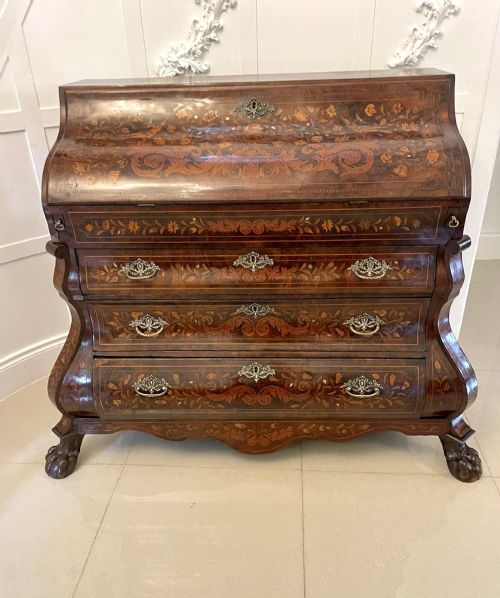

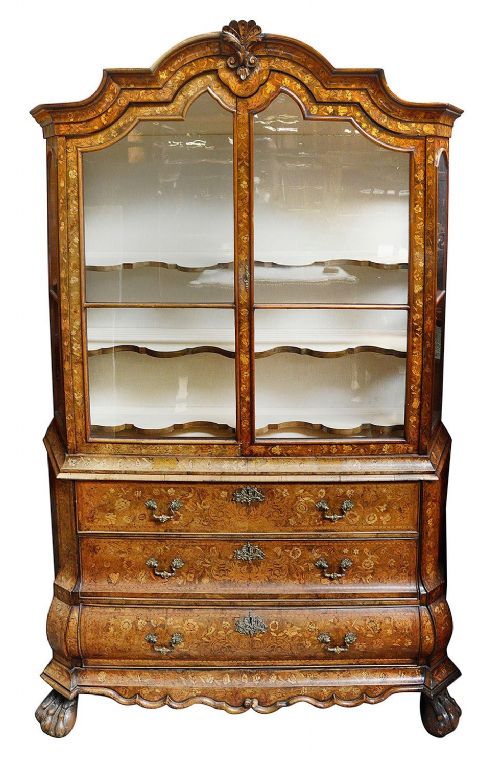


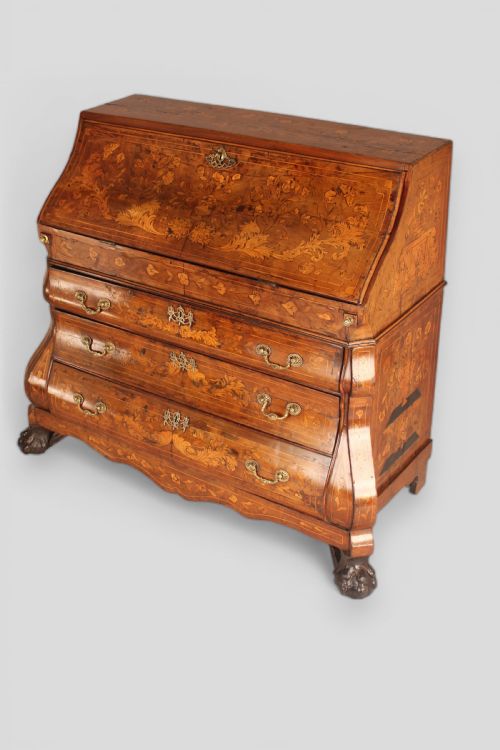


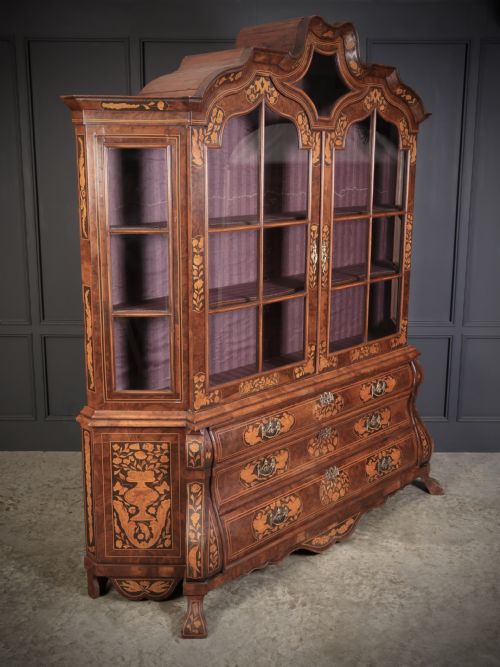


Dutch Bombe Bureau
A dutch bombe bureau brings sweeping convex curves and intricate floral marquetry to a room, offering a dramatic workspace paired with deep storage.
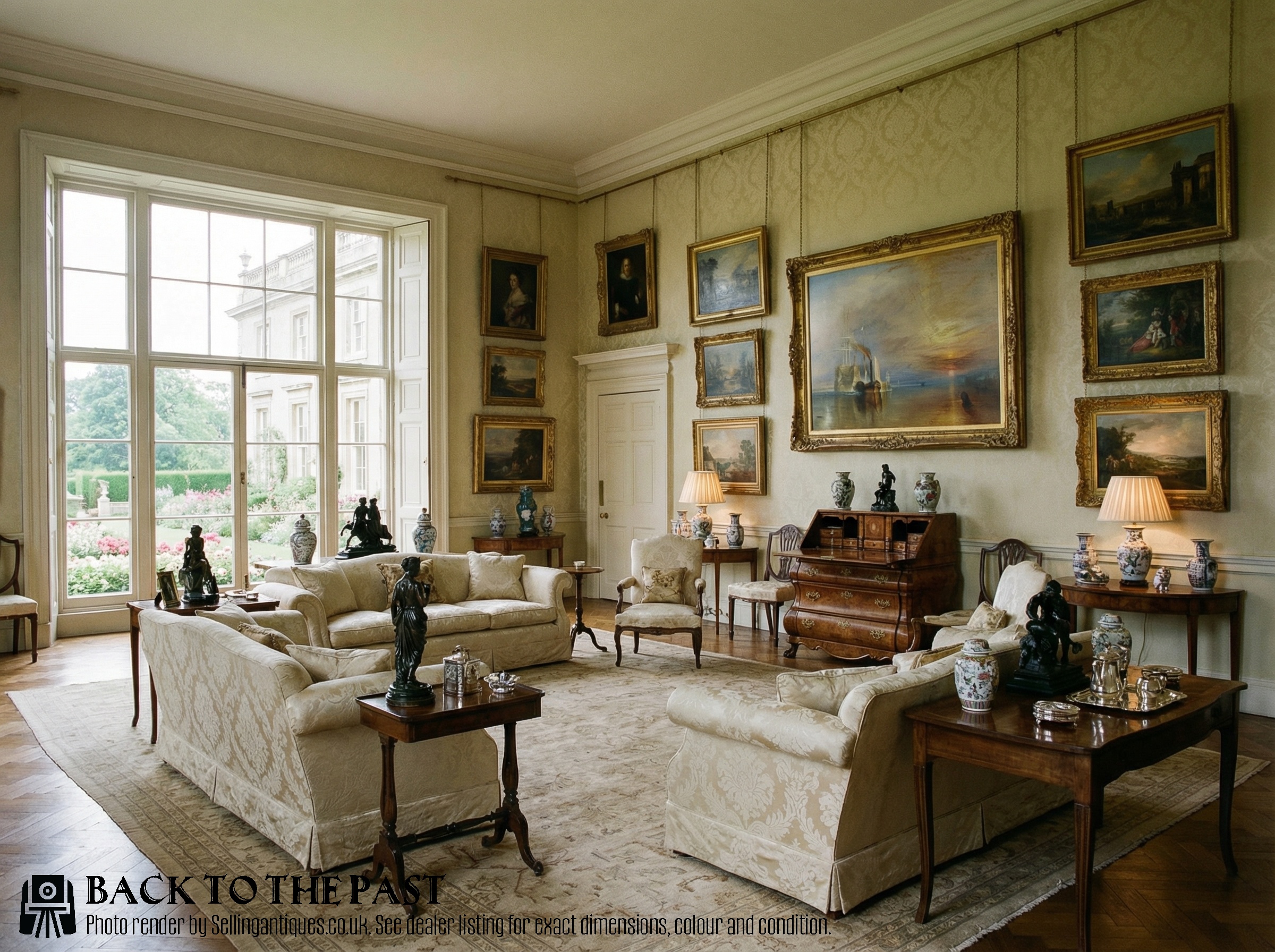
Dutch Bombe Bureau
A dutch bombe bureau combines a sloping writing flap with a swollen, swelling lower carcass that curves outward from top to bottom. These pieces emerge primarily from the eighteenth century, alongside later nineteenth-century interpretations and twentieth-century revivals.
You will encounter simple writing desks as well as monumental bureau bookcases and tall display cabinets fitted with glass doors. Walnut, burr walnut, and mahogany form the predominant carcasses, often overlaid with elaborate floral marquetry.
The characteristic silhouette relies on a bulging front and sides that demand considerable cabinetmaking skill to execute correctly. Alongside desks, the evidence records related forms such as bombé commodes, chests of drawers, and vitrines sharing the same swollen profile.
How they were made
Cabinetmakers constructed the carcass using solid timbers like walnut, mahogany, or fruitwood, veneering the curved exterior with highly figured burr walnut to create natural pattern and depth. Brass hardware, including drop handles and keyhole escutcheons, provides functional contrast against the dark wood.
Floral marquetry surfaces were formed by cutting thin slices of different fruitwoods and veneers into intricate botanical motifs, which were then fitted precisely together and inlaid into the primary wood. The swollen bombé shape required shaping thick timbers or building up curved framing elements to achieve the characteristic outward sweep.
Listings feature 18th-century, 19th-century, and 1920s periods, utilising walnut, burr walnut, mahogany, fruitwood, and brass.
What varies in quality
The ambition of the marquetry design separates standard iterations from exceptional examples, with master carvers and marqueters covering every available surface in detailed floral displays rather than sparse panels. The density and selection of burr walnut veneer also dictate visual richness, where highly figured grain patterns wrap seamlessly around the pronounced curves.
Proportion and execution of the bombé contour define structural merit, requiring crisp transitions where the convex sweep meets the base and feet. Cabinetmaking finesse shows in the alignment of drawer linings and the fluid integration of the fall-front desk lid into the swollen facade.
Morison of Edinburgh
The Dutch Bombe Bureau Glossary
- Bombé
- An outward-swelling, bulging contour found on the front and sides of furniture carcasses. This convex shape requires advanced carpentry to curve timbers or veneers smoothly.
- Marquetry
- A decorative technique where small pieces of varied coloured wood veneers are assembled to form pictorial patterns, particularly floral designs. It covers the exterior surfaces of many bureau bookcases.
- Burr walnut
- Wood taken from the warted excrescences of walnut trees, displaying chaotic, highly figured grain patterns. It provides rich visual texture across the fronts and lids.
- Vitrine
- A glass-fronted display cabinet designed to showcase porcelain, books, or curiosities. These pieces often sit atop a drawer base or match the marquetry style of the matching desks.
Dutch Bombe Bureau: Frequently Asked Questions
What is a bombe bureau?
A bombe bureau is a writing desk featuring a sloped fall-front lid above a swollen, convex lower cabinet. The curved sides and front give the piece a distinctive volumetric silhouette.
Most examples date from the eighteenth century or later revivals, frequently decorated with elaborate floral marquetry over walnut or mahogany timbers.
How do I date a bureau?
Dating relies on examining the underlying secondary woods, construction methods, and stylistic cues such as marquetry motifs or hardware. Eighteenth-century models display hand-cut joinery and aged patination.
Later nineteenth-century and twentieth-century versions often show standardised fixings or revival styling while retaining the traditional walnut or mahogany materials.
How were these desks used?
The drop-down flap served as a dedicated writing surface, concealing a fitted interior of small drawers and pigeonholes for correspondence and documents. The deep drawers below provided substantial storage for household papers or textiles.
Bureau bookcases added upper display shelving for books or decorative objects, functioning as the primary administrative centre of a grand interior.
How do I clean marquetry?
Marquetry surfaces require gentle dusting with a dry, soft cloth to prevent particulate accumulation within the delicate veneer joints. Avoid modern chemical sprays or excessive moisture which can loosen the inlaid fruitwood pieces.
Occasional application of a traditional beeswax feed nourishes the timber and preserves the natural lustre of the burr walnut and inlay.