





Bombe Front Desk
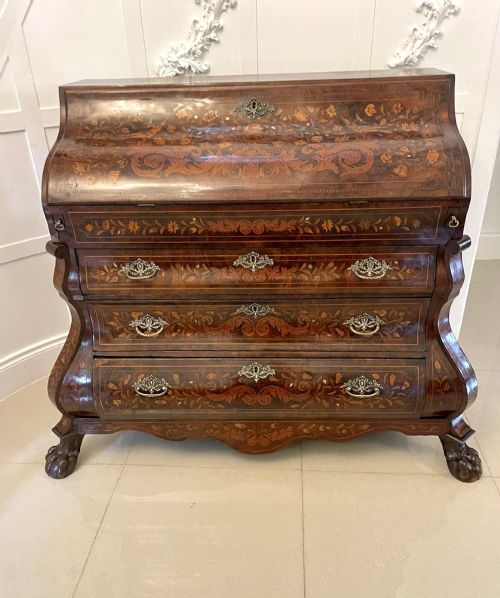
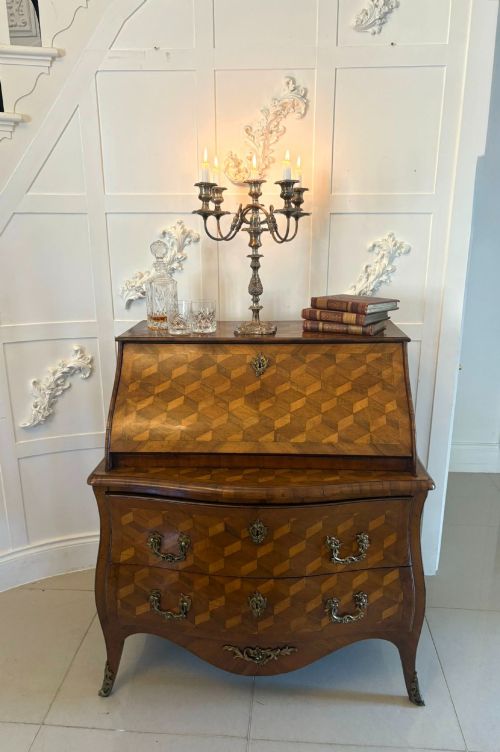
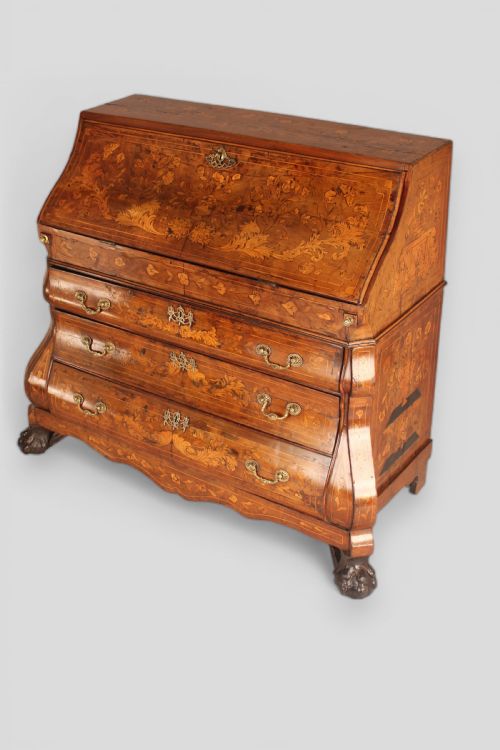
These bombe front desk pieces bring dramatic swelling curves and rich marquetry into a room, offering both a statement cabinet and a practical writing surface.
Bombe Front Desk
A bombe front desk takes many forms across this selection, appearing most frequently as bureaux, bureau bookcases, and writing desks with characteristic outward-swelling profiles. These pieces emerge from the 18th century, Georgian period, 1800, 19th century, 1880, and 1920, with Dutch and French origins dominating the stylistic landscape.
The aesthetic leans heavily into Dutch Baroque, Dutch Rococo, French Chateau, Rococo Revival, and Georgian design. Walnut and burr walnut dominate the structural choices, accompanied by mahogany, fruitwood, glass, and brass fittings that complete the traditional workspace.
What varies in quality
The ambition of the marquetry design sets examples apart, moving from simple linear stringing to dense, multi-toned floral imagery executed in diverse fruitwoods. Handling the curved drawer fronts reveals whether the timber has been shaped with genuine mastery or built through simpler applied blocking.
The choice of primary timber creates a distinct hierarchy, where richly figured burr walnut commands greater visual presence than plainer mahogany or standard walnut. Superior execution shows in the seamless continuity of grain across the swelling drawer fronts and the crispness of the applied brass hardware.
Meticulous Dutch artisans spent hours cutting tiny fruitwood petals just to make floral marquetry cabinets bulge with permanent wooden bouquets.
Morison of Edinburgh
The Bombe Front Desk Glossary
- Bombe
- A convex or outward-swelling shape characteristic of furniture fronts and sides from the 18th century onwards. This contour requires advanced shaping techniques to achieve the desired silhouette.
- Marquetry
- Decorative patterns formed by fitting together thin slices of various coloured woods and other materials onto a structural surface. Floral arrangements are especially common on Dutch examples.
- Bureau
- A sloping desk that opens to reveal a writing surface and small interior compartments for papers. Many versions combine this desk form with a glazed bookcase above.
- Parquetry
- Geometric patterns created with small wooden tiles laid into a surface veneer. It offers a structured contrast to flowing floral marquetry.
- Escutcheon
- A protective plate surrounding a keyhole, often cast in brass. These details complement the overall design of the drawer fronts and doors.
Bombe Front Desk: Frequently Asked Questions
What is a bombe front desk?
A bombe front desk is a writing cabinet featuring distinct convex, swelling sides and drawer fronts that project outward. These pieces date across the 18th, 19th, and early 20th centuries.
Originating largely from Dutch and French workshops, they combine functional writing surfaces with decorative marquetry and substantial storage capacity.
How do I use a bureau desk daily?
The sloping fall-front opens down to create a flat writing ledge above internal pigeonholes and small drawers. You can store stationery inside and close the flap to conceal paperwork when not in use.
Larger bookcase versions also offer upper shelving for displaying books or collection items behind glass doors.
Where were these desks made?
The evidence points primarily to Dutch and French makers working within Baroque and Rococo revival styles. Regional workshops utilised local fruitwoods alongside imported mahogany and burr walnut veneers.
Cabinetmakers across these regions adapted the sweeping curves to both large bureau bookcases and smaller writing desks.
How do I distinguish 18th-century pieces from later ones?
Eighteenth-century and Georgian pieces display period-specific timber patination and hand-cut construction details within the internal carcase. Later pieces from the 19th century or 1920 often adapt these earlier Rococo and Baroque motifs with different secondary woods.
Examining the internal drawer construction and veneer thickness helps clarify the likely age of the cabinet.