
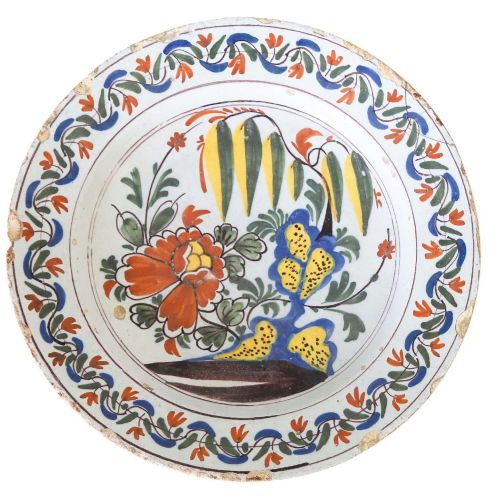


Delftware Floral Chargers
These delftware floral chargers are tin-glazed earthenware dishes that bring 18th-century hand-painted colour and Dutch or English domestic history straight to a wall or dresser.
Delftware Floral Chargers
Delftware floral chargers are large earthenware wall dishes and display plates produced across the eighteenth century in English and Dutch workshops. When you search for delftware floral chargers, you encounter substantial plates adorned with hand-painted floral motifs executed in cobalt blue or polychrome palettes.
The objects on this page span the 1700s, featuring Dutch Baroque influences alongside Georgian forms. Most examples take the shape of broad chargers, platters, or decorative plates intended primarily for visual display rather than dining.
Originating from major pottery centres, these pieces include English productions alongside Dutch works from the seventeen-hundreds. Buyers will find both single display chargers and paired small plates decorated with floral and geometric designs.
What varies in quality
Quality rests upon the crispness of the hand-painted floral brushwork and the stability of the tin-glaze. Superior chargers display confident, fluent brushstrokes that describe botanical motifs with clarity and balance across the broad centre and rim.
The purity and smoothness of the white tin-glaze surface distinguish finer examples from standard production pieces. Potted weight, potting symmetry, and the complexity of the polychrome or manganese palette further elevate a charger within the range.
Eighteenth-century painters occasionally left stray thumbprints trapped in the tin-glaze on the undersides of chargers, offering a silent handshake across three hundred years.
De Witte Ster
The Delftware Floral Chargers Glossary
- Delftware
- Earthenware pottery covered with an opaque white tin-glaze and painted with metallic oxides. This technique originated in the Netherlands and spread to English potteries during the seventeenth and eighteenth centuries.
- Charger
- A large decorative plate or platter traditionally displayed on a sideboard or hung on a wall rather than used for serving food. These pieces measure significantly wider than standard dining plates.
- Tin-Glaze
- A ceramic glaze made opaque by the addition of tin oxide, creating a white surface suitable for painting. It provides the characteristic smooth ground found on eighteenth-century delft pottery.
- Polychrome
- Decoration employing multiple colours, typically iron red, green, yellow, and blue painted over the white tin-glaze. This style contrasts with monochrome blue painting.
- Grand Feu
- A high-temperature ceramic firing technique where the raw glaze and painted pigments are fused in a single kiln run. This process causes colours to melt slightly into the glaze surface.
Delftware Floral Chargers: Frequently Asked Questions
Are these chargers English or Dutch?
Eighteenth-century delftware chargers were manufactured in both England and the Netherlands, with distinct stylistic overlaps due to the migration of potters and designs across the North Sea. English workshops in places like London, Bristol, and Liverpool produced substantial quantities alongside famous Dutch centres.
Distinguishing between them often relies on subtle characteristics of the clay body, glaze tone, and the specific palette of the floral painting rather than broad visual categories.
How do I hang a charger safely?
Hanging a heavy earthenware charger requires a purpose-built spring-loaded plate hanger that distributes weight evenly around the rim without placing stress on the ceramic body. Ensure the wall fixing is secure and anchored into solid masonry or a stud.
Keep display locations away from direct sunlight, high humidity, and areas subject to vibration to protect the historical tin-glaze from environmental damage.
What does polychrome mean on delftware?
Polychrome decoration refers to the use of multiple colours beyond standard cobalt blue, incorporating pigments such as iron red, manganese purple, yellow, and green. Painters applied these mineral colours directly onto the unfired tin-glaze before the final kiln firing.
This multi-coloured approach allowed artisans to create vibrant floral and geometric compositions that reflect both Asian export porcelain influences and European folk traditions.