
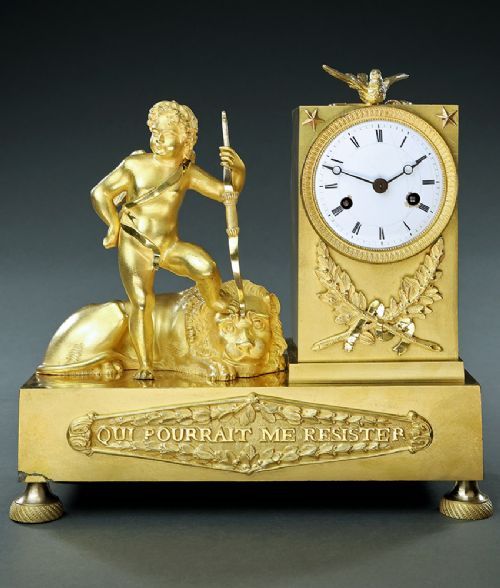


Decorative Gilt Desk Timepiece
These decorative gilt desk timepiece designs bring polished brass and enamel into a study, offering small-scale timekeeping with sculptural presence.
Decorative Gilt Desk Timepiece
A decorative gilt desk timepiece sits on a writing table or mantel, combining metalwork with a dial. You will frequently encounter French brass, ormolu, and gilt bronze examples alongside English fusee pieces from the nineteenth century.
Makers housed these movements within architectural cases, glass four-glass housings, and figural sculptures involving putti or animals. The forms span compact carriage clocks, boudoir pieces, and small mantel clocks designed for intimate spaces.
The styles range from Regency and French Empire to Rococo revival and Egyptian Revival. Each version relies on gilded metal surfaces to catch the light of a room.
Materials and construction methods
Casings utilise cast brass, gilt bronze, and ormolu, often paired with glass panels or marble plinths. Artisans chased and engraved the metallic surfaces by hand to create intricate borders and textural contrast.
Porcelain and alabaster occasionally supplement the metal structures, providing smooth white or painted surfaces that balance the heavy gilding.
Listings feature brass, marble, porcelain, and champlevi enamel across nineteenth-century Victorian, Edwardian, and Regency periods.
Distinguishing quality in metalwork and movement
Quality rests in the crispness of the bronze casting and the depth of the hand-chasing on the gilt surfaces. Superior examples display sharp relief on figural elements like cherubs and animals, rather than soft, blurred edges from worn moulds.
The precision of the engraving across the brass carriage frames and the quality of the enamel dial work separate standard production from superior pieces. Signed movements by notable makers generally indicate higher grade internal components and careful regulation.
Le Roy Paris·Tiffany·Hessen Paris·Henri Jacot·John Bennett Cheapside London·Barwise London
The Decorative Gilt Desk Timepiece Glossary
- Ormolu
- A technique of applying finely ground high-carat gold to a bronze object, creating a rich golden lustre. It defines much of the best French metalwork.
- Fusee
- A conical pulley used in clock movements to maintain even tension on the gear train as the mainspring unwinds. This mechanical addition improves timekeeping accuracy.
- Champlevé enamel
- A method where troughs are dug into a metal surface and filled with enamel powder before firing. The resulting coloured patterns sit flush with the surrounding metal frame.
- Four-glass clock
- A timepiece housed in a brass-framed glass case that allows light to pass through all sides. This design reveals the delicate movement within.
- Carriage clock
- A portable spring-driven timepiece originally designed for travelling officers. They typically feature a carrying handle and a glass-panelled brass case.
Decorative Gilt Desk Timepiece: Frequently Asked Questions
Where should I place a desk timepiece?
These clocks suit writing desks, library tables, and small mantelpieces where their detailed metalwork remains visible at close range. Keep them away from damp walls and direct sunlight to protect the gilt finishes and enamel dials.
Ensure the surface is stable and level so the movement beats evenly. Smaller carriage and boudoir clocks also sit well on bedroom chests or side cabinets.
How do I distinguish French from English timepieces?
French pieces often display ornate cast bronze, ormolu cases, and decorative enamel work reflecting Rococo or Empire styles. They frequently use platform escapements.
English examples from the same era, particularly fusee clocks, tend to focus on mechanical precision with engraved backplates and heavy brass plates. Signatures on the dial or movement usually confirm the place of origin.
What is a crystal regulator clock?
A crystal regulator is a mantel or desk clock enclosed by glass panels on four sides within a brass or gilt frame. This style emerged in the late nineteenth century to showcase the oscillating pendulum and movement.
These pieces rely on a mercury or compensated pendulum that remains visible through the central glass door. The open design allows light to flood through the entire housing.