


Victorian Gilt Bronze Horology
Victorian gilt bronze horology brings heavy, polished metalwork and precise clockwork together to anchor a grand mantelpiece.
Victorian Gilt Bronze Horology
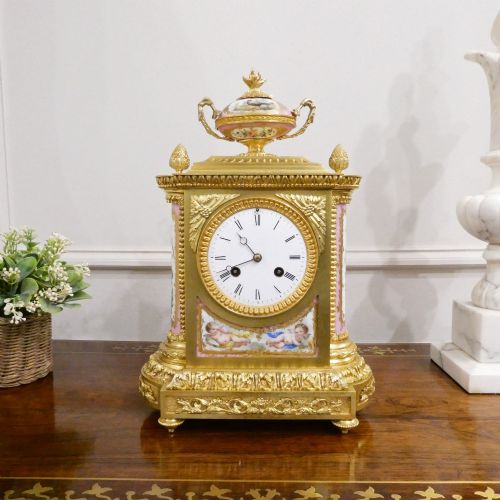
Victorian gilt bronze horology covers heavy mantel clocks and portable carriage clocks produced across the nineteenth century and into the Edwardian period. These pieces combine cast metal cases with enamel dials, glass panels, and sometimes porcelain plaques or tortoiseshell details.
The most common forms on this page are French and English mantel clocks alongside brass and gilt carriage clocks. Makers range from London firms like John Bennett and Payne to French workshops associated with Drocourt and Jean-Baptiste Delettrez.
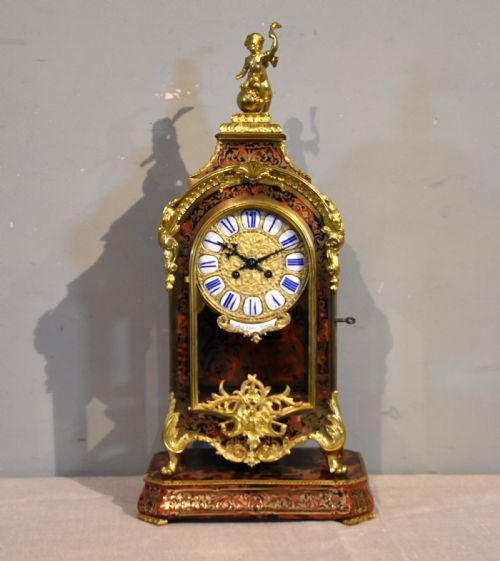
Styles lean heavily towards French revivals, including Louis XV, Louis XVI, and Rococo Revival designs alongside strict Victorian interpretations. Cases feature cast cherubs, crystal regulators, and gorge or corniche framing.
Materials and construction
Cases are formed from cast gilt bronze, ormolu, and brass, often paired with ebonised wood or green glass panels. Metalwork is chased and gilded to create contrasting matte and polished surfaces across figural cherubs and architectural mounts.
Dials frequently utilise white enamel with painted Roman numerals, protected behind bevelled glass panes within heavy brass or bronze bezels. Movements involve intricate brass gear trains, strike repeat mechanisms, and fusee or platform escapements.
Cast bronze cherubs sit quietly among the gears, keeping watch over centuries of ticking time.
Assessing quality and execution
Quality rests in the crispness of the bronze casting and the depth of the chasing, where sharper relief on figures and foliage separates superior work from softer secondary pieces. Heavier cast cases with well-defined architectural mouldings hold greater presence.
The sophistication of the internal movement dictates the standard, particularly when extra complications like strike repeat or alarm functions are present alongside signed backplates from notable makers.
Jean Baptiste Delettrez·John Bennett Cheapside London·Drocourt·Payne of London
The Victorian Gilt Bronze Horology Glossary
- Ormolu
- Gilded bronze produced by applying a mercury and gold amalgam to a bronze base and firing it. This historic technique creates a rich, durable surface finish.
- Fusee
- A conical pulley used in mechanical clocks to maintain an even pull on the gear train as the mainspring unwinds. It ensures consistent timekeeping.
- Corniche
- A distinct carriage clock case style featuring a stepped top and base with rounded or columns corners. It is characteristic of finer nineteenth-century travel clocks.
- Gorge
- A stepped, architectural case profile typical of better quality French carriage clocks. The stepped top moulding frames the upper glass panel.
- Crystal regulator
- A mantel clock housed within glass panels on all sides to expose the movement and pendulum. These designs emerged during the late nineteenth century.
Victorian Gilt Bronze Horology: Frequently Asked Questions
Why does my clock strike the wrong hour?
Rack strike clocks can drift out of sync if the hands are moved incorrectly or if the clock stops running mid-strike. Allow the clock to complete its strike sequence before advancing the hands again.
Many antique movements require professional adjustment if the count wheel or rack mechanism slips out of alignment.
How do I date a French mantel clock?
Examine the style of the case, the typography on the enamel dial, and any maker stamps on the brass movement backplate. Stylistic revivals like Louis XVI or Rococo often point to mid or late nineteenth century production.
Registration marks or exhibition medals stamped on the brass movement can narrow down the manufacturing decade further.
Where should I place a gilt bronze clock?
Keep these heavy clocks on a stable, level surface away from direct sunlight, dampness, and rapid temperature changes. Mantelpieces remain traditional as long as the shelf bears the substantial weight.
Ensure the clock rests squarely so the pendulum beats evenly without binding against the back case.