
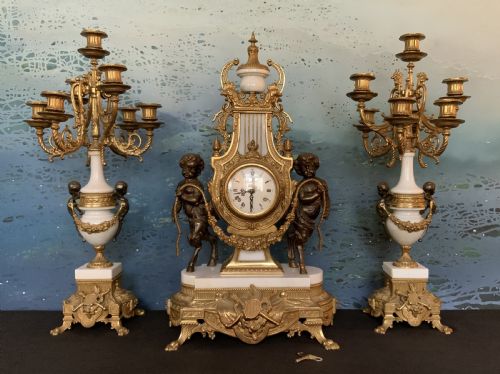


Antique Brass Cherub Clock
An antique brass cherub clock brings sculptural romance and precision timekeeping into a room, combining cast metalwork with playful winged figures.
Antique Brass Cherub Clock
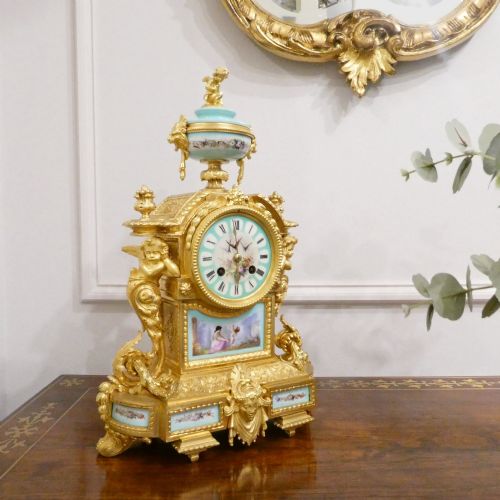
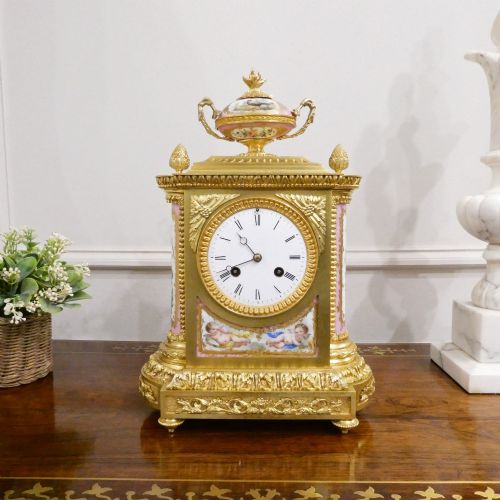
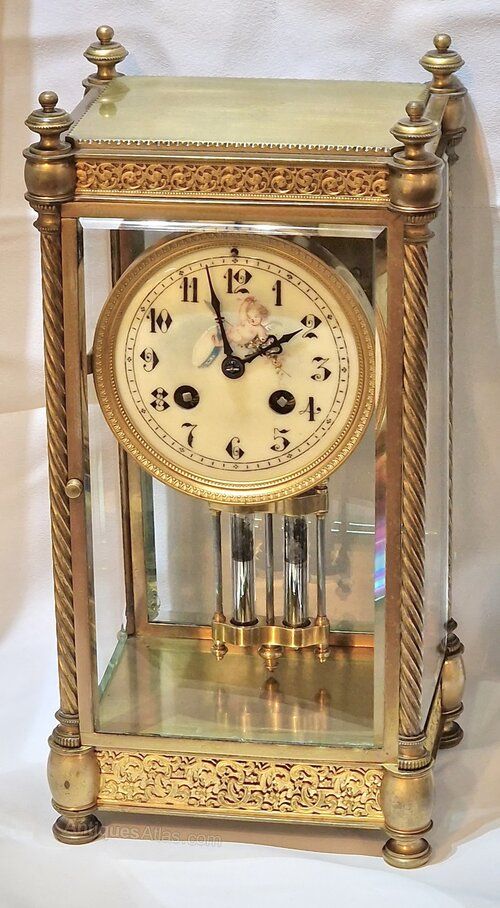
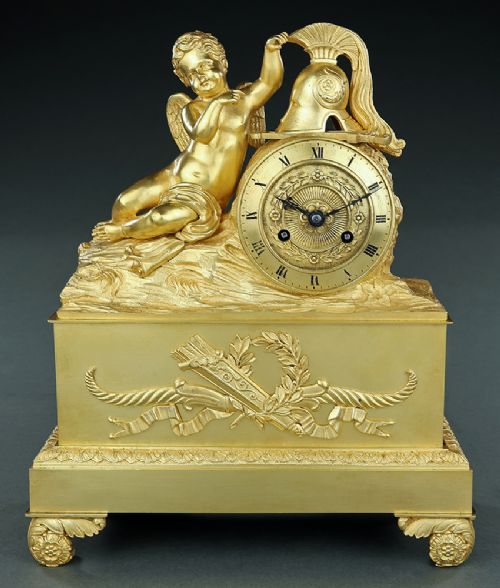
An antique brass cherub clock typically manifests as a mantel clock or garniture set featuring cast figures of putti, cupids, or cherubs alongside traditional clock faces. These domestic timepieces draw heavily from French Rococo Revival, Louis XVI, and Empire styles popular throughout the nineteenth century.
Most examples you encounter on this page date from the Victorian era and the latter half of the nineteenth century, executed by French and English clockmakers. They range from diminutive desk clocks and single fusee movements to monumental multi-piece garniture sets complete with matching candelabras.
Materials and construction methods
These clocks rely on heavy cast brass, gilt bronze, and ormolu frames paired with internal mechanical movements driven by springs and pendulums. Metal components are frequently mercury-gilded or polished to achieve a bright golden lustre.
Many dials incorporate painted porcelain panels, enamel cartouches, or Sevres-style inserts decorated with floral motifs. Cases often integrate contrasting materials such as white marble, slate, or exotic hardwoods to support the heavier bronze and brass castings.
Listings feature movements ranging from simple eight-day French strikes to complex single fusee mechanisms by London makers.
Distinctions in execution and design
The division between standard production and exceptional work rests on the crispness of the chasing and the depth of the metal casting. Finer pieces exhibit hand-finished details on the cherub figures, where hair, wings, and facial expressions retain sharp definition rather than soft, rounded edges.
Movement quality also dictates overall merit, separating mass-market brass works from signed movements by notable makers. Heavier cases with integrated porcelain plaques and matching candelabra garnitures represent higher tiers of nineteenth-century manufacture.
Jean-Baptiste Delettrez·Le Roy Paris·Samuel Marti·John Bennett·Henry Berkeley·Baetens London·P.H. Mourey·Japy Freres
The Antique Brass Cherub Clock Glossary
- Ormolu
- Gilded bronze produced by applying a mercury and gold amalgam to a bronze base and heating it until the mercury vaporised. This technique creates a durable, warm golden finish characteristic of better nineteenth-century clock cases.
- Garniture set
- A matched grouping consisting of a central clock flanked by decorative accessories such as vases or candelabras. These sets were designed to sit symmetrically on a mantelpiece.
- Fusee
- A conical pulley used in clock movements to maintain an even tension on the chain or cord as the mainspring unwinds. This mechanism improves timekeeping accuracy across the power reserve.
- Champleve enamel
- A technique where troughs or cells are hollowed out in the metal surface and filled with vitreous enamel before firing. It provides vibrant colour and geometric or floral patterns around the clock face.
Antique Brass Cherub Clock: Frequently Asked Questions
How do I wind an antique clock?
Most mechanical clocks on this page use a key inserted into specific winding holes on the dial to tension the mainspring.
Turn the key slowly and stop the moment you feel firm resistance to avoid damaging the internal teeth.
What is a garniture clock set?
A garniture set includes a central clock accompanied by matching decorative pieces like candelabras or urns.
These sets were manufactured as a unified decorative scheme for display on a fireplace mantel.
How do I date a nineteenth-century clock?
Dating relies on maker signatures, style markers like Rococo Revival or Empire motifs, and registration marks stamped on the brass movement.
Historical records of firms such as Japy Freres or Samuel Marti help narrow the production decade.
Where should I place my clock?
Position the clock on a sturdy, level surface away from direct sunlight, dampness, and rapid temperature changes.
Mantels and heavy wooden sideboards offer stable platforms that prevent vibrations from interfering with the pendulum.