



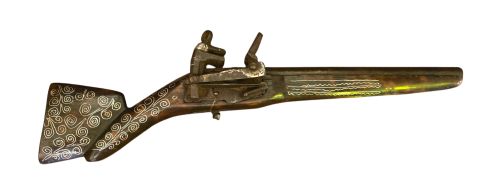

Dark Wood Handguns
Dark wood handguns are historical firearms shaped in walnut, hardwood, and general wood stocks, offering collectors tactile pieces of military and civilian history.
Dark Wood Handguns
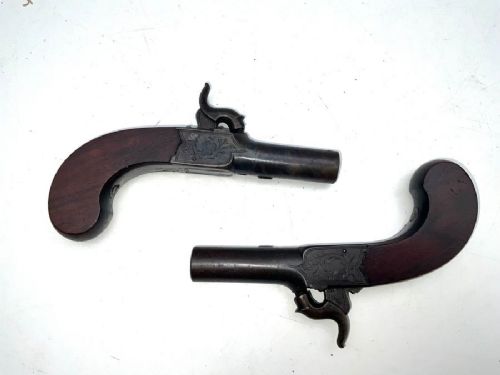
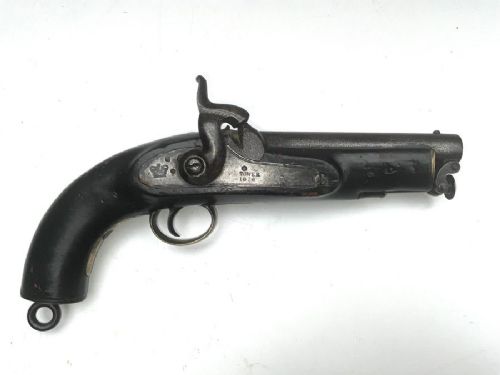
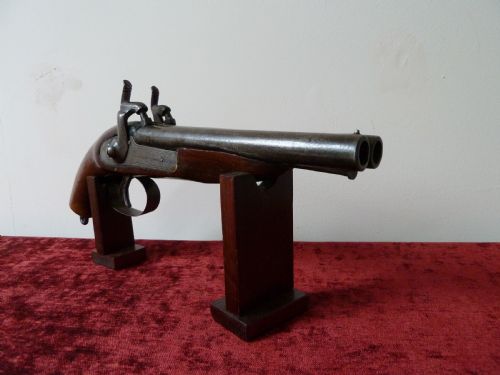
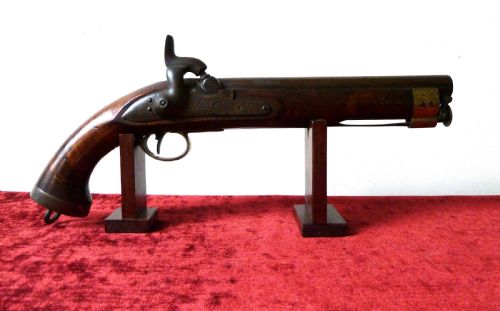
Dark wood handguns comprise antique firearms housed in rich timber stocks, spanning the Georgian, Victorian, and 18th Century European periods. These pieces include flintlock and percussion systems, ranging from small pocket pistols to heavy cavalry and sea service sidearms.
Buyers on this page most frequently encounter nineteenth-century military and civilian pocket pistols, alongside Georgian holster pistols and Ottoman flintlock long pistols. Such items reflect both domestic defence and formal military issue from British, Belgian, Italian, and Ottoman makers.
The category covers diverse mechanical forms, from double-barrel pocket models and belt pistols to pinfire pistols equipped with foldaway bayonets. Each object demonstrates the practical firearm technology of its specific operational era.
Materials and construction methods
Stocks rely heavily on walnut and denser hardwoods, shaped to fit the hand and carved or fitted to receive the action. Timber selection provided the necessary structural strength to absorb the recoil of discharge.
Metal components integrate steel barrels, iron locks, and brass furniture, frequently complemented by silver inlay work. These elements are joined using traditional fasteners and pinned through the wooden stock to secure the firing mechanism.
Listings feature walnut, hardwood, steel, brass, and silver across 18th Century, Georgian, and Victorian periods.
Markers of distinction
Quality rests upon the crispness of maker stamps, London proofs, and cast brass furniture details. Superior examples exhibit precise inletting of the metalwork into the walnut stock and retain clean, legible engraving.
Condition and originality dictate the standing of a piece, particularly the survival of untouched surfaces on both the timber and the steel components. Evidence of maker attribution, such as signed locks by makers like T. Potts, elevates the historical significance.
T. Potts
The Dark Wood Handguns Glossary
- Flintlock
- An ignition mechanism utilising a flint struck against a steel frizzen to create sparks that ignite the gunpowder charge. This system predates percussion ignition across the eighteenth and early nineteenth centuries.
- Percussion
- A later ignition method where a hammer strikes a percussion cap containing priming compound placed on a nipple. This innovation replaced the flintlock system during the nineteenth century.
- Holster pistol
- A large firearm designed to be carried in a saddle holster rather than on a belt or in a pocket. These weapons saw extensive use by cavalry units and officers.
- Snaphaunce
- An early type of flintlock mechanism featuring a manually opened frizzen separate from the pan cover. It represents an intermediate development in firearm ignition history.
- Frizzen
- The vertical steel plate struck by the flint in a flintlock mechanism to produce sparks. Grooved versions assisted in directing the spark downward into the priming pan.
Dark Wood Handguns: Frequently Asked Questions
What periods do these handguns cover?
The available selection spans from the late 18th Century through the Victorian era of the mid-19th Century. These dates reflect changing military and civilian demands across European and Ottoman manufacturing centres.
Items range from Georgian flintlock holster pistols to later percussion pocket pistols and pinfire designs.
How do flintlock and percussion pistols differ?
Flintlock pistols rely on a flint striking a steel frizzen to generate sparks for ignition. This older technology was largely superseded by the percussion system.
Percussion pistols use an external hammer striking a small percussion cap placed on a nipple, offering greater reliability in damp weather.
Were these pistols used by the military?
Many listings represent official military contracts and service arms, including East India Company issues and British cavalry holster pistols. These pieces were built to standard military specifications for troop distribution.
Other examples include naval sea service pistols and private officer purchases intended for personal defence during travel.
What woods are used for the stocks?
Stocks are predominantly fashioned from walnut and general dense hardwoods selected for durability under field conditions. These timbers were shaped to provide a secure grip during firing.
Some pieces feature decorative brass furniture or silver wire inlay embedded directly into the wood surface.
How should I display a dark wood handgun?
Display requires a stable environment away from direct sunlight and extreme humidity fluctuations to protect the timber stock and metal parts. Proper mounting or flat cabinet storage prevents physical strain on the action and wood.
Routine maintenance involves light application of protective oil on the metal surfaces to preserve the historic finish.