
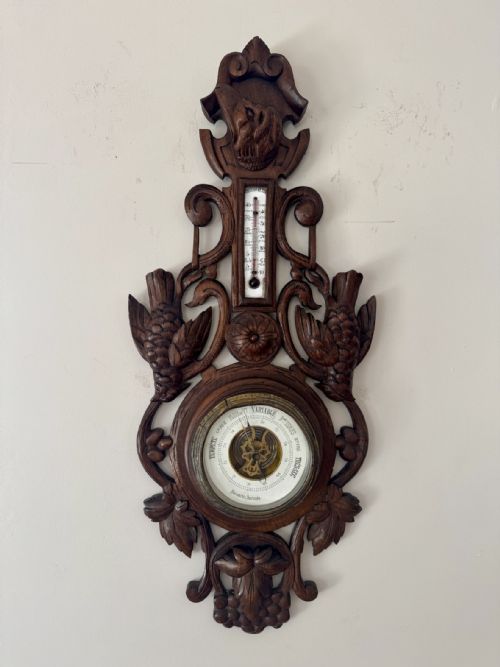


Dark Walnut Barometer
These dark walnut barometers combine practical weather-tracking with deep, rich timber tones that anchor a room.
Dark Walnut Barometer
When you search for a dark walnut barometer, you are looking at domestic weather-recording instruments housed in deep brown timber cases. The pieces found here span the Victorian era, the nineteenth century, and one seventeenth-century example.
You are most likely to meet nineteenth-century aneroid versions, often carved in the Black Forest style with elaborate foliage or animal motifs. Stick barometers and banjo clock combinations also appear among the walnut cases.
Origins stretch from British makers such as Negretti and Zambra to Scandinavian workshops and continental Black Forest carvers. Each piece uses the dark grain of walnut to frame dials made of porcelain, ceramic, or glass.
How they were made
Cabinetmakers shaped solid walnut and lindenwood into carved frames, housing delicate internal aneroid movements or mercury tubes. Skilled hands carved intricate wooden details for Black Forest models, contrasting the smooth polish of the main timber bodies.
Dials utilised porcelain, ceramic, or brass plates, inscribed with weather scales and numerical data beneath protective glass covers. Horn and other secondary materials occasionally appeared in smaller decorative elements or bezels.
Some nineteenth-century carvers hid tiny beetles amongst the deep walnut leaves of their Black Forest barometers.
What varies in quality
The depth of carving and the crispness of the timber work separate standard production pieces from finer examples. Deeply undercut foliage on Black Forest cases requires significant skill from the carver, creating strong shadows and texture.
The integration of multiple functions, such as combining a barometer with a thermometer or a clock in a banjo configuration, indicates higher ambition in the original design. The legibility of the ceramic or porcelain dials and the preservation of the original glass also define the upper tier.
Negretti & Zambra
The Dark Walnut Barometer Glossary
- Aneroid barometer
- A weather-reading instrument that uses a small, flexible metal box called an aneroid capsule to measure atmospheric pressure without employing liquid mercury. This design allowed instruments to be built into compact wall cases.
- Banjo barometer
- A household weather glass housed in a case shaped like a banjo, typically featuring a round dial at the top and a thermometer or humidity gauge down the long stem. They gained immense popularity during the nineteenth century.
- Stick barometer
- A tall, narrow instrument that displays atmospheric pressure through a vertical tube filled with mercury alongside a sliding vernier scale. These represent the more traditional form of weather glass.
- Black Forest style
- A distinctive nineteenth-century Swiss and German carving tradition known for realistic depictions of animals, leaves, and natural scenery. Walnut and lindenwood served as the primary mediums for these sculptural works.
Dark Walnut Barometer: Frequently Asked Questions
How do I read a barometer?
Read the primary pointer to see the current atmospheric pressure indicated on the dial scale. Setting the manual indicator needle over the main pointer lets you track whether pressure rises or falls over the course of the day.
Falling pressure typically signals approaching rain or wind, while rising pressure points toward settled, clear weather. Comparing successive readings provides a reliable guide to local meteorological shifts.
Where should I hang my barometer?
Hang your barometer on an interior wall away from direct sunlight, radiators, and heavy draughts. Temperature fluctuations can interfere with the internal mechanical components and alter the accuracy of the readings.
A stable indoor environment protects the walnut timber case from warping while ensuring the delicate internal linkages operate smoothly for years.
How do I date a walnut barometer?
Examine the style of the timber carving, the materials used for the dial, and the construction of the bezel. Victorian pieces often feature heavy ornamentation or specific banjo formats, whereas seventeenth-century examples display simpler, sparser lines.
Maker signatures inscribed on the brass or porcelain plates also provide a direct link to active operational periods and documented workshops.
What is the difference between aneroid and stick barometers?
Aneroid barometers rely on an internal expanding metal capsule to register pressure changes, allowing for compact, highly decorative wall cases. Stick barometers use a long vertical tube of liquid mercury exposed to atmospheric changes.
Stick models tend to have a more restrained, architectural appearance, whereas aneroid versions accommodate elaborate carved wooden frames.