


Vintage Weather Predictor
These vintage weather predictors are practical barometers, clock combinations and scientific instruments that bring period charm and atmospheric tracking to any wall or mantelpiece.
Vintage Weather Predictor
When you search for a vintage weather predictor, you encounter a selection of barometers, scientific instruments, wall clocks and mantel clocks. These pieces span the Georgian, Victorian and Edwardian eras, reflecting centuries of domestic meteorological interest.
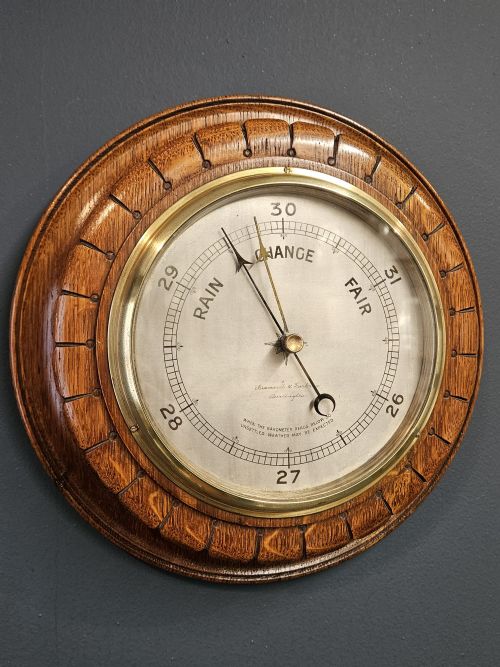
The most common form on this page is the Victorian barometer, often mounted in a mahogany or ebonised wood case with a silvered metal dial. You also find specialised pocket instruments and carved Black Forest wall pieces.
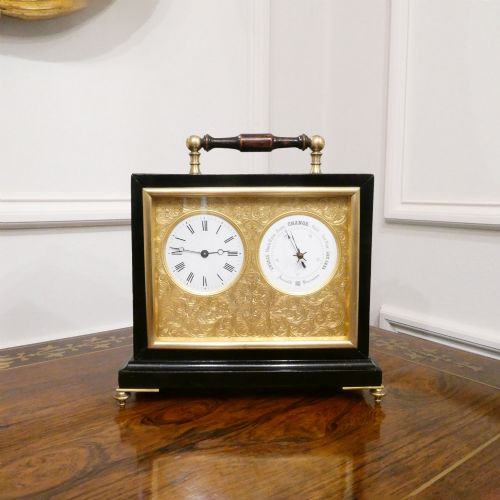
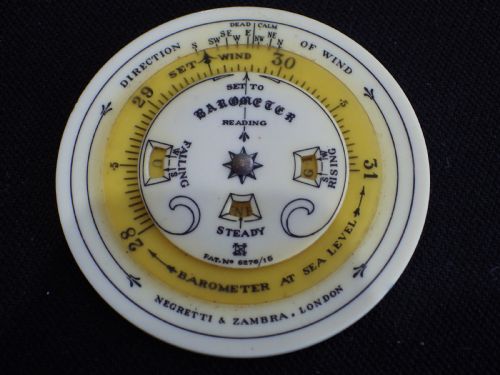
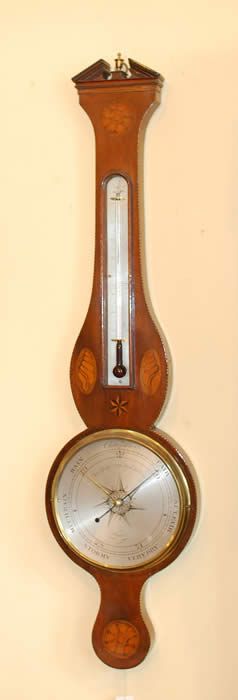
Makers range from provincial firms like Bramwell & Harbron of Darlington and W.E. Pain of Cambridge to notable London businesses such as Blake & Son and Negretti & Zambra. Their work records the evolution of home weather recording from Georgian wheel designs to Edwardian combination clocks.
How they were made
Cases utilise dense timbers like mahogany and walnut, alongside ebonised wood and carved Black Forest styles. These woods provide stable housings for sensitive internal movements and glass dials.
Dials combine brass and silvered metal, often featuring engraved lettering and enamel details. Pocket versions integrate celluloid instructions and fitted boxes to protect delicate portable components.
Listings span the Georgian, Victorian and Edwardian periods, featuring mahogany, walnut, brass and ebonised wood.
What varies in quality
The standard of engraving on the silvered metal dials and the crispness of the timber case carving distinguish finer examples from simpler workshops. Provincial maker signatures also add historical context to specific regional pieces.
The complexity of the housing, such as onion top mahogany wheel cases or combined clock and barometer units, elevates the ambition of the original design.
Negretti & Zambra·Bramwell & Harbron·Blake & Son·W.E. Pain·Dominic Gatty
The Vintage Weather Predictor Glossary
- Aneroid barometer
- An instrument that measures atmospheric pressure without liquids, using an expanding metal capsule. This mechanism allowed barometers to become more compact and suitable for wall mounting.
- Wheel barometer
- A domestic barometer design where a float in a siphon tube turns a pointer via a pulley and weight. This form dominated 19th-century hallways and parlours.
- Silvered metal
- A brass or copper dial surface treated with a silver compound to create a matte finish. Engraved markings are then filled with black wax for legibility.
- Black Forest
- A regional style of wood carving originating in Germany, known for naturalistic motifs. These pieces often feature deep relief work showing foliage or animals.
Vintage Weather Predictor: Frequently Asked Questions
How do I read a barometer dial?
The pointer moves clockwise as atmospheric pressure rises, indicating fair weather, and counter-clockwise as pressure falls, pointing towards rain. Many traditional dials include engraved descriptive text ranging from stormy to very dry.
Matching the current needle position against a secondary set hand allows you to track whether pressure is rising or falling over the course of the day.
Where should I hang a wall barometer?
Barometers require stable interior locations away from direct heat sources and heavy vibrations. Hallways and studies traditionally hosted these instruments where family members checked conditions before stepping outside.
Ensure the wall fixing securely supports the weight of dense hardwood cases like mahogany or walnut.
What is a pocket forecaster?
Pocket forecasters are portable meteorological instruments housed in protective cases with printed instructions. They allowed travellers and outdoorsmen to track local pressure changes while away from home.
Examples like those by Negretti & Zambra combine pocket watch formats with specialised calculation dials.
How do I date a barometer?
Dating relies on stylistic clues in the case design, the materials used, and the signature of the maker inscribed on the dial. Georgian wheel instruments differ markedly from Edwardian combination clocks and Victorian aneroid models.
Records of active maker partnerships further narrow the manufacturing window for signed pieces.