
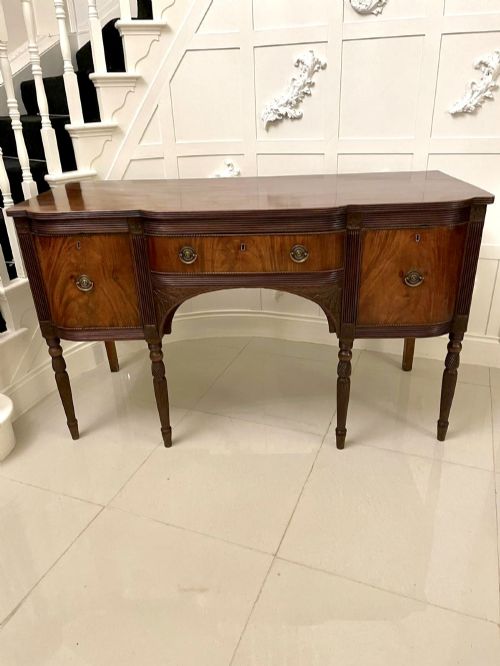
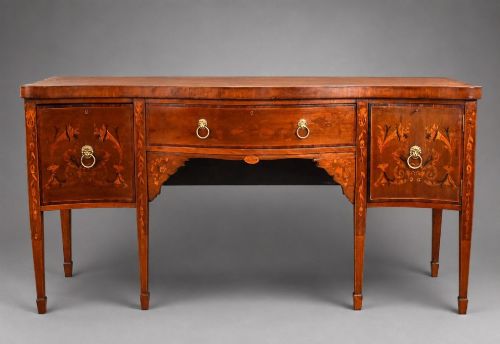


Dark Timber Sideboard
A dark timber sideboard brings substantial presence and historic storage to a room, ranging from Georgian mahogany to rustic French painted surfaces.
Dark Timber Sideboard
A dark timber sideboard serves as a practical storage piece and a focal point within a dining room, hallway, or living space. When you search for a dark timber sideboard, you encounter forms spanning several centuries, from George III breakfronts to Victorian mahogany pieces and Edwardian inlaid serpentine designs.
The most common examples on this page are nineteenth-century pieces in mahogany and oak, alongside regional country house dresser bases and serving tables. These objects combine utilitarian storage drawers and cupboards with formal or vernacular stylistic details.
Origins vary widely across the selection, encompassing English country workshops, French provincial makers, Anglo-Indian studios, and Chinese export centres. Each piece reflects the domestic storage needs and timber availability of its specific period and region.
Materials and Construction
Makers relied primarily on dense hardwoods such as mahogany, oak, walnut, and padauk, often enhanced by flame mahogany veneer, boxwood stringing, or brass hardware. These durable timbers provided the structural integrity required for heavy use in dining rooms and libraries.
Joinery techniques ranged from dovetail drawers and pegged frames in seventeenth-century oak cupboards to delicate edge-stringing on Edwardian serpentine surfaces. Secondary woods like pine appear in internal partitions and drawer linings.
Finishes include polished mahogany, hand-painted surfaces on French and Pre-Raphaelite inspired pieces, and lacquered hardwood on Chinese examples. Carved details, such as those found on Gillows library bookcases and Jacobean panels, demonstrate specialist chisel work.
Listings feature dark timber sideboards spanning from the seventeenth century through to the Edwardian period, constructed in mahogany, oak, walnut, and padauk.
Evaluating Quality and Execution
Quality rests in the selection of the timber, such as highly figured mahogany or dense old-growth oak, and the precision of the grain matching across drawer fronts and doors. Superior examples display thoughtful proportions and harmonious integration of decorative elements like boxwood stringing or carved mouldings.
The construction of internal components, including secondary timbers, drawer linings, and the smoothness of sliding or pivoting mechanisms, separates workshop standards. Maker attribution, such as documented pieces by Gillows, elevates a piece through known standards of cabinetmaking.
The integrity of the surface finish and the retention of original brass hardware contribute significantly to the standing of an antique piece. Alterations to hardware, legs, or surface layers alter the historical cohesion of the furniture.
Gillows
The Dark Timber Sideboard Glossary
- Serpentine
- A curved furniture front featuring a convex centre flanked by concave ends. This shape requires advanced woodworking skill to construct.
- Breakfront
- A cabinet or sideboard whose central section projects forward from the flanking sections. It adds architectural depth to large case pieces.
- Padauk
- A heavy, durable tropical hardwood with a reddish-brown colour used in Anglo-Indian and nineteenth-century furniture. It takes a fine polish and resists decay.
- Dresser Base
- A low rectangular cabinet fitted with drawers and often a pot-shelf below, originating from country house kitchens and dining rooms. These pieces provided essential everyday storage.
- Chiffonier
- A compact nineteenth-century sideboard or side cabinet, typically featuring enclosed shelving below and a raised gallery or mirror above.
Dark Timber Sideboard: Frequently Asked Questions
How do I style a dark timber sideboard?
A dark timber sideboard anchors a room and provides a stable surface for lamps, ceramics, or framed artwork. Balance the deep tones of the wood with lighter walls or contrasting decorative objects.
Utilise the interior cupboard space and drawers for tableware, linens, or books to keep surrounding areas uncluttered. The piece functions equally well in a dining room, hallway, or spacious living area.
How do I identify the period of an oak sideboard?
Seventeenth-century oak pieces display pegged joinery, heavy plank construction, and carved panels reflecting vernacular or Jacobean styles. Later nineteenth-century oak furniture often incorporates revival motifs, machine-cut elements, and lighter interior secondary woods like pine.
Examine the drawer construction and tool marks on the interior timbers to understand the manufacturing date. Hand-cut dovetails and irregular board widths generally point towards eighteenth-century or earlier origins.
Are Anglo-Indian sideboards different from English ones?
Anglo-Indian sideboards utilise dense exotic timbers such as padauk, carved in traditional British furniture forms adapted by local artisans in India. These pieces often feature deep, intricate floral or foliate carving distinct from standard English workshop output.
The combination of European cabinet designs with South Asian carving techniques creates a unique hybrid aesthetic found in nineteenth-century homes. They share the same functional storage purpose as domestic English sideboards.