
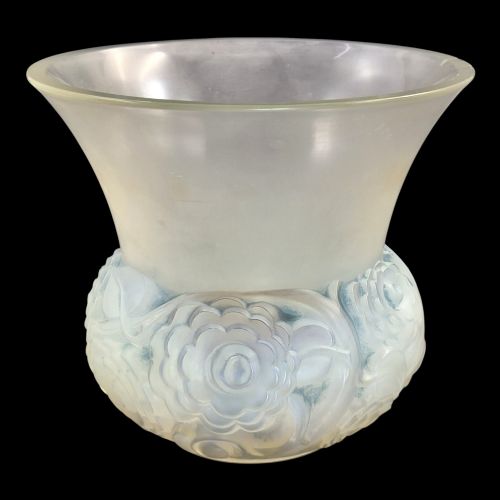


Crystal Flower Vase
A crystal flower vase brings weight and clarity to a room, holding cut stems while catching light through deep facets or coloured cased layers.
Crystal Flower Vase
A crystal flower vase sits heavy in the hand, formed from glass containing lead oxide to increase brilliance and resonance. When searching for a crystal flower vase, you encounter pieces spanning the Victorian, Edwardian, and Art Deco periods, alongside mid-century French and Belgian work.
The forms on this page range from tall lily vases and spill vases to large decorative centrepieces and heavy bubble glass vessels. Coloured cased glass versions appear frequently, showing layers of green, blue, or cranberry over clear crystal.
Materials and construction
Makers utilised lead crystal, clear glass, and cased glass, often applying colour over a clear crystal core before cutting through the outer layer. Techniques involved wheel engraving, gold enamel decoration, and silver plated mounts.
Moulded production sits alongside heavy hand-blown forms, while some pieces incorporate gilt bronze mounts or white cane decoration and pink trails.
Materials documented across the page include lead crystal, cased glass, silver plate, and gilt bronze.
Assessing quality
Quality rests on the depth and crispness of the wheel engraving, the weight of the metal content, and the precision of the cut facets. Pieces signed by known makers or designed by named artists show superior handling of form and colour separation.
The integration of silver plated or gilt bronze mounts and the purity of the cased colour layers separate standard production from finer studio or factory output.
Lalique·Daum·Val St Lambert·St Louis glassworks·Stevens & Williams
The Crystal Flower Vase Glossary
- Lead crystal
- Glass containing a high proportion of lead oxide, which increases the weight, refractive index, and acoustic resonance of the vessel.
- Cased glass
- A technique where a layer of coloured glass is fused over a clear crystal body, allowing craftsmen to cut through the outer colour to reveal the clear layer beneath.
- Wheel engraving
- A method of decorating glass by holding the vessel against a rotating abrasive wheel to carve intricate patterns or figures into the surface.
- Spill vase
- A slender vessel traditionally designed to hold taper candles or matches, later utilised for single flower stems.
- Centrepiece
- A large decorative vessel or bowl intended to sit in the middle of a dining table, frequently combined with silver plated or gilt bronze mounts.
Crystal Flower Vase: Frequently Asked Questions
How do I clean an antique crystal flower vase?
Wash the vessel by hand in lukewarm water using a mild detergent, avoiding sudden temperature changes that can crack the material. A soft brush helps clear residue from deep cut facets without scratching the surface.
Dry the piece immediately with a lint-free cloth to prevent water spots from dulling the clarity of the crystal.
How do I date a crystal flower vase?
Examine the weight, the style of the cutting, and any signatures or registration marks on the base. Victorian and Edwardian examples often feature intricate wheel engraving or silver plated mounts, while Art Deco pieces tend toward geometric forms or bold cased colours.
Maker signatures etched into the glass provide a precise indicator of origin, aligning the piece with known production periods.
What is cased crystal?
Cased crystal consists of two or more distinct layers of glass fused together during formation. Typically, a coloured outer layer coats a clear crystal interior.
Craftsmans cutting through the outer coloured layer create sharp contrast and pattern variation across the surface of the vase.
Are these vases heavy?
Crystal vases contain lead oxide, which adds significant density and weight compared to standard soda-lime glass. Larger examples from the twentieth century can weigh several kilograms.
This substantial weight provides stability when holding tall flower stems or heavy arrangements.