


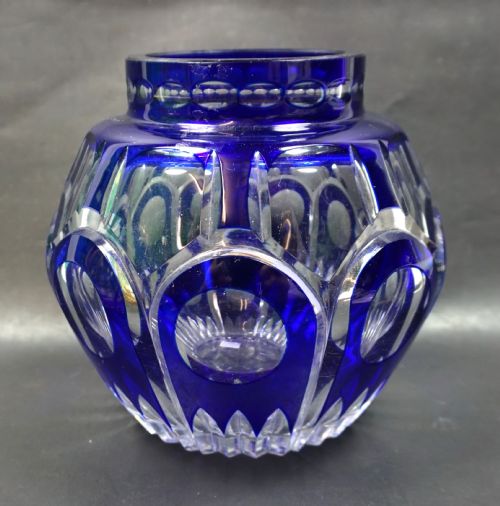


Cut Lead Crystal Vase
A cut lead crystal vase brings genuine weight and brilliant refraction to a room, catching the light in a way ordinary glass cannot.
Cut Lead Crystal Vase
A cut lead crystal vase is a heavy, light-reflecting vessel shaped for display or holding stems, appearing across periods from the Regency era through to Art Deco. When you search for a cut lead crystal vase, you encounter items ranging from early nineteenth-century English Regency table pieces to vibrant mid-century Belgian designs.
The selection on this page relies heavily on nineteenth-century Victorian and Edwardian examples alongside striking coloured overlay pieces from the 1930s. Forms vary from tall celery vases and wine coolers to sculptural Art Deco vessels by notable designers.
How they were made
These items are formed from heavy lead crystal glass, sometimes utilising cased or overlay techniques where a layer of coloured glass covers a clear crystal body. Makers then cut deep geometric or linear patterns through the outer layer to reveal the clear crystal beneath.
Techniques range from the precise wheel-cutting seen on Regency and Victorian vessels to the modernist cutting favoured by designers in the 1930s. The addition of lead oxide to the molten glass gives the material its characteristic heft and refractive brilliance.
Listings span the Regency, Victorian, Edwardian, and Art Deco periods, utilising lead crystal, cased glass, and overlay glass.
What varies in quality
The quality of a piece rests upon the crispness of the cutting and the clarity of the crystal glass itself. Superior examples display sharp, cleanly defined facets that catch the light cleanly without blurring.
Design attribution and material treatment also separate standard production from exceptional work. Pieces featuring coloured overlay demand high technical skill to balance the outer colour with the deep crystal base beneath.
Charles Graffart for VSL·Joseph Simon for Val St. Lambert·Val St. Lambert·Keith Murray for Stevens & Williams
The Cut Lead Crystal Vase Glossary
- Lead Crystal
- Glass containing a significant proportion of lead oxide, which increases weight, clarity, and the dispersion of light.
- Overlay Glass
- A vessel formed of two or more distinct layers of glass, typically a coloured exterior over a clear crystal interior.
- Celery Vase
- A tall pedestal vessel originally designed for serving celery stalks upright on the nineteenth-century dining table.
- Wheel-Cutting
- A traditional decoration technique where a glass vessel is held against a rotating abrasive wheel to carve patterns into the surface.
Cut Lead Crystal Vase: Frequently Asked Questions
How do I clean an old crystal vase safely?
Wash the item by hand in warm water using a mild liquid detergent. Avoid sudden temperature changes to prevent thermal shock to the heavy glass.
Dry the vessel immediately with a lint-free cloth to maintain the refractive clarity of the cut facets.
Can I use these vases for fresh flowers?
These vessels are fully functional and hold water safely for floral arrangements. The heavy lead content provides a stable base for tall stems.
Rinse the interior thoroughly after use to prevent mineral deposits from settling in the deep cut patterns.
How do I tell an Edwardian piece from a Victorian one?
Victorian examples tend to feature heavier proportions and dense, intricate cutting styles. Edwardian pieces often display lighter forms and more restrained surface decoration.
Examining the base and the weight helps distinguish the manufacturing habits of each specific decade.
Why are some crystal vases coloured?
Coloured pieces are created using the cased or overlay glass technique. A layer of coloured glass is fused over clear crystal before the cutting process begins.
Cutting through the outer skin exposes the clear crystal underneath, creating a sharp contrast in tone.