
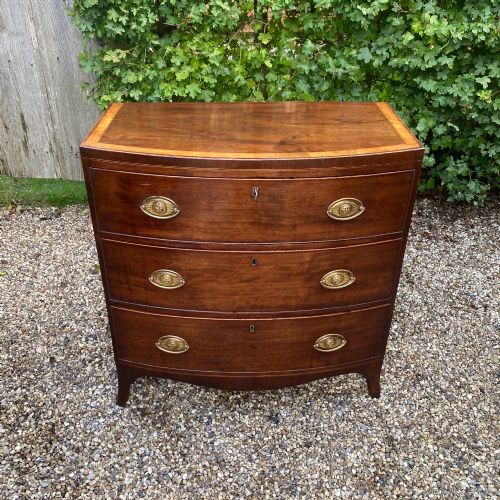
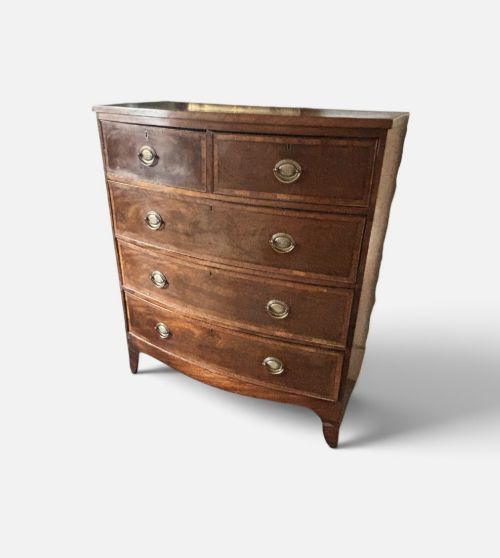
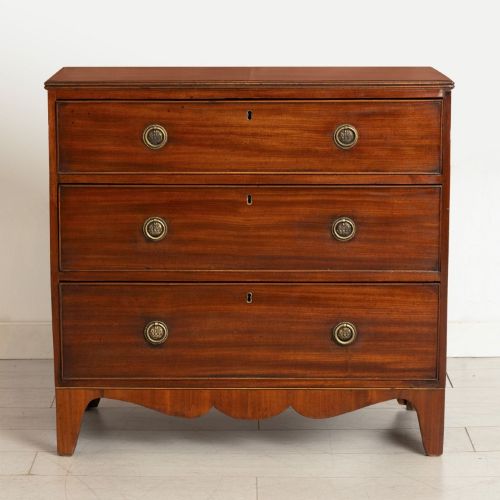
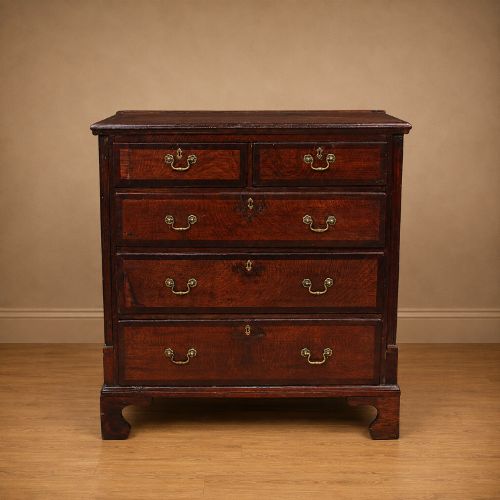
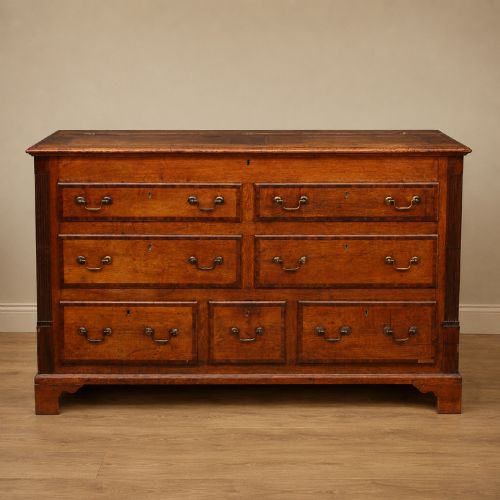

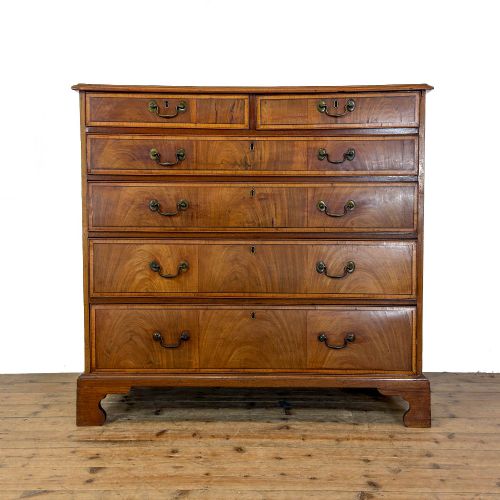
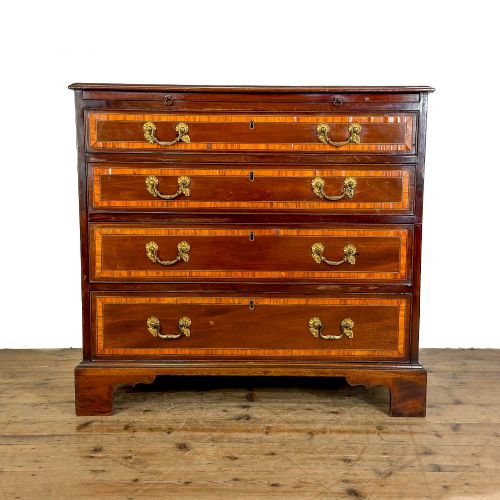
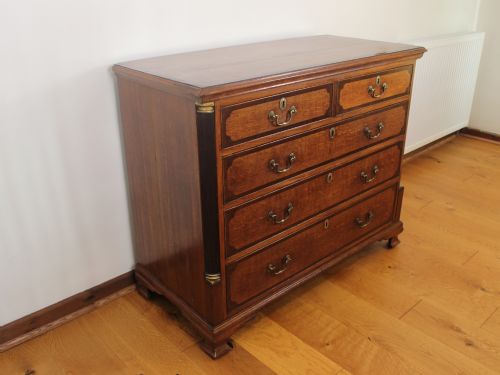
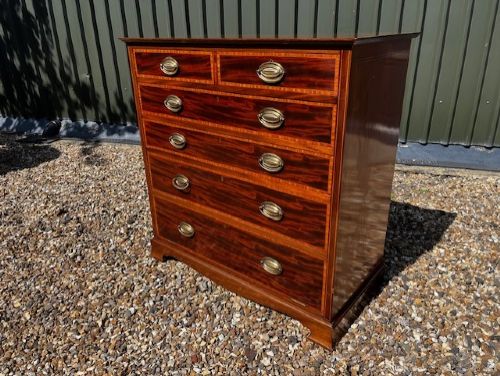

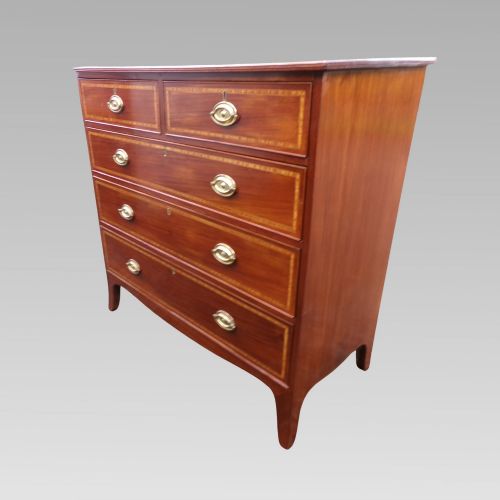


Crossbanded Mahogany Chest
A crossbanded mahogany chest brings together rich timber and border banding to anchor a traditional room with practical storage.
Identifying a crossbanded mahogany chest
A crossbanded mahogany chest is a sturdy case furniture piece designed primarily for domestic storage, defined by a distinct border veneer laid perpendicular to the main grain. You will encounter these pieces largely from the Georgian, Victorian, and Edwardian eras, appearing in various formats from small bedside proportions to tall chest on chest designs.
The dominant material is mahogany, frequently accented with contrasting timbers along the top and drawer edges. Pieces frequently present as rectangular banks of drawers, though bow front and kneehole variations also emerge from the records.
Materials and construction methods
Cabinet makers constructed these carcases using solid mahogany and secondary timbers such as oak, applying thin veneers to principal visible surfaces. Crossbanding strips were meticulously laid grain-to-grain around the edges of tops and drawer fronts to frame the primary timber.
Metal hardware such as brass handles and escutcheons were fitted by hand to secure operational drawers. Secondary woods like walnut, satinwood, rosewood, and kingwood appear as contrasting banding elements.
Retail Price Guide 2026
Typical UK retail prices for crossbanded mahogany chest, calculated from the Sellingantiques database of over a million retail prices indexed since 2003. This retail price guide relies exclusively on Sellingantiques data; no external sources or auction records are used, so the figures do not describe the wider market.
The listings show mahogany chests paired with brass hardware, oak secondary woods, and contrasting satinwood or rosewood crossbanding.
Assessing quality in construction
Quality reveals itself in the crispness of the crossbanding and the selection of figured mahogany timber for the primary surfaces. Finer examples display precise matching of grain patterns and subtle secondary wood borders that complement the main carcase.
Structural integrity, the neatness of dovetail joints on the drawers, and the retention of original brass handles separate ordinary utility pieces from superior workshop output.
Lamb of Manchester
The Crossbanded Mahogany Chest Glossary
- Crossbanding
- A border veneer applied to the edges of a surface where the grain runs perpendicular to the main timber. This technique creates a neat framed effect around drawer fronts and tops.
- Mahogany
- A durable tropical hardwood prized for its deep reddish-brown tone and stable grain. It served as the primary timber for high-end case furniture throughout the eighteenth and nineteenth centuries.
- Dovetail
- A traditional interlocking joint used to connect drawer sides to drawer fronts and backs. Hand-cut dovetails indicate earlier craftsmanship before the widespread adoption of machinery.
- Escutcheon
- A protective metal plate surrounding a keyhole on a drawer or door front. These plates are typically cast in brass and secured with small pins.
- Banding
- A narrow strip of contrasting wood veneer inlaid around the perimeter of a panel or top. It functions alongside crossbanding to provide visual definition.
Frequently Asked Questions
What is a crossbanded mahogany chest?
A crossbanded mahogany chest is a traditional storage unit featuring a wooden carcase faced in mahogany and bordered by perpendicular strips of veneer.
These pieces range from small Georgian drawers to larger Victorian and Edwardian tall chests, providing functional storage with decorative timber framing.
How do I date a mahogany chest?
Dating relies on observing construction methods, timber choices, and overall design proportions. Georgian pieces typically display hand-cut joinery, while later Victorian and Edwardian examples incorporate different secondary woods and hardware.
Comparing drawer linings, handle styles, and banding materials helps establish the approximate period of manufacture.
Where were these chests used?
These pieces served primarily in bedrooms, dressing rooms, and hallways as functional storage for clothing and linens. Their robust construction and finished tops also allowed them to function as surface display areas in domestic settings.
Specialist variants like bachelor chests and kneehole configurations offered writing surfaces or compact storage for specific household duties.
What woods are used with mahogany?
Cabinet makers frequently combined mahogany with contrasting timbers such as satinwood, rosewood, kingwood, walnut, and oak. These secondary woods were utilised for crossbanding borders, inlay lines, and internal carcase construction.
The contrast between the dark reddish mahogany and lighter or more figured banding materials defines the decorative aesthetic of the period.