

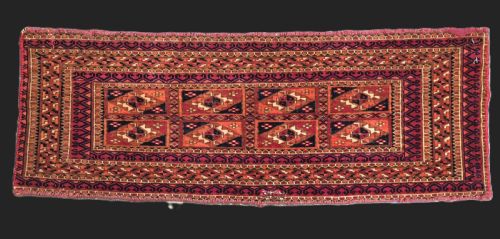
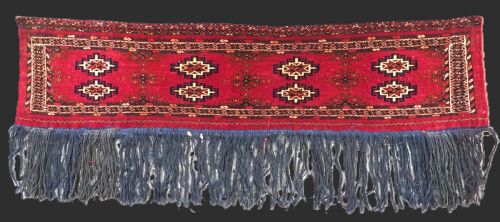
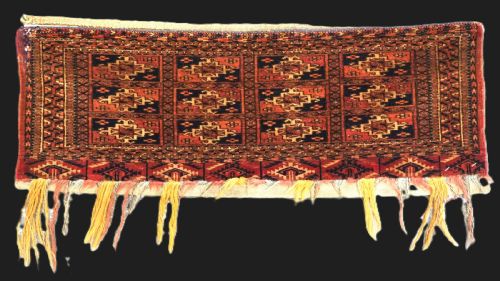


Crimson Wool Torba
A crimson wool torba is a tribal bag face woven with natural dyes, bringing nomadic Central Asian history directly into your interior.
Crimson Wool Torba
When you search for a crimson wool torba, you encounter Central Asian nomadic weavings created by Turkmen tribes including the Tekke, Saryk, Yomut, and Ersari groups. These traditional bag faces served as dowry weaving or functional household storage within tribal tents across the trans-Caspian steppes and oases.
The pieces on this page span the nineteenth century, with particular concentration around eighteen eighty and eighteen seventy. You find examples displaying distinct tribal motifs such as the gul, aina gul, curled leaf, and ikat patterns on a rich red ground.
Most specimens survive as individual bag faces, though some retain their original plain weave backs or complete mafrash structures. Sizes range from compact small formats to larger Ersari Beshir pieces.
What varies in quality
Quality in a crimson wool torba rests upon the precision of the drawing and the density of the weave. Finer knotting allows the intricate secondary motifs and tribal guls to appear with sharp definition.
The depth and vitality of the natural dye palette also dictate the standing of a piece. Superior examples display rich crimson tones and harmonious contrasts that retain their visual impact across the surface.
Nomadic weavers packed these bags tightly with bedding each spring, turning household clutter into portable art.
The Crimson Wool Torba Glossary
- Torba
- A small utilitarian bag or bag face used by nomadic tribes for storage inside the tent. They often feature prominent primary guls arranged in horizontal rows.
- Gul
- A repeating medallion or principal design motif associated with specific Turkmen tribes. Different clans utilised distinct forms to mark their identity.
- Mafrash
- A large rectangular storage container or box bag used for bedding and household goods during migration. The faces of these containers share techniques with torbas.
- Beshir
- A sub-group of Ersari Turkmen known for employing unusual large-scale patterns and ikat-inspired designs. Their weaving displays distinct regional characteristics from Central Asia.
- Aina Gul
- A specific mirror-patterned primary medallion found on Turkmen tribal trappings. The motif incorporates geometric subdivisions within the main octagonal form.
Crimson Wool Torba: Frequently Asked Questions
What is a crimson wool torba used for?
Nomadic tribes utilised these bags inside tents for storing small personal possessions, household items, or dowry goods during seasonal migrations.
Today, collectors mount these bag faces on walls or display them as decorative floor textiles in modern interiors.
How do I tell different Turkmen tribes apart?
Weavers from groups such as the Tekke, Saryk, Yomut, and Ersari employed distinct tribal guls and colour palettes. Examining the specific medallion shapes and border patterns reveals the origin.
Reference literature on Central Asian rugs helps attribute individual pieces to specific oasis or steppe regions.
Are these torbas complete bags?
Many examples survive today as individual bag faces because the original backings wore out through heavy daily utility. Some pieces retain their plain weave backs or complete structures.
Both single faces and complete bags hold equal standing among textile collectors.
How do I clean and care for a torba?
Protect the hand-spun wool and natural dyes by keeping the textile out of direct sunlight to prevent fading. Gentle surface dusting or professional textile cleaning maintains the condition.
Avoid abrasive scrubbing or harsh chemical washing that might damage the historical fibres.