



Cornish Coastal Watercolour
These cornish coastal watercolour works capture the light and harbours of the West Country through the eyes of regional painters.
Cornish Coastal Watercolour
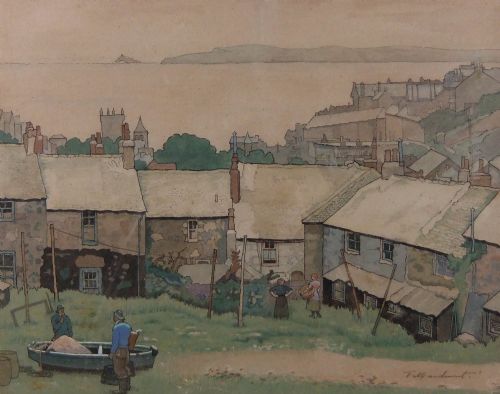
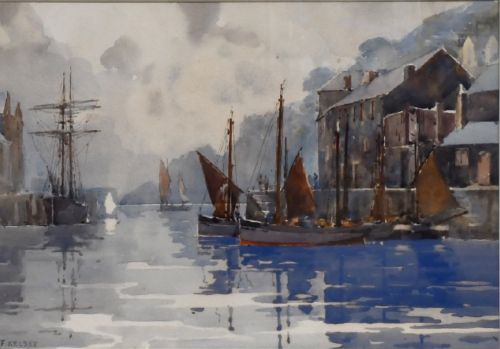
A cornish coastal watercolour depicts the rugged shores, bustling harbours, and fishing communities of the region through delicate pigment on paper. You encounter works spanning from the nineteenth century into the mid twentieth century, encompassing movements such as the Newlyn School and St Ives School.
The subjects focus heavily on familiar Cornish locations including St Ives, Mousehole, Looe, Polperro, and Newlyn. Painters recorded the daily life of fisherfolk, local luggers at sea, and coastal cottages alongside granite cliffs and harbour walls.
Most examples appear framed under glass in wood or gilt wood surrounds. They range from intimate views of harbour rocks to broader panoramas of coastal landscapes and seascapes.
Materials and Technique
Artists laid watercolour pigment and ink onto paper supports, often building translucent washes to capture shifting coastal light and sea spray. The application relies on controlled brushwork to define water, sky, and stone without heavy impasto.
The completed works find protection behind glass within wooden or gilt wood frames, preserving the delicate paper surfaces from atmospheric moisture and handling over decades.
Several artists clearly stood by the exact same Cornish harbour walls to paint, leaving us multiple Victorian angles on the exact same rocks.
Evaluating Quality
The strength of a piece rests in the surety of the brushwork and the artist's ability to render the distinctive luminosity of the West Country atmosphere. Stronger examples convey a vivid sense of place and movement, particularly in depictions of rough seas and active harbours.
Provenance and association with documented regional schools lift certain works above standard topographical views. Pieces tied directly to established artistic circles in Newlyn or St Ives carry greater historical resonance.
William Banks Fortescue·Thomas Maidment·Frank Kelsey·George F Pennington·Richard Harry Carter·Ernest F Hill·Frederick Stuart Richardson·Ralph Todd·William Lee Hankey·Walter Sweet·S J Lamorna Birch·Cuthbert Crossley
The Cornish Coastal Watercolour Glossary
- Newlyn School
- An art colony that flourished in West Cornwall from the late nineteenth century onwards, known for plein-air realism depicting local fisherfolk and coastal life.
- Watercolour
- A painting method where natural pigments are suspended in a water-based solution and applied to paper. It relies on the white of the paper to provide luminosity through translucent washes.
- St Ives School
- A twentieth-century grouping of artists based in the Cornish coastal town, transitioning from traditional maritime subjects towards broader modern idioms.
- Lugger
- A traditional two-masted fishing boat commonly seen in historical West Country maritime art and coastal scenes.
Cornish Coastal Watercolour: Frequently Asked Questions
How do I care for antique watercolours?
Keep these works away from direct sunlight to prevent the watercolour pigments from fading on the paper.
Ensure they hang in rooms with stable humidity to protect both the paper support and the wood or gilt wood frame.
Are these paintings original?
The works recorded here are original painted watercolours on paper rather than printed reproductions.
Many bear signatures, inscriptions, or historical framing that connect them directly to their period of creation.
What is the Newlyn School?
The Newlyn School refers to artists who settled in the Cornish fishing village to paint ordinary people and coastal scenes in natural light.
Their focus on plein-air observation shaped the character of West Country maritime art around the turn of the twentieth century.
How are these artworks framed?
Most examples are mounted behind glass within traditional wood or gilt wood frames selected to suit the period.
The glazing protects the delicate watercolour surface from dust and atmospheric damage while allowing clear viewing.