
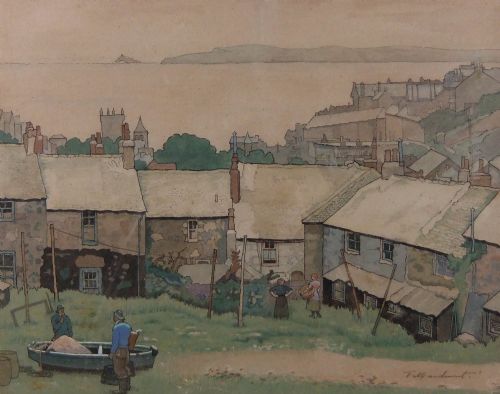


St Ives School Artwork
St ives school artwork brings coastal light and modernist abstraction into a room, offering the bold textures and Cornish landscapes that collectors prize.
St Ives School Artwork
When you search for st ives school artwork, you encounter paintings that capture the distinctive light, harbours, and coastal landscape of Cornwall. The pieces on this page span from the early twentieth century through to the middle decades, reflecting the shifting tides of British modernism.
Framed works dominate the selection, often housed in traditional wood frames that complement the painted surface. The subjects range from quiet rural cottages and churchyards to abstract compositions and harbour scenes like St. Ives itself.
Materials and methods
Artists created these works using oil paint on canvas or board, alongside watercolours applied to paper surfaces. These primary materials define the physical presence of the pieces, whether built up in thick, textured layers or washed in translucent tones.
Many works are housed in wood frames selected to suit the period and style of the painting. The combination of canvas, oil paint, and wood provides the standard structural makeup across the decades represented.
Periods represented reach from nineteen hundred through to nineteen sixty.
Judging quality in these paintings
Quality rests on the sureness of the brushwork and the strength of the composition, whether the piece leans towards post-impressionism or mid-century abstraction. Stronger works demonstrate a confident handling of pigment and space that defines the best regional output.
The significance of the artist and the directness of their connection to the Cornish artist communities elevate certain pieces above standard topographical watercolours. Provenance and period context add weight to the individual canvas or paper.
Joan Gillchrest·Tony Giles·Denis Mitchell·George Turland Goosey·Adrian Heath·Fred Mayor·Frederick William Jackson·Cuthbert Crossley·Henry Silkstone Hopwood·Terry Frost
The St Ives School Artwork Glossary
- St Ives School
- A group of artists living and working in Cornwall who drew inspiration from the landscape and pioneered British modernism. Their output bridges traditional coastal scenes and radical abstraction.
- Watercolour
- A painting method where fine pigment is suspended in a water-based solution and applied to paper. It allows for transparent washes of colour that capture transient atmospheric effects.
- Oil Paint
- A slow-drying medium made by mixing pigments with oils, typically applied to canvas or board. This technique permits rich texture, deep colour saturation, and varied impasto effects.
- Mid-Century Modern
- A design and art movement spanning roughly the middle decades of the twentieth century. It prioritised clean forms, abstraction, and a departure from strict academic realism.
- Post-Impressionism
- An art style that followed impressionism, extending its use of vivid colours while placing greater emphasis on geometric forms and expressive brushwork.
St Ives School Artwork: Frequently Asked Questions
What defines st ives school artwork?
These pieces capture the unique light and coastal geography of Cornwall through varying lenses of impressionism and mid-century modernism. They bridge local topography and abstract experimentation.
Makers in this tradition engaged deeply with the physical landscape of the coast, translating harbour scenes, figures, and abstract forms onto canvas and paper.
How should I hang these paintings?
Keep them away from direct sunlight to protect watercolours on paper and oil paintings on canvas from fading. Ensure the wood frames are securely hung from appropriate wall fixings.
Allow the textures of the oil paint or the delicate washes of the watercolour space to breathe on a neutral wall.
How do I tell periods apart?
Earlier works from the nineteen-tens and twenties often lean towards impressionist or post-impressionist handling of light and rural subject matter. Mid-century pieces introduce bolder abstraction and different treatments of canvas and board.
Examining the listed dates and stylistic shifts helps place an individual work within the progression from early twentieth-century realism to later modernism.
Were these works made for daily use?
Paintings served primarily as decorative and expressive fine art objects intended for display in domestic or institutional interiors rather than utilitarian functions. They recorded landscapes and abstract concepts for collectors and galleries.
Over the decades, these watercolours and oil paintings have been preserved within frames to protect the fragile paper and canvas supports.