


Muted Grey Watercolour Painting
When you search for a muted grey watercolour painting, you are looking at works spanning the Victorian era through the mid-twentieth century.
Muted Grey Watercolour Painting
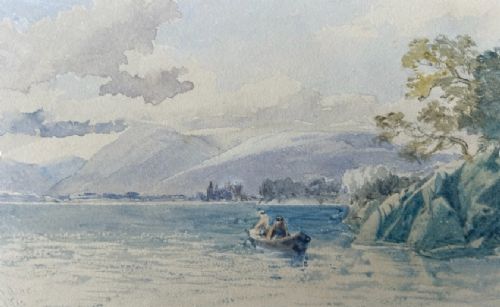
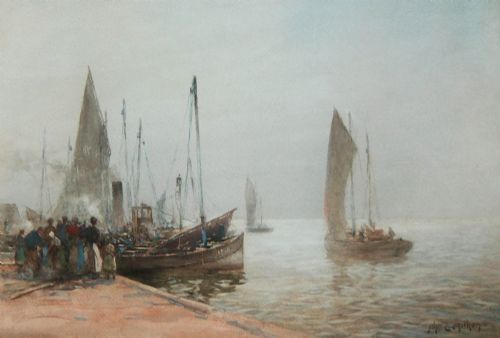
A muted grey watercolour painting typically captures British landscapes, coastal scenes, and town views created between the nineteenth and mid-twentieth centuries. The selections on this page encompass works by named artists depicting locations from Scottish lochs and Yorkshire dales to London landmarks and European harbours.
The dominant forms are fine art watercolours on paper, often framed with ink and watercolour pigment to render atmospheric weather conditions, winter snowscapes, and quiet rural settings. Most examples stem from established artistic movements including British Impressionism, the Barbizon School, and Modern British practices.
Materials and technique
These works rely fundamentally on watercolour pigment applied to paper surfaces, frequently supplemented with ink for definition and linear detail. Artists manipulated wash density and moisture levels on paper to achieve subtle tonal gradients, capturing overcast skies and muted coastal light.
Supports generally consist of traditional watercolour paper housed within wood frames. The application combines transparent washes with opaque pigments to build depth across landscapes, marine views, and genre scenes.
Materials documented across the works include watercolour pigment on paper, ink, and wood framing elements.
What varies in quality
Quality rests upon the artist's command of tone and atmospheric perspective, distinguishing works with assured brushwork from stiffer topographical records. The finest examples demonstrate a confident handling of pigment that creates genuine spatial depth within restricted colour palettes.
Condition and paper preservation also influence standing, particularly where fugitive pigments have retained their integrity or faded uniformly. The strength of composition and subtlety of tonal transition ultimately separate accomplished studio output from more routine topographical sketches.
Thomas Miles Richardson Jnr·James E. Aitken·Albert Ludovici Jnr·Fred Lawson·Arthur Reginald Smith·Cuthbert Crossley·Tom Clough·James Orrock·James Watson·Henri Joseph Harpignies·John Mitchell·A. G. Hayward·Ernest F. Hill·Edmund Morris Wimperis·Thomas James Lloyd·Rowland Henry Hill·Hirst Walker·Fred Mayor·William Lee Hankey·George Graham·Angus Rands·Robert Lesley Howey·Henry Charles Fox·William Collins·Henry John Sylvester Stannard
The Muted Grey Watercolour Painting Glossary
- Watercolour pigment
- Finely ground colour particles suspended in a water-soluble binder, applied to paper to create translucent washes.
- Wash
- A thin, fluid layer of diluted watercolour spread across paper to create smooth background tones or skies.
- Genre watercolour
- A painting depicting scenes from everyday life, featuring figures engaged in common daily activities.
- Monogram
- A motif made by overlapping or combining letters to form a logo or identifier used by the artist instead of a full signature.
- Barbizon School
- A nineteenth-century art movement focused on tonal realism, naturalism, and atmospheric landscape painting.
Muted Grey Watercolour Painting: Frequently Asked Questions
What subjects do these watercolours show?
The subjects range across British landscapes, coastal harbours, marine views, and street scenes. Many capture specific topographical locations in Yorkshire, Scotland, and London during different seasons.
Artists frequently recorded rural life, architectural landmarks, and weather effects such as snow and twilight. These varied regional viewpoints reflect the diverse travels and sketching grounds of British artists across multiple decades.
How should I hang watercolour paintings?
Watercolour paintings require protection from direct sunlight to prevent the pigments and paper from fading over time. Position them on interior walls away from direct windows and sources of excessive humidity.
Using conservation-grade framing materials helps maintain the stability of the paper support. Proper placement ensures the subtle tonal gradations remain clear for years to come.
How do I identify the period of a piece?
Periods can often be identified through the artist's active dates, stylistic traits, and framing conventions. Works from the Victorian era typically feature heavier detailing, while early twentieth-century pieces adopt looser impressionistic brushwork.
Signatures, monograms, and exhibition labels on the reverse provide further clues for dating. Comparing the technique to established movements like Modern British or British Impressionism clarifies the era.
What is the difference between marine and landscape watercolours?
Marine watercolours focus specifically on coastal scenes, harbours, shipping, and open sea views. They frequently incorporate maritime elements such as boats, tides, and coastal architecture.
Landscapes concentrate on inland topography, including valleys, rivers, fields, and rural architecture. Both genres utilise similar watercolour pigments and paper supports but emphasise distinct environments.