



British Architectural Watercolour
British architectural watercolour paintings record city streets, village cottages and ancient abbeys with fluid pigment on paper.
British Architectural Watercolour
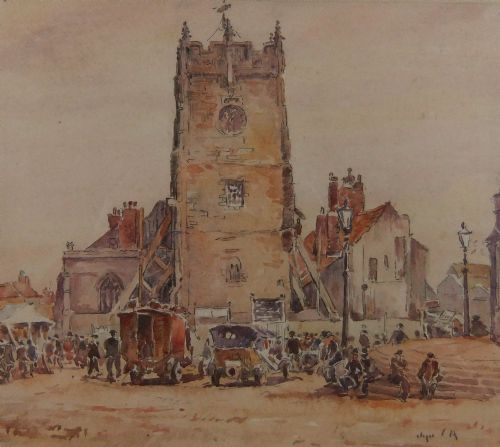
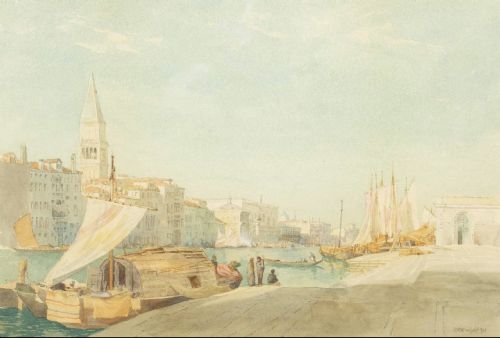
A british architectural watercolour captures built environments ranging from London street scenes and cathedral towers to Venetian canals and country houses. These works span periods from the nineteenth century through the 1960s, reflecting changing Victorian, Edwardian, and mid-century British artistic sensibilities. Buyers encounter townscapes, landscape settings with historic buildings, and detailed studies of stone structures.
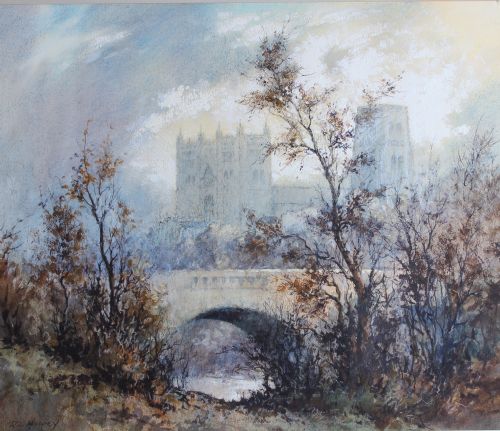
The most common pieces on this page originate from the early decades of the twentieth century, often framed and executed as standalone wall art. Creators document familiar landmarks like Durham Cathedral, York Minster, and London thoroughfares with observational precision. These paintings function as visual records of topography and architectural heritage.
Materials and technique
Artists apply watercolour pigment and ink onto paper supports, sometimes combining watercolour paint with acrylic or pencil to define sharp structural lines. The transparency of the medium permits washes of colour to build depth in stonework, skies, and shadows. Painters utilise the white of the unpainted paper to create highlights on building facades and reflective water surfaces.
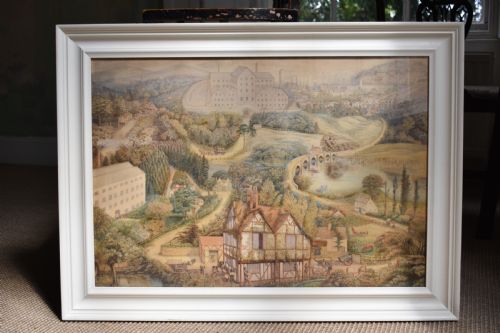
Framing typically involves wood and glass to protect the delicate paper surface from atmospheric moisture and handling. Ink drawings often provide the underlying framework before washes of watercolour pigment are applied to complete the composition. These water-based media require careful preservation to maintain the vibrancy of the pigments over decades.
Listings feature works created across eight distinct decades, spanning from the nineteenth century through the 1960s.
Assessing quality and execution
Quality rests upon the artist's ability to render perspective, scale, and architectural detail accurately within the fluid constraints of watercolour. Stronger works demonstrate confident brushwork and precise ink drawing that give stone, timber, and brick convincing weight and texture. Weaker examples rely on stiff outlines and flat washes that obscure the vitality of the scene.
The condition of the paper and the retention of pigment vibrancy heavily influence desirability. Pieces that survive with minimal fading and crisp paper integrity present the artist's intended atmosphere more successfully. Compositional balance between the architectural subject and its surrounding landscape further separates standard topographical records from accomplished fine art paintings.
Thomas Ellison·Richard Henry Wright·Robert Leslie Howey·Fred Lawson·Charles James Lauder·Rowland Henry Hill·Stanley Orchart·George Whyatt·Hercules Brabazon Brabazon·David Small·John Sowden·Jack Merriott·Tom Dudley·David Law·Noel Harry Leaver·Wilfred Knox·Beatrice Parsons·Annie L Lee
The British Architectural Watercolour Glossary
- Watercolour
- A paint consisting of pigment suspended in a water-soluble binder, applied to paper to create translucent washes of colour.
- Topography
- The detailed mapping and artistic representation of specific real-world locations, towns, and buildings.
- Diptych
- An artwork made of two separate painted panels or sheets designed to be displayed together as a single matched pair.
- Wash
- A thin, fluid layer of diluted watercolour pigment spread evenly across the paper to represent skies, water, or large background areas.
British Architectural Watercolour: Frequently Asked Questions
How do I care for an antique watercolour?
Keep the framed painting away from direct sunlight to prevent the watercolour pigments from fading over time. Ensure the room humidity remains stable to protect both the paper support and the wooden frame.
Avoid hanging these works in damp environments like kitchens or unventilated spaces. Professional framing with acid-free materials safeguards the paper from chemical degradation.
Were these watercolours meant for framing?
Most pieces were created as finished works of art intended for domestic display within interior spaces. Artists frequently exhibited or sold them fully mounted and framed behind glass to protect the delicate paper.
Smaller studies might have begun as travel sketches in portfolios before later receiving professional framing. Today, standard framing remains essential for preserving their physical integrity on a wall.
How can I tell a Victorian watercolour from a 1930s piece?
Victorian works often feature heavier, highly detailed Academic or British Impressionist stylings with dramatic lighting. Palette choices and framing styles also shift perceptibly as tastes moved from nineteenth-century realism toward mid-century British modernism.
Signatures, framing materials, and accompanying labels on the reverse often provide clues to the exact decade of creation. Comparing the architectural styles depicted can also help anchor the painting within a specific historical era.
What is the difference between a townscape and a landscape?
A townscape focuses primarily on streets, buildings, bridges, and urban infrastructure as the main subject of the composition. Architecture dominates the field of view, highlighting human-made structures over natural scenery.
A landscape places greater emphasis on natural topography, fields, rivers, and trees, with buildings appearing only as minor elements within the wider view.