

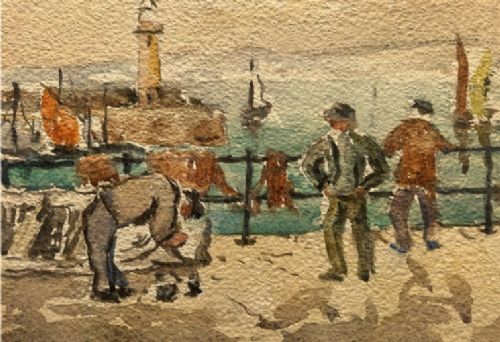

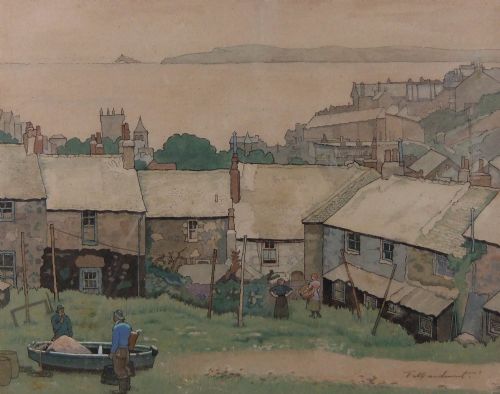
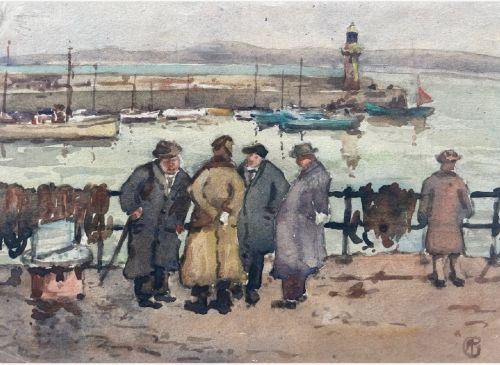


Original Cornish Watercolour Artwork
Original cornish watercolour artwork captures the shifting coastal light and rugged harbours of the West Country through sensitive washes on paper.
Original Cornish Watercolour Artwork
Original cornish watercolour artwork encompasses framed paintings and framed artwork depicting the harbours, coastal marine scenes, and rural village life of the West Country. These pieces emerge predominantly from the late nineteenth century through to the middle of the twentieth century, reflecting a rich regional artistic heritage.
The buyer frequently encounters maritime subjects such as trawling luggers and harbour rocks alongside inland village scenes. These works capture specific locations including St Ives, Looe, Polperro, and Lamorna.
Stylistically, these watercolours span Victorian fine art, Edwardian marine art, British Impressionism, and the output associated with the Newlyn School and St Ives School. Such watercolours offer a direct window into the coastal topography and working communities of historical Cornwall.
Materials and execution
These works are executed primarily using watercolour pigment and ink applied to paper surfaces, capturing transient atmospheric conditions with fluid washes. Artists utilised the white of the unpainted paper to create highlights of light on water and stone.
Surviving examples are preserved behind glass to protect the delicate pigments from moisture and fading. Many works retain their period framing, utilising wood or gilt wood surrounds that complement the palette of the painting.
Original Cornish Watercolour Artwork Retail Price Guide 2026
Typical asking prices for original cornish watercolour artwork among the pieces listed under this phrase on Sellingantiques today, from the lower quarter to the upper quarter. They describe what is for sale here now, not the wider market.
Listings span from 1890 through to 1940, encompassing Victorian, Edwardian, and early twentieth-century periods.
Evaluating quality and handling
Quality in these watercolours depends upon the sureness of the draftsmanship and the artist's ability to render the particular quality of West Country light. Finer works demonstrate a confident economy of brushwork, capturing movement in water and atmosphere without excessive reworking.
Condition plays a central role, distinguishing works that retain their original pigment vibrancy from those affected by light damage or foxing. The integration of period framing, particularly original gilt wood or timber surrounds, enhances the integrity of the piece.
William Banks Fortescue·Thomas Maidment·Frank Kelsey·George F Pennington·Richard Harry Carter·Frederick Stuart Richardson·William Lee Hankey·S J Lamorna Birch·Cuthbert Crossley·John Baragwanath King
The Original Cornish Watercolour Artwork Glossary
- Watercolour pigment
- Finely ground colour suspended in a water-soluble binder, applied in translucent washes to paper. This medium allows artists to build luminous layers of tone.
- Newlyn School
- An art colony based in a Cornish fishing village during the late nineteenth and early twentieth centuries. Artists focused on plein-air painting of local communities and coastal life.
- St Ives School
- A twentieth-century grouping of artists centred on the Cornish coastal town, embracing both traditional landscape representation and progressive modern idioms.
- Gilt wood
- Timber framing finished with a thin layer of gold leaf or metallic gilding. This traditional finish was frequently employed to frame fine watercolours of the Victorian and Edwardian periods.
Original Cornish Watercolour Artwork: Frequently Asked Questions
How should I display my watercolour?
Keep watercolours away from direct sunlight to prevent the pigments from fading over time.
Ensure they are hung in rooms with stable humidity levels to protect both the paper and the wooden frame.
What subjects are most common?
Coastal marine views, fishing luggers in harbour, and rural village scenes dominate this regional artwork.
Artists frequently depicted specific Cornish locations like St Ives, Polperro, and Lamorna.
How do I recognise the period?
Dating relies on stylistic markers ranging from Victorian academic precision to the looser brushwork of early twentieth-century Impressionism.
Framing materials and paper characteristics often align with the late nineteenth and early twentieth centuries.
Why is glass used on watercolours?
Glass protects the vulnerable paper surface and water-soluble pigments from airborne dust, moisture, and physical contact.
Traditional framing kept the glass slightly separated from the painting using a mount to prevent condensation.