
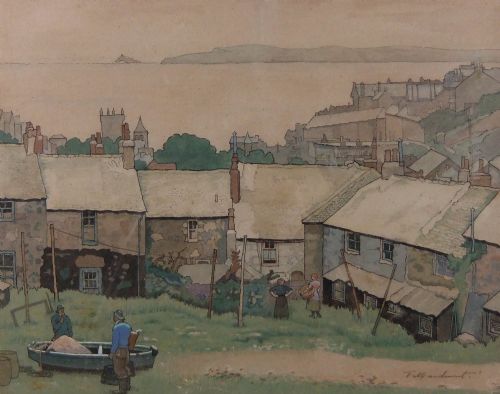


St Ives School Painting
These st ives school painting works capture the shifting light and rugged coastline of Cornwall through the eyes of coastal modernists.
St Ives School Painting
A st ives school painting captures coastal Cornish scenes, maritime views, and rural landscapes through early twentieth-century and mid-century movements. Buyers will find works ranging from early Newlyn School and British Impressionism to mid-century modernism and abstract compositions.
The selection on this page centres on original works on paper, board, and canvas, framed in wood. Subjects span from harbours and churches to still lifes and figurative studies.
Materials and Technique
Artists worked primarily in oil paint and watercolour, applying pigment to stretched canvas, wooden board, or heavy paper. These mediums allowed painters to record both rapid coastal sketches and built-up studio compositions.
Framing typically utilises simple wood frames that complement the modernist and impressionist palettes of the period without overpowering the artwork.
St Ives School Painting Retail Price Guide 2026
Typical asking prices for st ives school painting among the pieces listed under this phrase on Sellingantiques today, from the lower quarter to the upper quarter. They describe what is for sale here now, not the wider market.
Several artists painted with sand stuck firmly in their wet oils after working too close to the Cornish tide.
Evaluating Quality
Quality rests upon the strength of the composition, the handling of light and pigment, and the clarity of the artist's vision. Works that demonstrate a confident command of colour and brushwork stand apart from simpler decorative pieces.
Provenance and documented association with the Cornish artist communities also elevate an individual piece, reflecting the historical significance of the maker within the movement.
Joan Gillchrest·Tony Giles·Denis Mitchell·Adrian Heath·Fred Mayor·Frederick William Jackson·Cuthbert Crossley·Henry Silkstone Hopwood·J Titcomb·Hilda Freeman
The St Ives School Painting Glossary
- Watercolour
- A painting method in which the paints are made of pigments suspended in a water-based solution. It is typically applied to paper to achieve translucent layers of colour.
- Oil paint
- A slow-drying paint made by mixing pigments with a drying oil, most commonly linseed oil. This medium allows for rich texture and deep colour saturation on canvas or board.
- Canvas
- Heavy woven fabric stretched across a wooden frame to form a stable support for oil paintings. It remains the classic surface for durable studio works.
- Post-Impressionism
- An art movement that extended impressionism while rejecting its limitations, favouring a greater emphasis on symbolic content and structural brushwork.
St Ives School Painting: Frequently Asked Questions
What defines a st ives school painting?
These works are defined by their connection to the Cornish artist colonies, focusing on coastal landscapes, maritime life, and the development of British modernism. They bridge traditional impressionist observation and mid-century abstraction.
Artists drew direct inspiration from the distinct light and geography of the Cornish coast, producing pieces that range from early century watercolours to bold mid-century oils.
How should I care for a watercolour?
Watercolour paintings require protection from direct sunlight to prevent the fading of delicate pigments on paper. Framing under glass with acid-free mounts ensures the paper remains stable over time.
Keep these works in rooms with stable humidity and temperature to avoid warping the paper or degrading the backing materials.
Where were these paintings created?
The works originated in and around the fishing port of St Ives and neighbouring Cornish settlements where artist communities flourished. Painters gathered in these coastal towns to capture the local fishing fleets, rugged cliffs, and intimate street scenes.
Many of the creators trained at established institutions before settling permanently or working seasonally in Cornwall.
How do I identify the period of a work?
Dating relies on stylistic clues, framing materials, and the documented lifespan of the artist recorded on the canvas or reverse. Early twentieth-century pieces often lean towards impressionism, while works from mid-century show modernist or abstract tendencies.
Examine the back of the board or stretcher bars for signatures, dates, or old gallery labels that place the work in its historical context.