

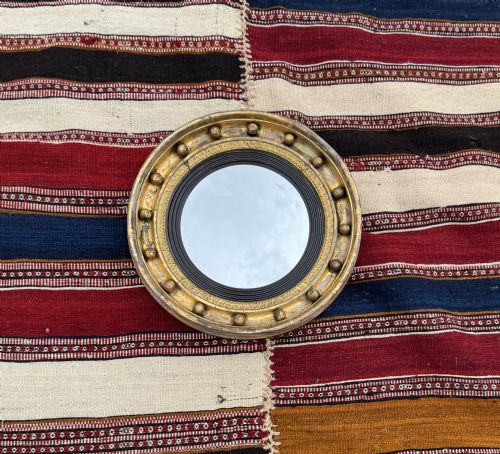
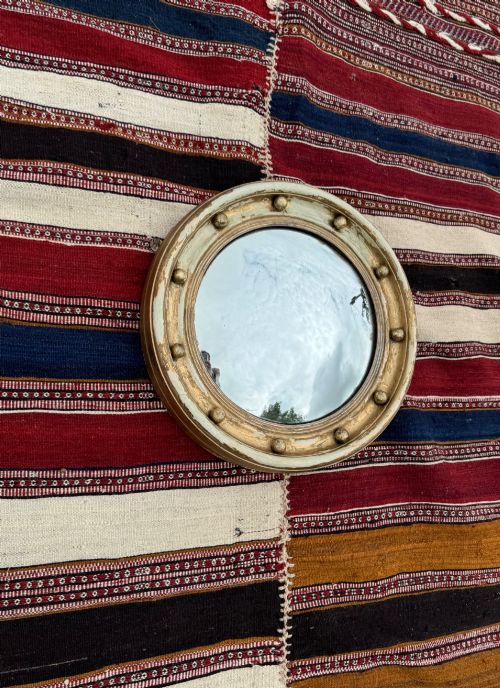


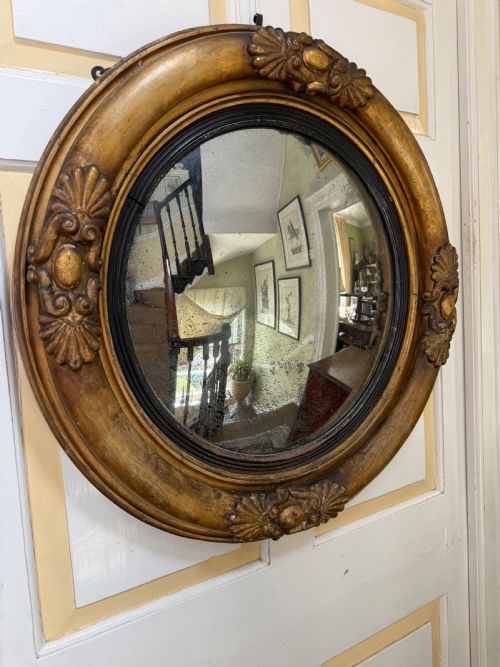


Convex Fish Eye Mirror
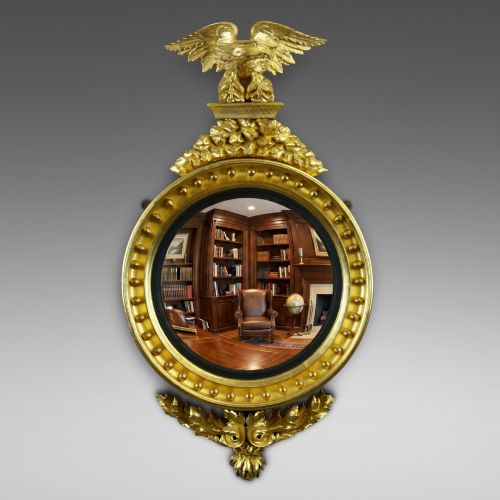
A convex fish eye mirror bends the room into a deep sphere of light, drawing the eye across the entire interior.

Convex Fish Eye Mirror
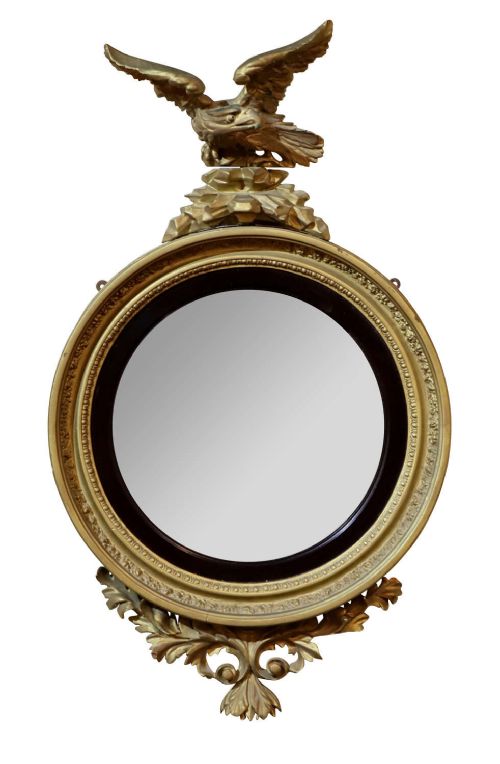
A convex fish eye mirror gathers a whole room into a single circular glass plate, offering a unique perspective on interior spaces. The pieces gathered here belong predominantly to the Regency, Georgian, and Victorian eras, alongside later revivals from the twentieth century.
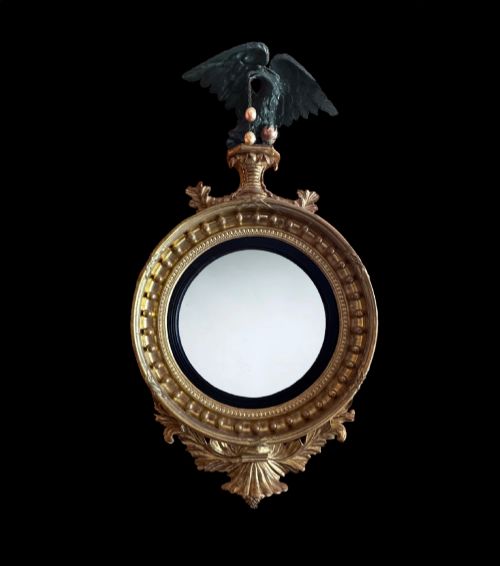
Most examples take a circular form framed in giltwood or gesso, frequently featuring detailed crests like carved eagles or candle arms known as girandoles. Smaller hall mirrors and larger wall-hung variants appear across the selection, showing how these objects served both decorative and practical purposes in domestic interiors.
Materials and Construction
Makers shaped these frames from wood, applying layers of gesso before gilding them with gold leaf to achieve a brilliant metallic finish. Some examples incorporate ebonised wood or japanned surfaces, introducing dark contrasts to the reflective glass.
The curved mirror glass itself relies on specialist blowing and silvering techniques to maintain an even distortion across the circular plate. Carved details such as eagle surmounts or foliate scrolls were fixed directly to the wooden armature before finishing.
Listings feature periods spanning from the Georgian and Regency eras through the Victorian age up to the 1930s.
Assessing Quality
The clarity and depth of the curved glass plate set finer examples apart from later commercial adaptations. A well-preserved gilt surface retains its original warmth and crispness in the carved mouldings without heavy re-gilding.
Structural integrity in the heavy wooden frame and the secure seating of the mirror plate indicate superior workshop execution. Finer pieces demonstrate careful proportion between the circular frame and decorative crests like eagles or girandole arms.
The Convex Fish Eye Mirror Glossary
- Giltwood
- Wood coated with a thin layer of gold leaf applied over a prepared gesso ground. This finish provides the characteristic bright metallic appearance seen on period frames.
- Gesso
- A plaster-like mixture applied to wooden frames to create a smooth surface for carving and gilding. It allows for crisp ornamental details.
- Girandole
- A wall mirror fitted with candle branches attached to the frame. The curved glass reflects the candlelight back into the room.
- Ebonised
- Wood treated to imitate ebony, producing a dense black finish. It offers a stark contrast to gilded ornaments.
Convex Fish Eye Mirror: Frequently Asked Questions
Where should I hang a convex mirror?
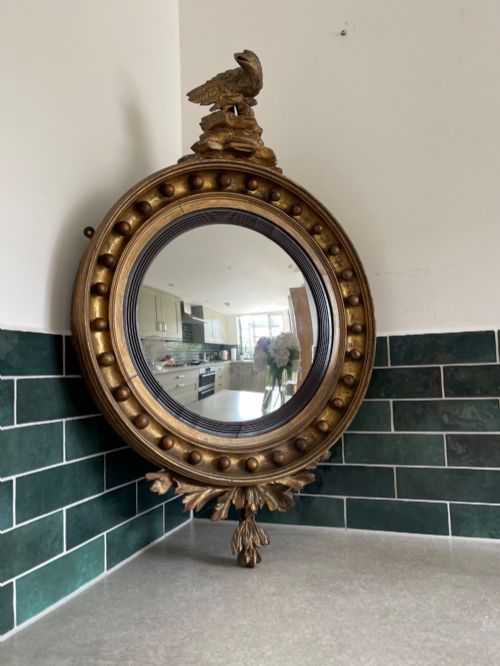
These mirrors work best on a principal wall where they can capture the light and movement of an entire room. Placing them opposite a window maximises the panoramic reflection.
Because of their optical distortion, hanging them at eye level allows viewers to appreciate the compressed perspective of the surrounding space.
How do I date a convex mirror?
Dating relies heavily on the style of the frame, the application of the gesso, and the characteristics of the mirror glass. Regency examples often feature reeded ebony inner bezels and prominent crests.
Later Victorian and twentieth-century revivals tend to display simplified mouldings and machine-finished timber or glass that lack early hand-worked irregularities.
What is an eagle surmount?
An eagle surmount is a carved wooden bird perched on top of the mirror frame, a popular decorative motif during the Regency period. These birds usually stand on a rocky outcrop with chains or foliage hanging down the sides.
Symbolically, the bird added a sense of majesty and status to the room while visually balancing the heavy circular frame below.
How do I clean convex mirror glass?
Dusting the glass gently with a soft, dry cloth prevents the accumulation of dirt without scratching the delicate silvered surface. Avoid using harsh chemical sprays that might seep behind the frame and damage the backing.
Care should also be taken around the giltwood frame, as moisture can lift the original gesso and gold leaf layers.