
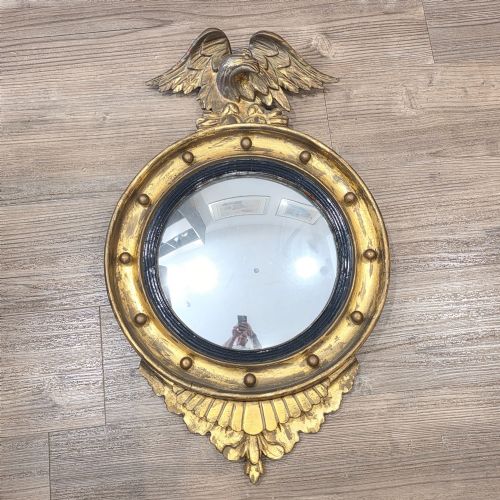
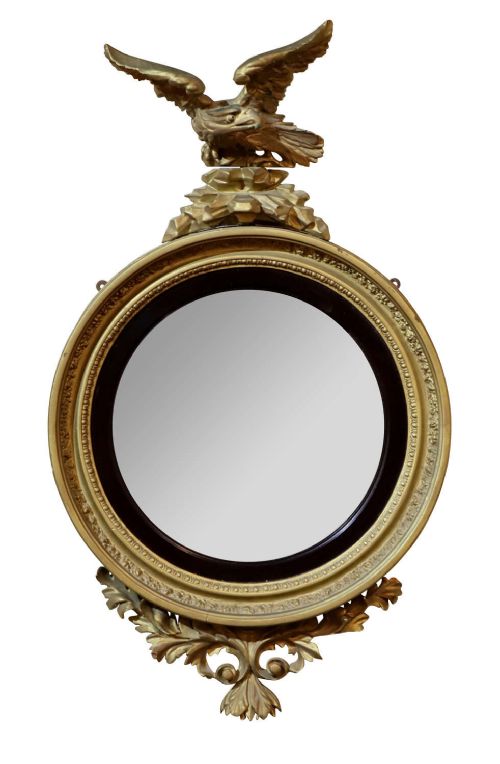
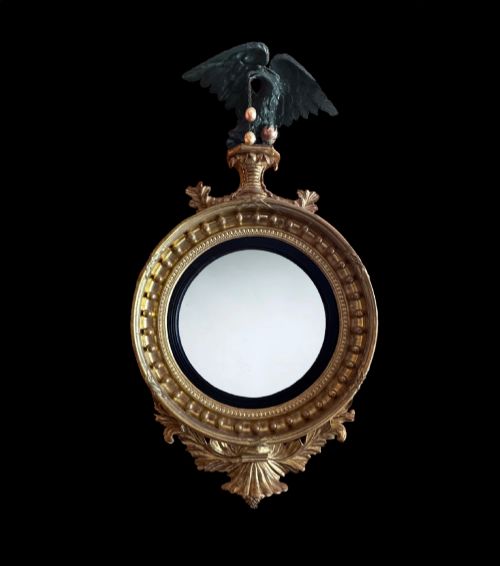

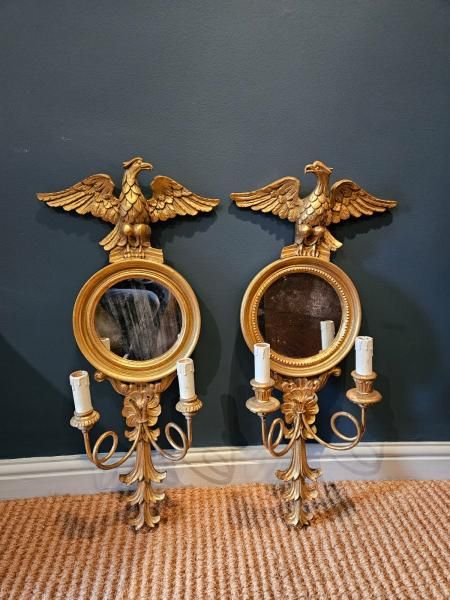
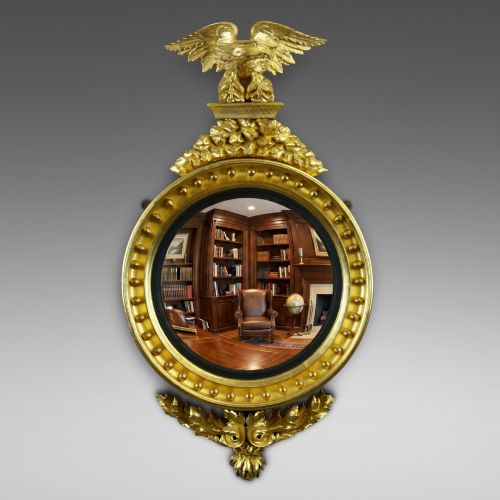
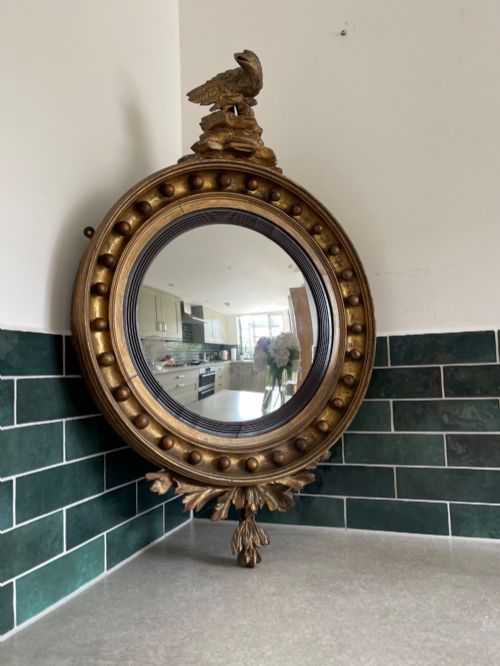


Carved Eagle Convex Mirror
A carved eagle convex mirror brings dramatic focal depth and historic grandeur to any interior wall.

Carved Eagle Convex Mirror
A carved eagle convex mirror is a striking circular wall glass designed to distort and widen the reflection of a room while commanding attention through sculptural ornament. The most common version met here is the Regency giltwood circular convex mirror topped with a spread eagle surmount. These pieces originate primarily from the Regency and Georgian periods, continuing into Victorian and 19th Century revivals.
The form typically combines a round frame with a bowed glass plate, sometimes fitted with candle arms known as girandoles. Wall mirrors and wall sconces appear across the selection, with dating stretching from the Georgian era through the 1920s. Buyers look for these items to anchor a room with period character and reflective light.
Materials and construction methods
Makers built these frames using timber, ebonised wood, and brass, applying gesso to create crisp details before finishing the surface in giltwood. Mirrored glass provides the curved reflective surface, housed within circular mouldings that often feature ball details around the perimeter.
Carving the eagle surmount required skilled handwork to shape the wings and body perched atop the frame. The combination of carved wood, applied gesso, and gold leaf defined the standard workshop practice of the Regency and 19th Century periods.
Listings demonstrate that while Regency and 19th Century pieces dominate, examples extend from the Georgian era through Victorian times and into the 1920s.
Evaluating the range of quality
Quality rests upon the crispness of the wood carving and the depth of the giltwood finish. Master carvers rendered the spread eagle and framing elements with vigorous detail, whereas lesser examples show softer, flatter modelling in the gesso and timber.
The preservation of the original mirrored glass and the proportion of the eagle surmount relative to the circular frame dictate the visual balance of the piece. Superior examples maintain intact gilding layers and well-proportioned girandole arms where fitted.
The Carved Eagle Convex Mirror Glossary
- Convex mirror
- A round wall glass with an outward-curving surface that reflects a wide, fish-eye view of the interior. This form was popular during the Regency and Georgian eras for illuminating dark corners.
- Giltwood
- Timber covered with a thin layer of gold leaf applied over a gesso ground. It creates the characteristic metallic sheen seen on period frames.
- Gesso
- A plaster-like mixture applied to timber frames to build up a smooth surface for carving and gilding. It allows for intricate relief ornamentation.
- Girandole
- A wall mirror fitted with attached candle sconces. The candle arms multiply the reflected light in a room.
- Surmount
- The decorative element mounted at the very top of a mirror frame. In these pieces, it takes the form of a carved eagle.
Carved Eagle Convex Mirror: Frequently Asked Questions
How do I hang a heavy convex mirror safely?
These frames carry substantial weight due to the timber, gesso, and glass construction. Secure the hanging wire or bracket directly into wall studs using appropriate hardware.
Avoid relying solely on plaster walls to support the load, and ensure the hanging point matches the central balance of the circular frame.
What is the best room for a convex mirror?
Dining rooms, hallways, and living spaces benefit most from the wide-angle reflection these glasses provide. Placing them opposite a window captures maximum light and projects a miniature view of the entire interior.
Position the mirror at eye level to make full use of the curved perspective.
Why do these mirrors feature an eagle?
The eagle surmount served as a popular patriotic and neoclassical motif during the Georgian and Regency periods. It added height and architectural authority to the round frame.
Symbolically, the bird represented strength and vigilance in domestic interiors.