




Colonial Writing Box
A colonial writing box provides a portable desk for travel, fashioned in distant territories during the nineteenth century from dense hardwoods and fitted with metal mounts.
Colonial Writing Box
When you search for a colonial writing box, you encounter portable desks and storage chests made for travel during the nineteenth century, including the Victorian and Regency periods. The forms range from simple writing slopes and correspondence boxes to larger metamorphic lap desks and deed chests.
The pieces on this page are most commonly Anglo-Indian or Ceylonese in origin, reflecting the distant outposts of the British Empire where they were constructed. Makers utilised local timbers to build robust boxes intended to withstand the rigours of transport by sea and land.
The selection includes specialised variations such as stationery boxes, workboxes, and campaign chests designed to hold writing materials alongside jewellery and sewing gear. These objects combine utilitarian brass bindings with intricate regional ornamentation.
How they were made
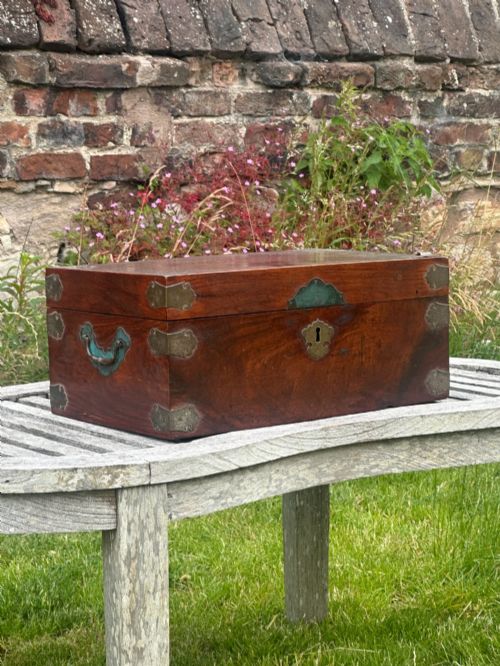
Cabinet makers constructed these boxes from heavy tropical timbers such as teak, padouk, camphor wood, and ebony, which resisted the humidity of tropical climates. These dense woods provided a stable foundation for intricate surface decoration and heavy metal hardware.
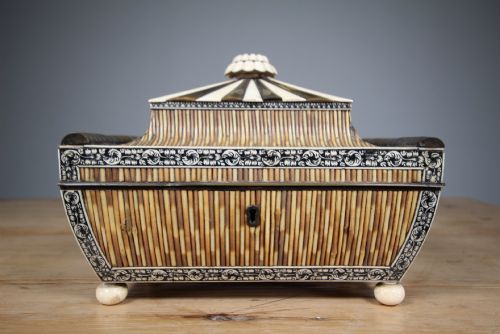
Workshops applied decorative elements including porcupine quill, bone, antler, and ivory inlay, alongside carved wood motifs characteristic of Anglo-Indian and Ceylonese craftsmanship. Brass binding and inset carrying handles were screwed into corners and edges to protect the wood during military campaigns and travel.
Anglo-Indian, Ceylonese, and Victorian styles dominate the selection of writing slopes and correspondence chests.
What varies in quality
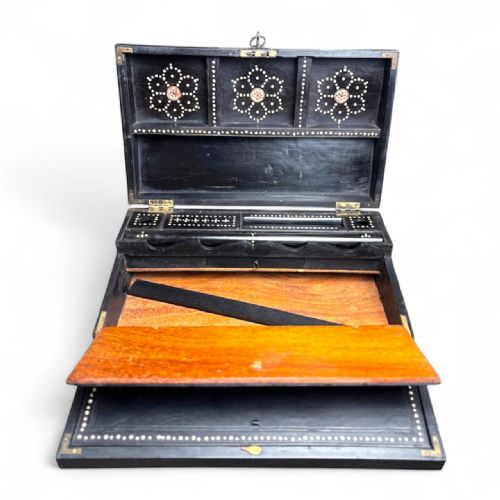
The grade of a piece depends upon the complexity of its interior fittings, such as secret drawers, concealed compartments, and roll-top mechanisms found in superior campaign slopes. Simpler deed boxes offer robust construction with fewer internal complexities.
Finishing details separate standard boxes from finer examples, notably the precision of brass corner reinforcement and the intricacy of bone or porcupine quill inlay. The choice of primary timber also influences character, with dense ebony and figured coromandel sitting at the higher end of the material scale compared to standard utility woods.
The Colonial Writing Box Glossary
- Campaign box
- A portable desk or chest built with recessed brass handles and corner brackets to withstand military transport.
- Writing slope
- A hinged box that opens to reveal an angled writing surface lined with leather or velvet, plus inkwell compartments.
- Padouk
- A heavy, durable tropical hardwood with a reddish hue utilised by cabinet makers in nineteenth-century workshops.
- Porcupine quill
- Strips of quill arranged in geometric patterns beneath glass panels on the exterior of Ceylonese boxes.
- Metamorphic
- Descriptive of a box that transforms through folding mechanisms into an expanded desk or multi-use storage chest.
Colonial Writing Box: Frequently Asked Questions
What is a colonial writing box?
A colonial writing box is a portable desk made in nineteenth-century outposts of the British Empire for officials and military officers on the move.
These boxes open to provide an angled surface for correspondence, accompanied by compartments for inkwells, pens, and paper.
How were campaign boxes used?
Campaign boxes served as travelling desks and storage chests for officers who needed to write letters and maintain records during postings abroad.
Their brass bindings and flush handles protected the timber and contents while travelling on ships and carriages.
How do I identify Anglo-Indian boxes?
Anglo-Indian boxes are identified by the use of regional timbers like teak, padouk, and ebony, combined with carved decoration or inlay.
Many examples incorporate bone, ivory, or porcupine quill alongside brass mounts that indicate production in places such as Ceylon or India.
What is inside a writing slope?
A writing slope contains a folding writing surface that opens to reveal compartments for stationary, stamps, and nibs.
Finer examples also conceal secret drawers behind false partitions or incorporate roll-top mechanisms.
Where were these boxes built?
These boxes were constructed in nineteenth-century workshops across regions influenced by British trade and administration, notably India and Ceylon.
Local craftsmen adapted traditional cabinet-making methods to suit European tastes using native hardwoods.