




Anglo Indian Writing Box
An anglo indian writing box brings dense exotic timbers and meticulous regional craftsmanship directly to a gentleman's desk.
Anglo Indian Writing Box
An anglo indian writing box takes many forms across the nineteenth century, including campaign slopes, correspondence chests, and stationery boxes. These pieces emerge from the intersection of British colonial administration and local artisan traditions in regions such as Ceylon, Vizagapatam, and Mandalay.
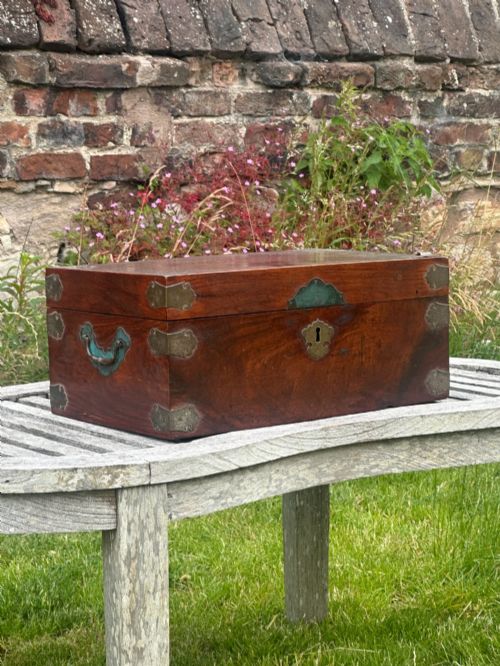
The most common version met on this page is the nineteenth-century writing box in solid ebony, teak, or padouk. These items were built for travel or official correspondence, combining sturdy internal compartments with elaborate exterior decoration.
Materials and Technique
Cabinetmakers utilised heavy tropical timbers like teak, padouk, ebony, and sandalwood to construct the carcase. These dense woods resist warping and provide a dark, uniform ground for decorative elements.
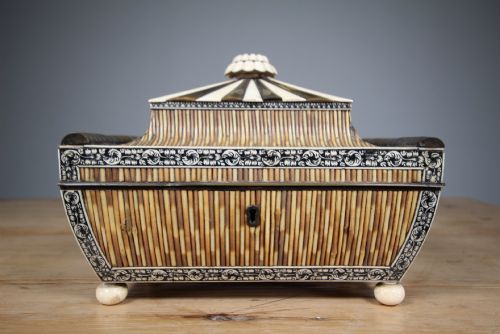
Craftsmen applied contrasting inlays of bone, ivory, brass, and porcupine quill into the wooden surfaces. Brass banding and corner mounts reinforced the structure for military or maritime transport.
The listings on this site record woods including teak, ebony, padouk, coromandel, sandalwood, and camphor wood.
Distinctions in Execution
The precision of the inlay work separates standard utility pieces from exceptional examples. Fine boxes display intricate geometric Sadeli mosaic or deeply carved foliage that integrates seamlessly with the timber.
The selection and figuring of the primary wood dictate the visual weight of the box. Highly polished coromandel, padouk, or dense ebony with intact brass mounts represent the upper tier of execution.
The Anglo Indian Writing Box Glossary
- Campaign box
- A portable chest or slope designed for military or travel use, fitted with flush brass handles and reinforced corners. These items allowed officers to maintain paperwork while on the move.
- Porcupine quill
- The sharp defensive spine of the rodent, utilised in Ceylonese workshops as a decorative veneer. Artisans arranged these quills in radial or linear patterns behind glass or protective frames.
- Sadeli mosaic
- A micro-mosaic technique native to Vizagapatam and Bombay, employing minute triangles of horn, bone, and metal. This work creates intricate, repetitive geometric bands around box lids and edges.
- Writing slope
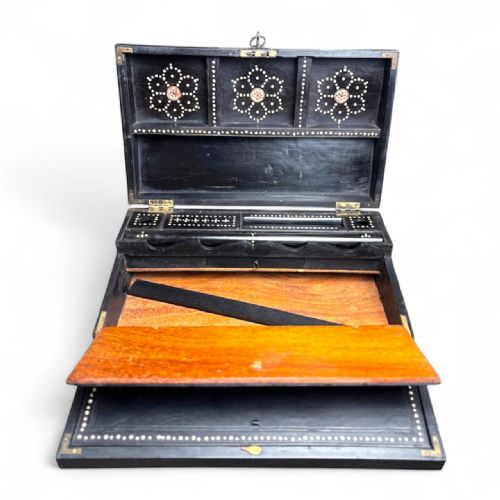
- A hinged desk accessory that opens to reveal an inclined writing surface lined with leather or velvet. Interior compartments hold inkwells, pens, and stationery.
Anglo Indian Writing Box: Frequently Asked Questions
How were these boxes used?
Owners used these boxes to store writing paper, pens, inkwells, and important documents. The sloping lid provided a firm surface for writing letters by hand.
Many examples include hidden drawers, secret compartments, and heavy brass locks to protect private papers and valuables during transit.
How do I date an anglo indian box?
Dating relies on timber choices, brass hardware styles, and the complexity of the inlay work. Nineteenth-century examples often feature heavy brass bound edges and campaign handles.
Earlier Regency pieces tend toward sarcophagus shapes, while later Victorian items incorporate intricate sandalwood carving or porcupine quill decoration.
Where were these pieces made?
These boxes originated across the Indian subcontinent and surrounding regions, including Ceylon, Vizagapatam, Mandalay, and Bombay. Local workshops adapted British furniture designs to showcase indigenous materials.
Cabinetmakers utilised regional resources like porcupine quills, sandalwood, and ivory alongside imported hardwoods.