



Roll Top Writing Slope
These roll top writing slope examples combine clever Victorian mechanics with sturdy campaign timbers for daily correspondence.
Roll Top Writing Slope
A roll top writing slope is a portable or fitted desk featuring a flexible tambour or cylinder top that conceals the writing surface and interior compartments. Buyers searching for a roll top writing slope typically encounter Victorian campaign pieces and stationary boxes designed for travel or domestic study.
How they were made
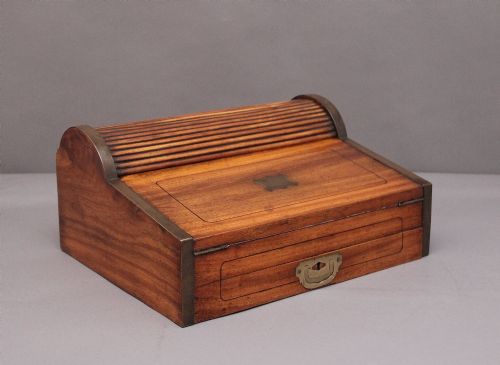
Cabinetmakers constructed these pieces using dense hardwoods such as camphor wood and mahogany, often reinforced with brass corners for travel durability. Interiors frequently incorporate contrasting satinwood or leather writing surfaces.
The flexible roll top mechanism relies on tightly joined wooden slats sliding smoothly within curved grooves. Parquetry and fine inlay work appear on refined domestic examples, distinguishing them from utilitarian campaign items.
Roll Top Writing Slope Retail Price Guide 2026
Typical asking prices for roll top writing slope among the pieces listed under this phrase on Sellingantiques today, from the lower quarter to the upper quarter. They describe what is for sale here now, not the wider market.
The listings feature nineteenth-century pieces spanning the Victorian and Edwardian periods, constructed in camphor wood, mahogany, oak, and burr walnut.
What varies in quality
Quality rests in the precision of the tambour mechanism and the crispness of the timber selection. Superior examples maintain smooth sliding action in the roll top and feature uncompromised brass fittings.
The choice of secondary woods and the intricacy of internal stationery fittings also separate standard utility boxes from finely detailed campaign and colonial pieces.
The Roll Top Writing Slope Glossary
- Tambour
- A flexible shutter made of narrow strips of wood glued to canvas, allowing it to slide around a curve. This mechanism forms the distinctive roll top on desks and writing boxes.
- Campaign
- Furniture designed to dismantle or fold easily for military officers on active service. These pieces typically feature recessed brass handles and corner brackets.
- Davenport
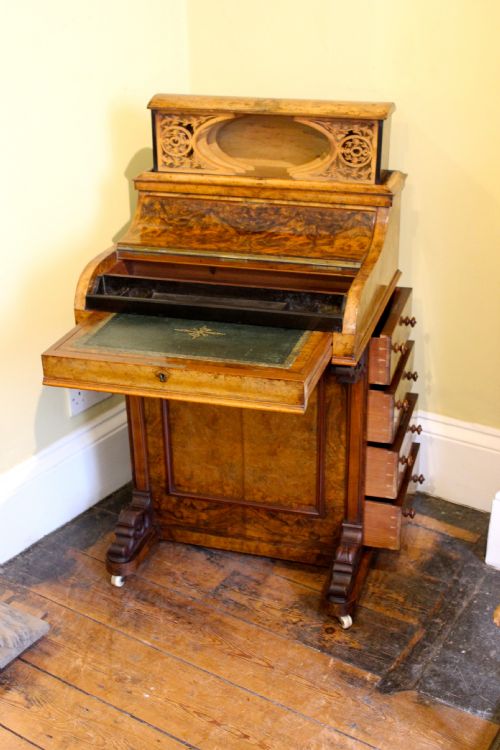
- A small compact desk featuring a sloping writing surface above a pedestal of drawers. It gained popularity during the Victorian era for domestic correspondence.
- Parquetry
- Geometric patterns formed by fitting small wooden tiles together. It creates decorative surfaces on miniature desks and fine stationery cabinets.
Roll Top Writing Slope: Frequently Asked Questions
How do roll top writing slopes work?
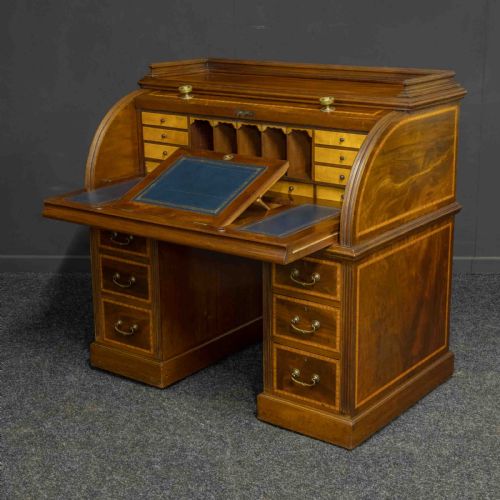
These pieces use a flexible tambour shutter that slides along curved tracks to cover the desk interior. Pushing the roll top back reveals pigeonholes, small drawers, and the main writing surface.
Many examples include locking mechanisms that secure the entire desk when the shutter is closed.
What is the difference between campaign and domestic slopes?
Campaign versions are built from robust timbers like camphor wood and feature heavy brass mounts for transport. They are designed to withstand travel and variable climates.
Domestic models often showcase decorative veneers such as burr walnut, mahogany, or parquetry intended for static study use.
How do I care for nineteenth-century writing slopes?
Keep these wooden pieces away from direct heat sources and sudden humidity changes to protect the tambour tracks and veneers. Regular light polishing with appropriate wax preserves the historic finish.
Avoid over-tightening brass fittings and treat the sliding shutter gently to maintain its alignment.
Can these desks be used for modern writing?
The internal compartments suit modern stationery, pens, and small tablets. The sloping surfaces provide a comfortable angle for reading and handwriting notes.
While original leather surfaces require gentle treatment, they remain fully functional for daily correspondence.