



Colonial Carved Cupboard
These colonial carved cupboard pieces bring intricate craftsmanship and rich timber grain to an interior.

Colonial Carved Cupboard
A colonial carved cupboard brings together domestic storage forms and dense, regional ornamentation from varied global trading posts and empires. When searching for a colonial carved cupboard, buyers encounter sideboards, cabinets on stand, corner cupboards, and chiffoniers from the seventeenth to the early twentieth century.
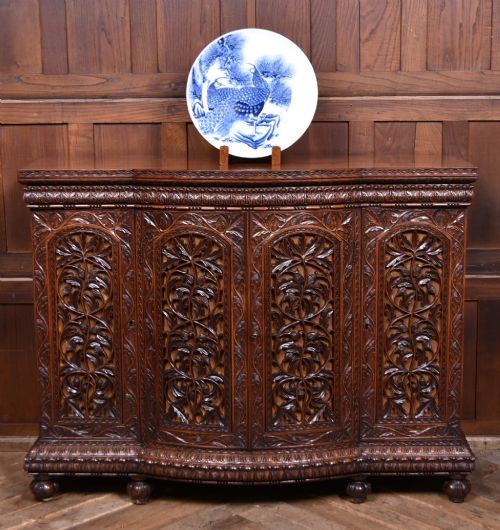
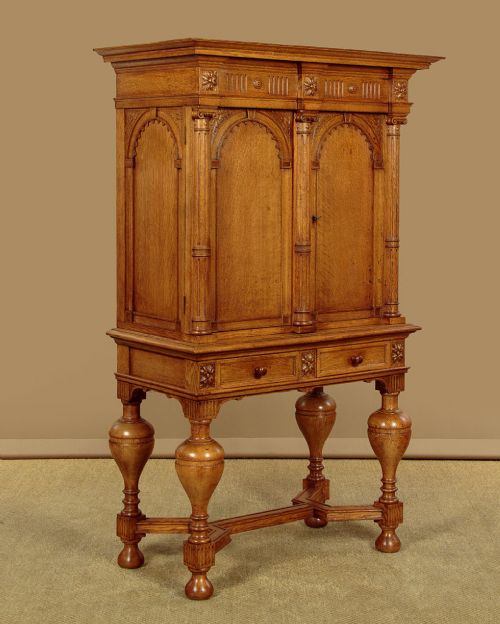
The Anglo-Indian and Burmese examples dominate the selection, showing deep relief carving on tropical hardwoods. Other pieces reflect Dutch, Portuguese, and Spanish Renaissance influences adapted by local craftsmen using native timbers.
Forms range from miniature linen presses and corner cabinets to large sideboards and veranda gin cabinets. These pieces served practical storage and display functions in colonial households while incorporating elaborate regional decorative vocabularies.
Materials and construction methods
Makers utilised dense tropical timbers such as teak, padouk wood, rosewood, and satinwood alongside European oak. These hardwoods provided stable foundations capable of supporting deep, chiselled surface carving without losing structural integrity.
Surface decoration relies on manual relief carving, often covering doors, panels, and friezes with floral or geometric motifs. Secondary details sometimes incorporate contrasting materials like bone inlay and brass hardware to accentuate the timber.
A veranda gin cabinet stands ready for tropical refreshment.
Assessing quality in carved furniture
Quality rests upon the crispness and depth of the manual carving across the timber surface. Finer examples display sharp undercutting and fluid design execution rather than shallow, mechanical scoring.
The selection of the timber grain and the stability of the joinery further distinguish superior pieces. Uniform colour in the teak, padouk, or satinwood and tightly fitted structural joints mark the higher tier of production.
The Colonial Carved Cupboard Glossary
- Padouk wood
- A heavy, dense tropical timber with a reddish hue used frequently in nineteenth-century cabinet making. It accepts intricate relief carving exceptionally well.
- Cabinet on stand
- A freestanding storage compartment elevated on an open frame or base. This form lifts the main decorative body to eye level.
- Vargueno
- A traditional Spanish cabinet form featuring a drop-front writing flap concealing small drawers. It often sits upon a dedicated architectural stand.
- Chiffonier
- A compact sideboard or cabinet equipped with drawers and shelves for storing table service. The form gained popularity during the nineteenth century.
- Linen press
- An upright wardrobe or cupboard designed originally for storing folded textiles and garments. Miniature versions served specialised domestic storage needs.
Colonial Carved Cupboard: Frequently Asked Questions
Where were these cupboards made?
These pieces originate from various global regions touched by European trade and colonisation, including India, Burma, and Ceylon. Local workshops combined European furniture forms with indigenous carving traditions.
The resulting objects reflect distinct cultural syntheses, utilising regional hardwoods and specific decorative motifs native to those overseas posts.
How do I care for tropical hardwood?
Tropical hardwoods require stable indoor humidity levels to prevent timber movement or cracking in the dense grain. Regular dusting with a soft cloth maintains the finish without moisture damage.
Avoid placing these cabinets near direct heat sources or strong sunlight. Occasional gentle waxing helps preserve the lustre of woods like padouk and satinwood.
What rooms suit a carved cabinet?
These cabinets work effectively in living rooms, dining spaces, or studies as focal storage furniture. Their rich timber tones and detailed relief work anchor neutral or traditional interior schemes.
Smaller formats such as corner cupboards or side tables fit into tighter circulation areas while providing functional surface space.
How do I date these pieces?
Dating relies on examining construction techniques, secondary woods, and stylistic crossover between European forms and regional carving. Nineteenth-century examples often combine heavier carcase construction with dense botanical relief.
Earlier seventeenth-century items show distinct Spanish or Dutch Renaissance architectural proportions and hardware. Comparing the timber species and joinery style clarifies the period of manufacture.