


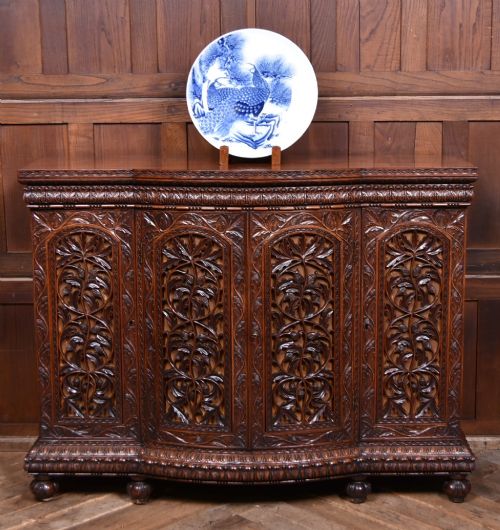


Anglo Indian Carved Credenza
An anglo indian carved credenza brings dense foliage and deep tropical grain into a room, offering heavy timber storage with a distinct colonial lineage.
Anglo Indian Carved Credenza
An anglo indian carved credenza spans sideboard, cabinet, and bookcase forms originating across the nineteenth century, including specific dates such as eighteen eighty and eighteen sixty alongside Victorian and Regency periods.
Buyers encounter sideboards, side cabinets, and chiffoniers most frequently on this page, reflecting the heavier utilitarian furniture exported or produced during the British colonial era.
The aesthetic bridges British furniture forms with intricate South Asian carving traditions, resulting in substantial storage pieces built for domestic display.
Materials and Construction
Workshops utilised dense tropical hardwoods, predominantly padouk wood, teak, rosewood, and solid satinwood, often paired with marble tops for durability and surface contrast.
Cabinetmakers constructed these pieces with heavy timbers carved deeply by hand, featuring intricate foliate motifs and structural elements like inverted breakfront pedestals.
Anglo Indian Carved Credenza Retail Price Guide 2026
Typical asking prices for anglo indian carved credenza among the pieces listed under this phrase on Sellingantiques today, from the lower quarter to the upper quarter. They describe what is for sale here now, not the wider market.
Materials appearing across the inventory include padouk wood, teak, rosewood, hardwood, solid satinwood, and marble.
Judging Quality and Execution
The standard of carving dictates the visual success of the piece, separating crisp, deep relief work from softer or shallower execution across the wood surface.
Timber selection and the integration of secondary elements, such as fitted marble tops, determine the overall substance and refinement of individual cabinets.
The Anglo Indian Carved Credenza Glossary
- Padouk wood
- A dense, reddish-brown tropical timber prized for its stability and rich grain. It served as a primary material for nineteenth-century colonial cabinetmakers.
- Inverted breakfront
- A cabinet facade where the central section recedes rather than projects. This configuration adds architectural depth to pedestal sideboards.
- Chiffonier
- A compact sideboard or tall cabinet equipped with doors enclosing shelves. Nineteenth-century examples often served to store dining silver or linens.
- Victorian Gothic Revival
- A nineteenth-century design movement drawing on medieval architectural motifs. Certain pieces combine these pointed arches with colonial carving techniques.
Anglo Indian Carved Credenza: Frequently Asked Questions
What is an anglo indian carved credenza?
It is a heavy storage piece, typically a sideboard or cabinet, made in the nineteenth century using tropical timbers like padouk and teak.
These pieces combine traditional British furniture shapes with intricate hand-carved ornamentation characteristic of colonial workshops.
Which woods were used for these cabinets?
The listings show padouk wood, teak, rosewood, hardwood, and solid satinwood.
Some examples also incorporate marble surfaces into their upper design.
How do I date an anglo indian carved credenza?
Dating relies on stylistic markers from the nineteenth century, including specific periods like Victorian and Regency.
Certain items carry more precise documentation such as eighteen eighty or eighteen sixty.
Where should I place a credenza in my home?
These substantial sideboards and cabinets suit dining rooms, large hallways, or living spaces requiring significant surface area and closed storage.
Their dense timbers and dark grain anchor a room visually.