


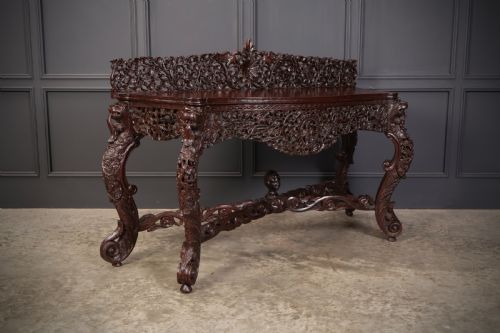


Pierced Carved Wood Sideboard
A pierced carved wood sideboard brings dense foliage and deep relief from nineteenth-century workshops straight into a modern dining room.
Pierced Carved Wood Sideboard
A pierced carved wood sideboard combines deep relief ornamentation with practical storage, originating in nineteenth-century colonial workshops. These pieces emerge from Anglo-Indian and Anglo-Burmese traditions, where local craftsmanship met British domestic forms to produce heavy, decorative furniture.
The version most commonly met on this page is a nineteenth-century example fashioned from padauk or rosewood. They appear as sideboards, cabinets, and console tables, frequently displaying intricate openwork foliage alongside fitted doors and brass hardware.
How they were made
Dense tropical timbers such as padauk, teak, rosewood, and hardwood form the structural foundation of these items. Artisans carved these heavy woods by hand, executing complex pierced designs that required exceptional skill to avoid splitting the material.
Assembly often incorporated traditional joinery supplemented by brass elements, while select examples integrated marble tops. The intense manual labour involved in undercutting the carved foliage created the characteristic layered depth visible across the panels and doors.
Pierced Carved Wood Sideboard Retail Price Guide 2026
Typical asking prices for pierced carved wood sideboard among the pieces listed under this phrase on Sellingantiques today, from the lower quarter to the upper quarter. They describe what is for sale here now, not the wider market.
Even the backboards received attention, proving that nineteenth-century carvers expected nobody to push their heavy sideboards flat against a wall.
What varies in quality
The crispness and depth of the hand-carved relief separate standard items from superior works. Finer examples display undercut foliage with distinct, sharp edges rather than rounded, shallow incisions.
Timber selection and grain consistency dictate the overall weight and presence of the furniture. Dense, dark rosewood and figured padauk achieve a richer finish than mixed hardwoods treated with heavy stains.
The Pierced Carved Wood Sideboard Glossary
- Padauk
- A dense, heavy tropical hardwood prized for its reddish-brown colour and durability. It takes a fine finish and resists decay.
- Pierced carving
- A technique where timber is cut entirely through to create openwork patterns. This method produces intricate shadows and a lightweight visual effect on heavy furniture.
- Anglo-Indian
- A descriptive term for nineteenth-century furniture made in India for British residents or export. It merges British furniture forms with traditional Indian carving motifs.
- Chiffonier
- A compact sideboard or cabinet equipped with drawers and shelves. Victorian examples frequently feature enclosed storage beneath a raised superstructure.
Pierced Carved Wood Sideboard: Frequently Asked Questions
What is an Anglo-Indian sideboard?
An Anglo-Indian sideboard is a nineteenth-century storage piece made in India for British colonial homes. It combines familiar European proportions with dense local woodcarving.
These items typically employ heavy tropical timbers like padauk and feature intricate foliage motifs carved in high relief across the doors and frame.
How do I care for padauk furniture?
Padauk furniture requires minimal intervention to maintain its rich surface and natural oils. Keep the timber away from direct heat sources and sudden humidity shifts to prevent cracking.
Apply a soft beeswax periodically and buff gently with a dry cloth. Avoid chemical sprays that strip the antique finish.
How do I date a carved wooden cabinet?
Dating a carved wooden cabinet relies on examining the timber species, construction methods, and stylistic influences. Nineteenth-century examples often utilise padauk, rosewood, or teak combined with hand-cut joinery.
Look at the interior secondary woods, backboards, and hardware fixings for signs of period manufacture. Wear patterns on the feet and handles also indicate age.