

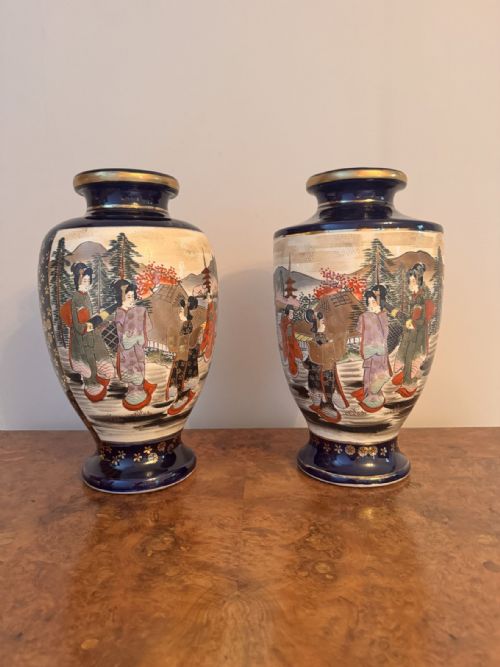
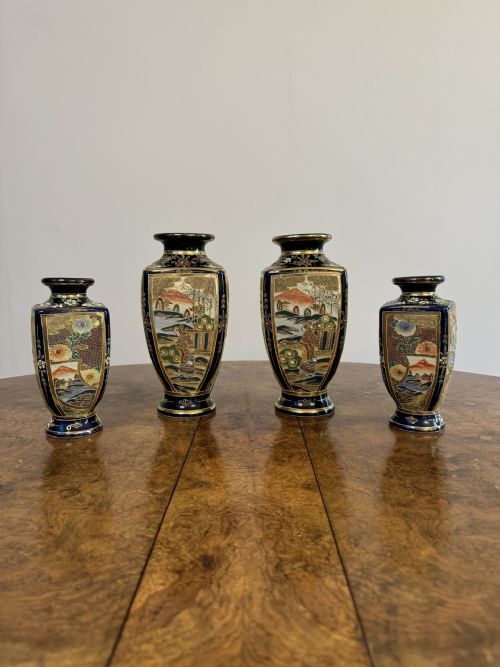


Cobalt Blue Satsuma Urns
Cobalt blue satsuma urns are striking Japanese earthenware vessels defined by deep blue grounds and intricate gilding, drawing collectors who value historic craftsmanship.
Cobalt Blue Satsuma Urns
Cobalt blue satsuma urns represent a specific subset of Japanese ceramic production from the Meiji period, Victorian era, and around 1900. These decorative vases and garniture sets display rich blue grounds complemented by hand-painted court figures, religious scenes, and landscape panels.
Buyers encounter single vases, matched pairs, and larger garnitures across these listings. Originating primarily from Kyoto and associated workshops, the pieces combine traditional Japanese forms with the detailed aesthetic demanded by late nineteenth-century export markets.
The dominant style on this page spans the Meiji period, featuring earthenware bodies heavily decorated with gold leaf, gilt, and enamel work. Understanding these origins helps distinguish genuine nineteenth-century output from later decorative wares.
How they were made
Makers utilised earthenware bodies as the foundation for these vessels, applying a distinct glaze to achieve the characteristic cobalt ground. This rich blue surface provides the contrast necessary for subsequent hand-painted details and decorative panels.
Artisans applied heavy gold gilt and gold leaf in raised patterns known as moriage. This technique builds tactile relief on the surface, framing court figures and landscapes with intricate metallic detailing.
Cobalt Blue Satsuma Urns Retail Price Guide 2026
Typical asking prices for cobalt blue satsuma urns among the pieces listed under this phrase on Sellingantiques today, from the lower quarter to the upper quarter. They describe what is for sale here now, not the wider market.
What varies in quality
The precision of the hand-painted court figures and landscape panels separates standard production from superior examples. Skilled brushwork and refined facial expressions indicate workshops operating at a higher artistic level.
The application and density of the gold leaf and moriage relief also define the grade of a piece. Heavier, more complex gilding combined with deep cobalt glazes marks out the top tier of these Japanese earthenwares.
Kinkozan·Kinkozan Circle·Nanzan
The Cobalt Blue Satsuma Urns Glossary
- Satsuma
- A type of Japanese earthenware traditionally featuring a fine, cream-coloured crackle glaze that serves as a canvas for elaborate overglaze enamel and gilt decoration.
- Moriage
- A ceramic technique where clay is piped onto the surface of a vessel to create raised decorative patterns before glazing and firing.
- Garniture
- A set of matching vases or urns designed to be displayed together symmetrically on a mantelpiece or sideboard.
- Meiji Period
- The era in Japanese history spanning from 1868 to 1912, noted for significant export ceramic production directed towards Western markets.
- Enamel
- Opaque or transparent glass-like substances fused to the ceramic surface through firing to impart vibrant colour to figures and floral motifs.
Cobalt Blue Satsuma Urns: Frequently Asked Questions
What are cobalt blue satsuma urns?
These pieces are Japanese earthenware vases and garniture sets featuring deep cobalt blue grounds, often decorated with gold gilt, moriage relief, and hand-painted figural panels.
Produced during the late nineteenth century and the Meiji period, they reflect the intersection of traditional Japanese pottery techniques and international export aesthetics.
How were these vases used?
They functioned primarily as decorative display items within late Victorian interiors, often arranged as pairs or larger garnitures on mantelpieces.
Their ornate presentation made them status symbols for collectors seeking examples of exotic craftsmanship.
How do I live with them?
Place them in stable locations away from direct sunlight and heavy foot traffic to protect their delicate enamel and raised gold leaf decoration.
Keep them away from moisture and clean only with a soft, dry cloth to preserve the historic earthenware and glaze.
How can I tell the period?
Examine the style of the hand-painted panels, the weight of the moriage, and any maker marks present on the base of the vessel.
Pieces originating from the Meiji period or late Victorian era typically exhibit distinct glaze characteristics and refined brushwork associated with known Kyoto workshops.