


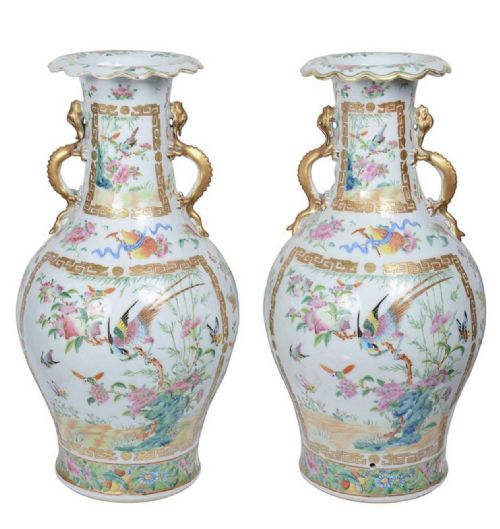
Oriental Gilt Display Vases
Oriental gilt display vases bring intricate painted detail and rich metallic highlights to a room.
Oriental Gilt Display Vases
Oriental gilt display vases encompass decorative vessels originating from Asian traditions, designed primarily for visual impact rather than utilitarian use. These pieces often feature elaborate painted scenes enriched with gold leaf or gold gilt applied across earthenware and porcelain bodies.
Buyers browsing this selection encounter numerous examples from the nineteenth century, including pieces spanning the Meiji and Edo periods as well as Chinese export wares. Common forms range from monumental lidded jars to miniature cylindrical vases and hexagonal Satsuma shapes.
The aesthetic leans heavily towards intricate figural processions, court scenes, and religious panels framed by dense floral patterns. Such items serve as focal points in traditional and eclectic interiors alike.
How they were made
Potters shaped these vessels using earthenware and fine porcelain bodies, often forming them into complex multi-sided structures or large display jars. Artisans then applied foundational layers of enamel, lacquer over black paint, or cobalt ground before working the surface.
Gilding techniques involved the careful application of gold leaf and gold gilt to accent specific motifs, figures, and borders. Relief work such as moriage added tangible texture beneath the metallic highlights, creating a layered visual depth.
Listings feature periods spanning the 1870s through the Edwardian era, predominantly showcasing Japanese Satsuma, Imari, and Chinese export styles.
What varies in quality
The degree of refinement in the painted figures and landscape panels separates standard decorative items from exhibition-quality works. Superior examples display exceptionally steady brushwork and finely rendered facial expressions within crowded processions.
The weight and application of the gold gilt also indicate the tier of the piece, with heavier, more deliberate gilding marking superior craftsmanship. Additionally, the crispness of form in moulded elements like bamboo-handle shapes or hexagonal rims defines the standing of the vessel.
Chosei·Seiko-en Chokei·Hododa·Kinkozan
The Oriental Gilt Display Vases Glossary
- Satsuma
- A type of Japanese earthenware featuring a crackled ivory-coloured glaze, typically decorated with polychrome enamels and extensive gold gilt. It became widely exported during the late nineteenth century.
- Moriage
- A ceramic technique where slip is piped onto the surface to create raised decorative details and textures, frequently highlighted with gold. This method gives the vessel a tangible, three-dimensional quality.
- Imari
- A style of Japanese porcelain named after the port from which it was shipped, traditionally characterised by a palette of underglaze blue, iron red, and added gold. These wares often display complex floral and geometric brocade patterns.
- Cloisonne
- An enamelling technique where metal wires are soldered to a base to form compartments, which are then filled with coloured paste and fired. The resulting surface presents distinct cells of colour divided by thin metallic lines.
Oriental Gilt Display Vases: Frequently Asked Questions
Where were these vases made?
These decorative vessels originate primarily from Japanese and Chinese ceramic traditions, produced in notable potting regions and export centres during the nineteenth and early twentieth centuries.
Craftsmen in kilns such as those associated with Satsuma and Arita created these pieces to satisfy international demand for ornate, highly gilded display objects.
How do I care for gilt vases?
Maintenance requires gentle handling to protect the delicate enamel work and fragile gold leaf or gilt highlights from abrasion. Dusting should be performed dry with a soft, clean brush rather than liquid cleaners.
Positioning the vessels away from direct sunlight and areas of high humidity helps preserve the integrity of the painted surfaces and lacquer elements.
How do I distinguish Satsuma from Imari?
Satsuma wares are typically earthenware characterised by a warm, crackled ivory glaze and dense polychrome figures enhanced with raised moriage and heavy gold. These pieces are meant for display rather than holding liquids.
Imari pieces are hard-paste porcelains that utilise a distinct palette of deep cobalt blue and iron red, often accented with gold in geometric and floral arrangements rather than crowded figural scenes.
What period do most pieces belong to?
The majority of the available vessels date from the nineteenth century, encompassing the later Edo period and the extensive Meiji period in Japan. Victorian and Edwardian cataloguing terms frequently apply to pieces imported into Britain during those eras.
Signatures, marks, and specific stylistic traits such as exhibition-quality Moriage help narrow down the production decade.