



Cobalt Blue Open Salts
Cobalt blue open salts bring a flash of rich colour to the table, pairing bright metal frames with deep glass liners.
Cobalt Blue Open Salts
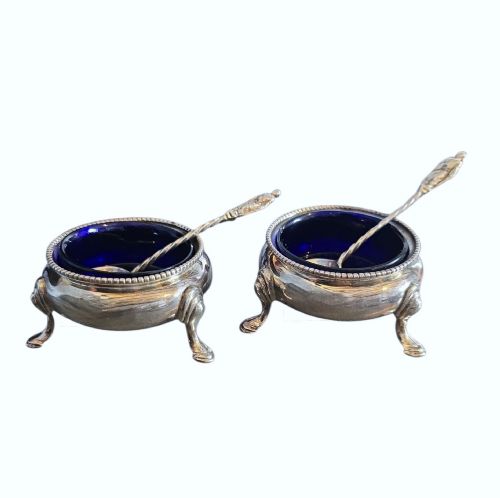
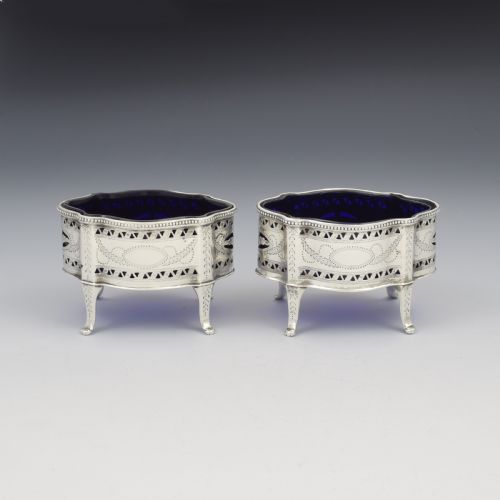
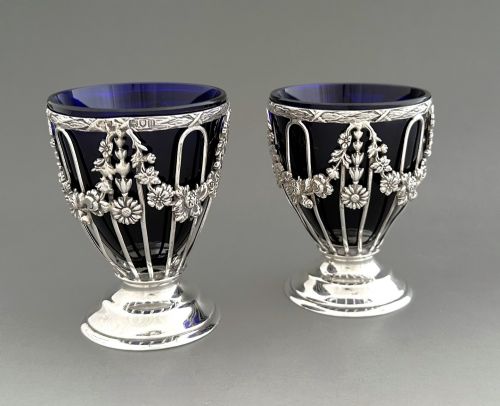
Cobalt blue open salts are small table vessels designed to hold loose salt for individual diners before the widespread use of free-flowing table salt. When you search for cobalt blue open salts, you encounter small glass liners paired with silver or silver-plated frames, ranging from simple boat shapes to pierced wirework designs.
The pieces on this page span the eighteenth century, the Victorian era, the Edwardian period, and the nineteen-thirties, reflecting diverse craftsmanship across several generations of dining history. Most examples take the form of pairs or sets of four, often accompanied by miniature spoons for serving.
Victorian and Georgian styles dominate the selections, alongside Georgian Revival and Art Deco interpretations from later decades. You will frequently find these small salt cellars described as table salts, condiment tubs, or open salts.
How they were made
Makers fashioned the glass inserts to fit snugly inside pierced or solid silver bodies, sometimes including original spoons of matching metalwork. Hallmarks stamped onto the sterling silver elements provide definitive markers of origin and date, while plated versions rely on base metals coated with a layer of silver.
Cobalt Blue Open Salts Retail Price Guide 2026
Typical asking prices for cobalt blue open salts among the pieces listed under this phrase on Sellingantiques today, from the lower quarter to the upper quarter. They describe what is for sale here now, not the wider market.
Dining guests once navigated formal meals with tiny silver spoons that look remarkably like shovels for miniature coal.
What varies in quality
Quality rests upon the crispness of the metalwork, the weight of the silver frame, and the brilliance of the cobalt glass liner. Intricate wirework and hand-pierced serpentine galleries demand greater skill from the silversmith than plain boat-shaped vessels.
Complete sets featuring matching components and original glass liners hold distinct character compared to assembled groups. The presence of matching hallmarked spoons further elevates the integrity of an antique set.
Beare Falcke
The Cobalt Blue Open Salts Glossary
- Open salt
- A small vessel designed to hold salt on the dining table for guests to pinch or spoon onto their food. These pieces lack shaker lids and rely on a removable glass liner.
- Glass liner
- A small insert, typically blown in a deep cobalt hue, that sits inside a metal frame to protect the silver from corrosion caused by salt. Liners are custom-fitted to the dimensions of each individual salt cellar.
- Wirework
- Metalwork formed from thin strands or wires soldered together into geometric or open patterns. This technique creates a lightweight, airy frame around the glass insert.
- Serpentine
- A curved shape featuring alternating convex and concave sweeps along the rim or body. This outline adds visual movement to Victorian table salts.
- Sterling silver
- A silver alloy containing a specific proportion of pure silver and other metals to ensure durability. British pieces feature hallmarks indicating this standard.
Cobalt Blue Open Salts: Frequently Asked Questions
What are cobalt blue open salts?
These small vessels served salt to individual diners at the formal dining table before the invention of moisture-resistant table salt. They combine a metal frame with a deep blue glass insert.
Dining etiquette of past centuries required guests to spoon or pinch salt from these open containers onto the edge of their plates.
How were open salts used?
Servants placed the salt cellars around the dining table, often one between every two guests, accompanied by a tiny spoon. Diners transferred a small portion of salt to their plates for seasoning food.
They remained a fixture of formal dining until shaker bottles transformed everyday table settings in the twentieth century.
How do I care for silver salts?
Remove the glass liner before cleaning the silver frame to prevent moisture from becoming trapped between the metal and the glass. Wash the cobalt glass gently in warm soapy water.
Polish the silver frame with a soft cloth and a reputable silver polish, taking care to avoid abrasive materials that might scratch the metal or glass.
Are original glass liners important?
Original glass liners add authenticity and ensure a correct fit within the antique metal framework. Because glass easily chips or cracks over centuries of use, surviving original liners are valued by collectors.
Replacement liners can serve a practical purpose, but matched period glass completes the historical integrity of the piece.