

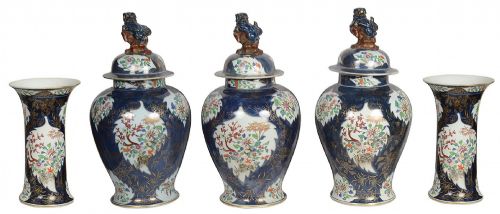


Cobalt Blue Garniture
A cobalt blue garniture brings symmetry and striking colour to a mantelpiece, usually arriving as a matched trio or pair of vases alongside a central clock.

Cobalt Blue Garniture
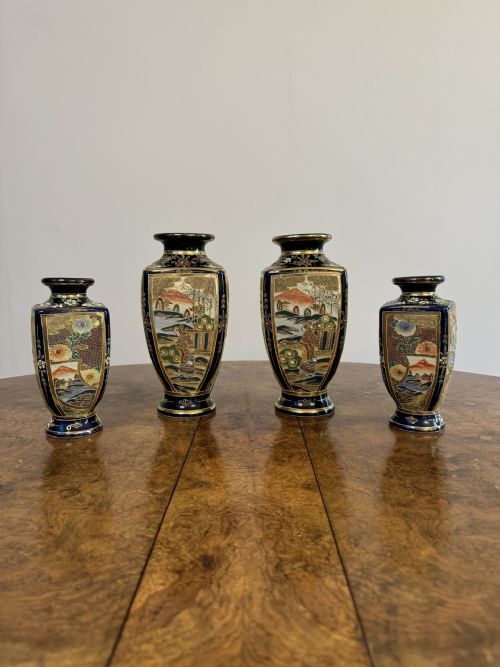
A cobalt blue garniture comprises a set of matching decorative vessels or clock sets designed to be displayed together on a mantelpiece or sideboard. These arrangements frequently appear in 19th Century French porcelain, alongside Japanese Imari and Satsuma sets from around 1900.
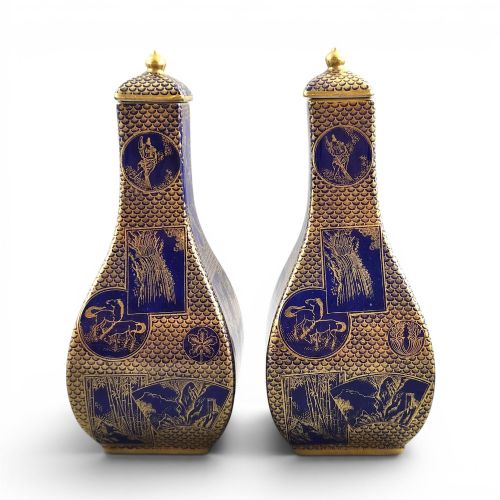
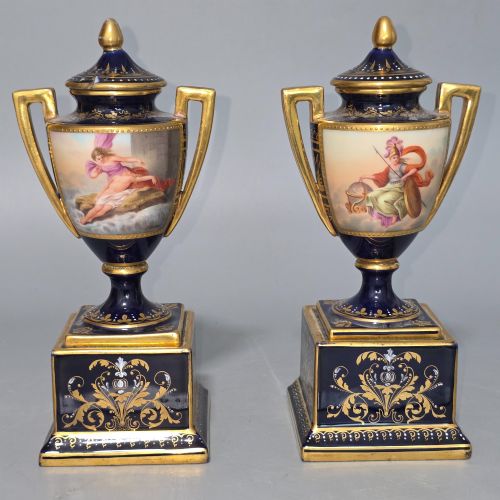
The form spans sets of three or four vases, pairs of lidded urns, and three-piece clock garnitures incorporating candelabra or side vases. Continental porcelain and earthenware pieces often utilise deep blue grounds to anchor decorative schemes involving gilding and painted scenes.
Buyers encounter Victorian interpretations of French designs, alongside genuine Japanese export wares produced during the Meiji and Edo periods. Each configuration provides a balanced focal point that reflects historical interior decoration preferences.
Materials and construction methods
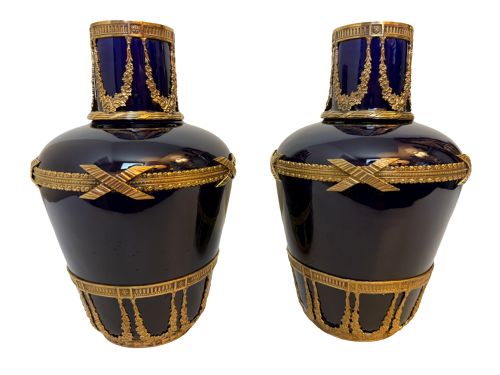
Makers shaped porcelain, earthenware, and glass bodies before applying rich cobalt glazes and enamel pigments by hand. Metal components such as ormolu, gilt bronze, and gold leaf were cast and chased to mount the ceramic vessels and clock housings.
Firing techniques allowed cobalt oxide to fuse into the glaze, producing deep blue tones that withstood high temperatures. Artisans then applied gilding and enamel details over the glaze before secondary firings fixed the surface ornamentation.
Mantel clocks in these sets often required regular winding just to keep the vases company in silence.
Distinctions in quality and execution
The standard of hand-painted detail and the precision of the ormolu mountings dictate the tier of a set. Finer examples display crisp ciselure on the metal mounts and meticulous brushwork on the porcelain panels.
Completeness and matching provenance strongly influence the standing of a garniture. Sets retaining their original covers and uniform glaze coloration command greater appreciation than assembled groupings.
Mason's Patent Ironstone·Thomas Steel·F. Koller
The Cobalt Blue Garniture Glossary
- Garniture
- A set of matching vases or ornaments designed for symmetrical display on a mantelpiece or furniture top. They typically comprise three or more matching pieces, sometimes incorporating a clock.
- Ormolu
- Gilded brass or bronze mounts applied to the base, handles, and rims of ceramic vases and clock cases. The technique was widely utilised by French makers during the nineteenth century.
- Imari
- Japanese export porcelain decorated in underglaze blue, iron red, and gold, highly influential on European ceramic decoration. Pieces from the Edo and Meiji periods frequently display this palette.
- Bleu de Roi
- A deep, rich royal blue enamel ground colour developed at the Sèvres porcelain factory. It provides a dark backdrop for gilt ornamentation and painted reserves.
Cobalt Blue Garniture: Frequently Asked Questions
What is a clock garniture?
A clock garniture is a matched set consisting of a mantel clock flanked by two matching side pieces, such as vases or candelabra. These sets were designed to sit together as a decorative unit on a fireplace mantel.
They coordinate in material, style, and colour scheme, frequently featuring porcelain bodies with ormolu mounts.
How do I display a garniture set?
Garniture sets look best arranged symmetrically on a wide mantelpiece, sideboard, or console table. The tallest piece, often a clock or central urn, sits in the middle with the matching vases placed evenly on either side.
Maintaining the original groupings ensures the visual balance intended by the maker.
How can I tell French porcelain from Japanese export wares?
French porcelain pieces from the nineteenth century typically feature European classical or floral motifs paired with ormolu mounts, frequently imitating Sèvres styles. Japanese pieces from the Meiji or Edo periods rely on distinctive palettes like Imari or Satsuma earthenware characteristics.
Examining the paste, glaze characteristics, and base markings helps identify the regional origin of the ceramics.
Are all garniture pieces made of porcelain?
While porcelain is the most common material for these decorative sets, other mediums do appear. Makers also utilised earthenware, glass, and ironstone as the primary bodies for vases and clocks.
Metal components in ormolu, gilt bronze, and gold leaf frequently accompany these materials to form the completed objects.