


Coastal Castle Artwork
Coastal castle artwork captures the moody drama of fortress ruins standing firm against the sea.
Coastal Castle Artwork
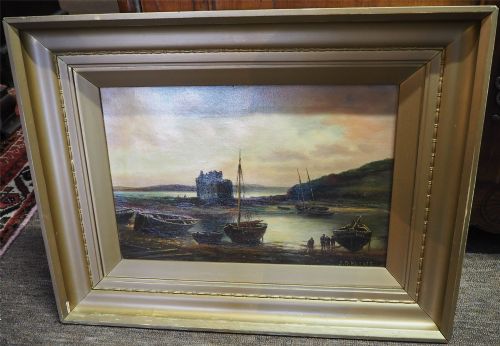
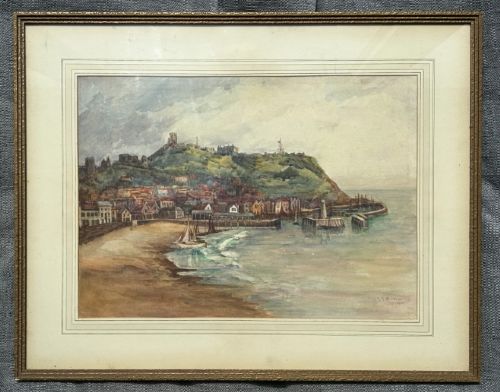
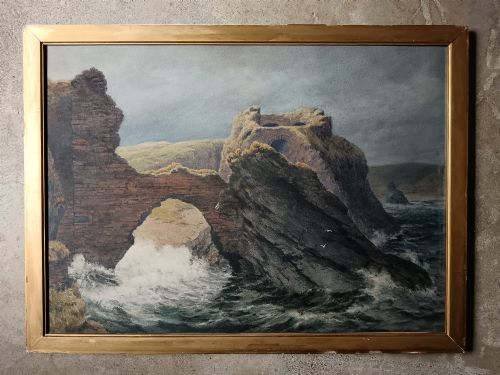
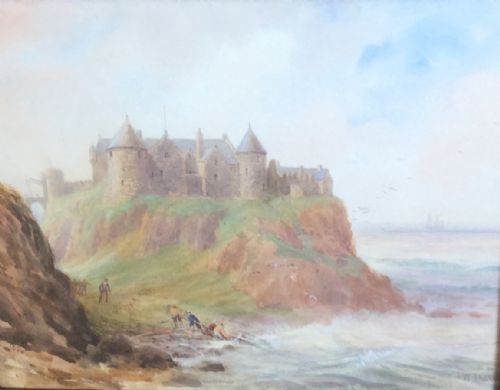
Coastal castle artwork encompasses fine art paintings and watercolours depicting medieval strongholds and coastal fortifications set against marine landscapes. These works frequently record historic British and European locations such as Bamburgh, Conwy, Dunluce, and Scarborough.
The selections available range from intimate nineteenth-century watercolours on paper to large country house oil paintings on canvas. Victorian and Edwardian examples dominate the offerings, bringing maritime drama and architectural history together.
Artists often frame these scenes with fishing boats, sandy beaches, or crashing shipwrecks to heighten the sense of isolation and resilience. Buyers encounter both signed works by known regional artists and atmospheric attribution pieces from British and Dutch schools.
Materials and Techniques
Painters of these coastal scenes relied primarily on oil on canvas or watercolour paint applied to paper. Canvas works often sit within ornate gesso and giltwood frames that reflect the formal presentation of nineteenth-century drawing rooms.
Watercolours utilise delicate washes to capture shifting mists, sea spray, and coastal light, occasionally heightened with gum arabic for depth. Oil paintings employ layered brushwork to build the rugged textures of stone walls and turbulent seas.
Several artists clearly preferred painting ruins while standing in the cold North Sea spray.
Evaluating Quality
Quality rests upon the artist's ability to render the atmosphere of the coastline alongside the structural integrity of the stone fortification. Skilled hands achieve convincing atmospheric perspective, capturing the damp salt air and shifting light.
The handling of secondary details, such as rigging on fishing boats or the geological strata of cliffs, distinguishes superior compositions. Original frames, particularly period giltwood surrounds, add substantial contextual value to the canvas.
F A Roylance·John Moxon·George Gregory·George Morland·Claude Thomas Stanfield Moore·Frank Wood·Willie Stephenson·William Edward Webb·Rowland Henry Hill·Joseph William Carey
The Coastal Castle Artwork Glossary
- Giltwood
- Wood carved and coated with gold leaf, frequently used for ornate nineteenth-century picture frames. This finish protected the timber while providing a luminous border for dark oil paintings.
- Gesso
- A plaster-like mixture applied to wooden frames as a smooth base for gilding. It allows intricate relief moulding around the edges of large landscape canvases.
- Attributed
- A term used when a painting shows the style and characteristics of a specific master but lacks definitive signature proof. It represents an expert assessment based on comparative works.
Coastal Castle Artwork: Frequently Asked Questions
Where were these coastal castle paintings created?
Most of these works depict actual locations along the British and Irish coasts, including Yorkshire, Northumberland, and County Antrim. Artists travelled to these sites to sketch ruins directly from the beach or clifftops.
Studio finishing then transformed these field sketches into larger exhibition pieces for Victorian patrons.
How do I date a nineteenth-century watercolour?
Dating relies heavily on signatures, exhibition labels on the reverse, and stylistic markers of costume or shipping in the foreground. Paper watermarked with specific mill dates can also narrow down the creation period.
Framing styles often provide secondary clues, though many works have been reframed over the decades.
Should I choose oil on canvas or watercolour?
Oil paintings on canvas offer richer textures and bolder colour palettes, making them striking focal points for larger rooms. They tend to be more robust, provided the canvas remains properly tensioned.
Watercolours provide a delicate, luminous quality best suited to bright spaces out of direct sunlight to prevent fading.
How do I hang a heavy giltwood framed painting?
Massive giltwood frames require secure wall fixings anchored directly into masonry or heavy studwork rather than standard picture hooks. Professional framing brackets distribute the substantial weight safely.
Ensure the hanging wire or rings on the back match the load capacity of the chosen hardware.