
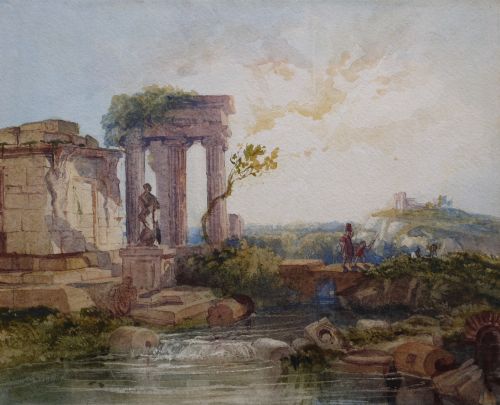


Victorian Ruin Watercolour Painting
A victorian ruin watercolour painting captures the solemn permanence of ancient and medieval decay through translucent washes on paper.
Victorian Ruin Watercolour Painting
A victorian ruin watercolour painting depicts architectural decay, monastic remains, and classical remnants across British and continental landscapes. These works frequently record sites such as Rievaulx Abbey, Bolton Abbey, St. Mary's Abbey in York, and foreign locations including Tivoli, the Arch of Titus, and Middle Eastern settings.
The pieces appearing on this page date from the nineteenth century up to nineteen-ten, spanning Victorian and Grand Tour aesthetics. They take the form of framed fine art works executed on paper or board, capturing both domestic antiquities and distant classical scenes.
Buyers encounter subjects ranging from coastal castle remnants to riverbanks framed by crumbling stonework. These watercolours reflect the nineteenth-century preoccupation with history, picturesque decay, and travel.
How they were made
Artists built these compositions upon paper and board supports using watercolour pigment, watercolour paint, and occasionally gouache. The medium allowed for fluid application, capturing atmospheric skies and weathered masonry through layered washes.
Finished works found protection beneath glass and within wooden frames, frequently incorporating gold leaf to accent the moulding. The combination of pigment and paper required careful mounting to preserve the delicate water-based medium over time.
Even uncredited nineteenth-century artists managed to make damp Yorkshire abbeys look positively inviting.
What varies in quality
The strength of a victorian ruin watercolour painting rests upon the precision of architectural rendering and the subtlety of atmospheric light. Skilled hands managed translucent washes to evoke damp stone, crumbling brickwork, and vast skies with minimal brushstrokes.
Provenance and documentation elevate certain works, particularly when signed by named artists or inscribed with specific topographical locations like the Colosseum or Yorkshire abbeys. The quality of the surrounding framing materials, such as period wood and gold leaf, also marks the distinction between standard works and exhibition pieces.
Richard Principal Leitch·R. P. Noble·John Sowden·Peter Toft·Walter John Bayes·Tom Dudley·William Crouch
The Victorian Ruin Watercolour Painting Glossary
- Watercolour
- A painting method in which the paints are made of pigments suspended in a water-soluble vehicle. It provides transparent layers of colour that allow the white of the paper to luminously shine through.
- Gouache
- An opaque water-based paint method sometimes combined with watercolour in these ruin paintings. It introduces body and opacity to highlight architectural stonework.
- Grand Tour
- A nineteenth-century cultural journey of Europe undertaken by upper-class young European men of the middle and upper classes. It inspired numerous topographical paintings of classical Italian ruins.
- Fine art
- Creative art intended to be appreciated primarily for its imaginative, aesthetic, or intellectual content. These framed pieces represent the academic standards of nineteenth-century draughtsmanship.
Victorian Ruin Watercolour Painting: Frequently Asked Questions
What subjects appear in these watercolours?
These works focus primarily on architectural decay, featuring medieval abbeys, coastal castles, and classical Roman remains. Artists recorded both British ecclesiastical sites and continental locations encountered during foreign travels.
Scenes range from riverbank ruins in Yorkshire to sunlit arches in Rome and the Middle East, reflecting a widespread nineteenth-century fascination with history.
How should I frame and display them?
Paper watercolours require protection from direct sunlight to prevent the pigments from fading over time. Glazing with appropriate glass helps shield the delicate washes from atmospheric moisture and dust.
Keep them away from damp walls and fluctuating temperatures to preserve both the paper support and any original wooden or gold leaf framing.
Are these works signed by the artists?
Some pieces bear the clear signature or monogram of the painter, while others remain entirely unsigned. Attribution often relies on stylistic comparison, period framing, or contemporary inscriptions written on the mount or reverse.
Works by documented nineteenth-century practitioners sit alongside anonymous examples executed with equal technical proficiency.
What materials make up these paintings?
The core materials consist of watercolour pigment applied to paper or board supports. Certain examples incorporate gouache to build opaque highlights upon crumbling stone.
Original presentations typically include wood frames, glass protection, and gold leaf detailing that match the aesthetic standards of the nineteenth century.