

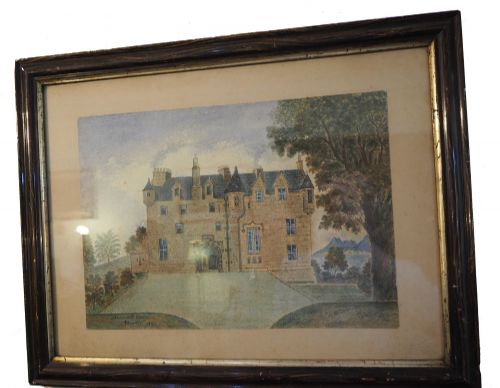
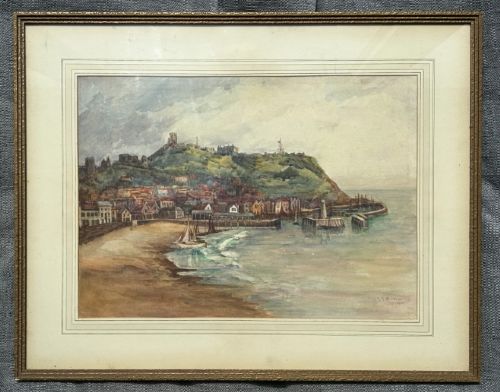
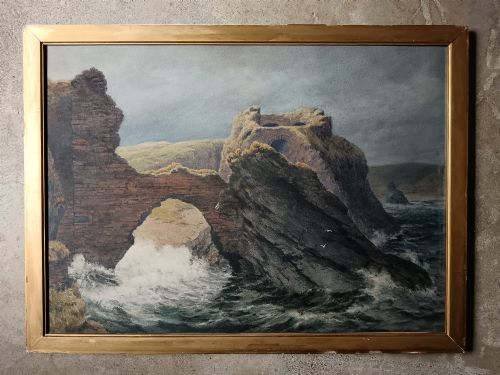


Castle Watercolour Painting
A castle watercolour painting captures historic strongholds and romantic ruins through translucent layers of pigment on paper.
Castle Watercolour Painting
A castle watercolour painting depicts historic fortifications, ruined strongholds, and noble estates set within British and European landscapes. These works range from detailed Victorian architectural studies to atmospheric twentieth-century interpretations.
The selections available here span the nineteenth and twentieth centuries, featuring notable regional landmarks such as Bolton Castle, Barnard Castle, and Windsor Castle. Artists utilised these subjects to explore the interplay between ancient stone architecture and surrounding natural topography.
Buyers will encounter works executed by both celebrated regional artists and skilled amateurs. The prevailing formats are framed landscape orientations that highlight the elevated vantage points favoured by historical topographers.
How They Were Made
Makers applied water-soluble pigments suspended in gum arabic onto various weights of paper, occasionally employing pen and ink underdrawings to define architectural stone and masonry. Pigments were layered from light washes to deep opaque details, allowing the luminous white of the paper to provide natural highlights.
Framed watercolours were protected behind glass within traditional wood frames, sometimes accented by gilt liners or mounts. This combination preserved the delicate fugitive pigments from moisture and ultraviolet degradation over successive centuries.
What Varies in Quality
Quality rests upon the artist's command of light, perspective, and atmospheric depth, distinguishing masterful topographical precision from rigid, mechanical rendering. Superior examples demonstrate confident brushwork that conveys the texture of aged stone and restless water without overworking the paper surface.
The preservation of the sheet significantly influences the standing of a piece. Works retaining their original pigment vibrancy, free from heavy foxing or acidic mount burn, represent the upper echelon of surviving examples.
John Moxon·Thomas Cooper Moore·Fred Lawson·George Graham·David Cox Jnr·Frank Wood·William Wyld·Alfred Robert Quinton·Willie Stephenson·Frederick Tully Lott·Sonia Lawson·Frank Wasley·Rowland Henry Hill·Carleton Grant·Owen Bowen·Fred Stead·Joseph William Carey·John Chase·Tom Anderton·David Cox Senior·John Syer·Harold Wharfe·Tom Campbell·Thomas Allom·J W Wilson
The Castle Watercolour Painting Glossary
- Watercolour
- A painting method in which the paints are made of pigments suspended in a water-based solution. This medium relies on transparent washes that allow the underlying paper to illuminate the composition.
- Grisaille
- A painting executed entirely in shades of grey or neutral monochrome. This technique was frequently employed in early studies to establish tonal values before applying colour.
- Foxing
- Small brownish spots caused by chemical reactions in the paper over time. Collectors monitor these age-related marks to assess the stability and storage history of the sheet.
Castle Watercolour Painting: Frequently Asked Questions
What subjects appear in these watercolours?
The compositions focus on medieval fortresses, coastal strongholds, and ruined abbeys positioned within river valleys and coastal vistas. Prominent historic sites across Yorkshire, Durham, and the Thames corridor frequently recur.
Artists emphasised the romantic decay of ancient stone walls contrasted against contemporary rural or marine activities.
How should I hang and light these paintings?
Watercolours require careful placement away from direct sunlight to prevent the fading of fugitive pigments. Displaying them in rooms with controlled, indirect illumination preserves the delicate integrity of the paper.
Acid-free backing boards and conservation glass provide essential protection against environmental humidity and atmospheric pollution.
How can I distinguish between periods?
Nineteenth-century works typically exhibit meticulous architectural detail and subdued earth tones in the manner of traditional topographical illustration. Twentieth-century examples often introduce freer brushwork, bolder pigments, and modernist compositional angles.
Framing styles, paper watermarks, and artist inscriptions further help anchor a piece within a specific decade or movement.
Are these works original or printed reproductions?
Every piece listed is a unique, hand-painted work executed directly onto paper using watercolour pigments. Close inspection reveals individual brush hairs, pigment pooling, and the physical indentation of the paper fibres.
Original sketches and finished exhibition pieces both carry the distinct touch of the artist's hand rather than mechanical dot patterns.