
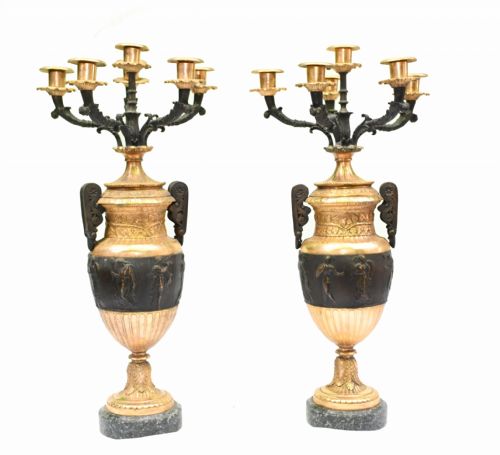


Classical Revival Urn
A classical revival urn brings the symmetry and sculptural dignity of antiquity directly into a room.
Materials and methods of construction
Metal vessels rely on cast bronze, brass, and gilt bronze, often assembled with patinated surfaces and mounted on marble plinths. Detail is achieved through crisp casting and chasing, supplemented by ormolu mounts.
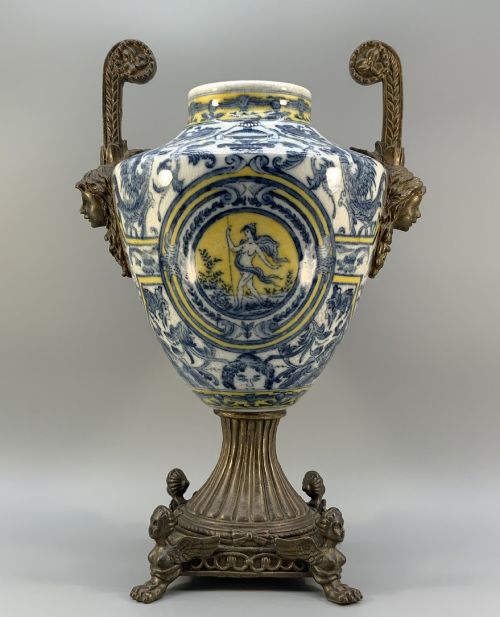
Ceramic and glass examples employ porcelain, majolica, and vitrified glass, decorated with classical scenes, hand-painted panels, or moulded relief. Faience and terracotta variations utilise traditional earthenware bodies finished with enamel or glaze.
Distinctions in quality
Quality rests in the fidelity of the casting and the crispness of the chased detail on metal surfaces, where sharper definition distinguishes superior work from softer commercial output. The weight of the bronze or brass and the choice of supporting marble or wooden pedestals indicate the maker's investment in materials.
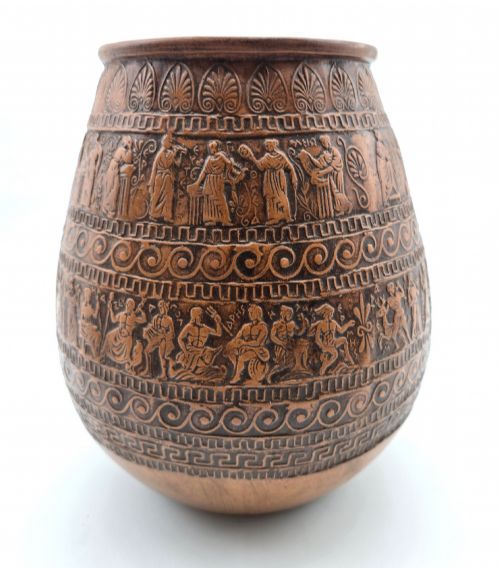
In ceramic and porcelain examples, the precision of the hand-painted classical scenes and the depth of the glaze separate standard decorative pieces from finer studio productions. Proportion and balance in the handle attachments and foot rims further reveal the maker's adherence to classical canons.
One unexpected survivor is a brass Pompeji kantharos cup designed for drinking, though nobody dares fill it with wine today.
Harrison Brothers And Howson·Edwards And Roberts·Thomas Hope
The Classical Revival Urn Glossary
- Campana urn
- A bell-shaped vessel with flared lips and loop handles, originating in ancient Greek pottery and widely adopted by nineteenth-century metalworkers.
- Grand Tour
- A cultural journey undertaken by wealthy young Europeans through France and Italy to study classical antiquities, inspiring domestic purchases of miniature bronzes and vases.
- Majolica
- Opaque tin-glazed earthenware decorated with colourful pigments, frequently produced in nineteenth-century Italy in Renaissance revival styles.
- Ormolu
- Gilt bronze mounted onto furniture, clocks, or ceramic vessels, providing a bright golden contrast against patinated metals or dark marble.
- Trefoil oinochoe
- A wine jug featuring a three-part cloverleaf rim, modelled on ancient Greek ceramic shapes.
Classical Revival Urn: Frequently Asked Questions
What is a classical revival urn?
A classical revival urn is a decorative vessel inspired by ancient Greek and Roman pottery and metalwork, produced mainly during the nineteenth and early twentieth centuries.
These pieces reflect the period's fascination with classical antiquity, drawing on archaeological discoveries and Grand Tour souvenirs to ornament Victorian and Edwardian interiors.
How were these urns used originally?
In antiquity, similar vessels served practical functions such as holding wine, water, or ashes, but nineteenth-century revival pieces were purely decorative.
Victorian homes displayed them on mantels, pedestals, and side tables to signal classical taste and scholarly refinement.
How do I style an urn at home?
Place a bronze campana urn or porcelain vessel on a mantelpiece or side cabinet where its vertical lines and classical proportions can act as a focal point.
Many examples have been safely converted into table lamps, allowing them to provide ambient lighting while retaining their sculptural silhouette.
How can I tell the period of an urn?
Dating relies on examining the material composition, casting technique, and surface patination, alongside any associated mounts or maker's signatures.
Nineteenth-century pieces often combine bronze with marble bases or employ nineteenth-century porcelain techniques that mimic earlier Sevres or Italian styles.