
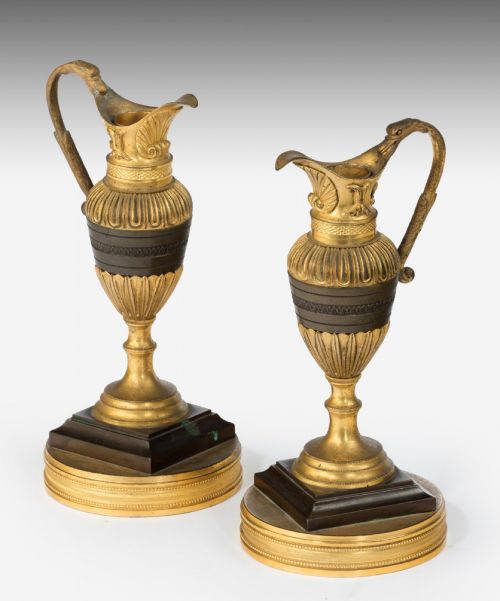


Classical Bronze Garniture Set
A classical bronze garniture set commands attention on any mantelpiece, bringing symmetry and architectural presence to a room through matched clocks and side pieces.
Classical Bronze Garniture Set
A classical bronze garniture set consists of a central mantel clock accompanied by matching side ornaments such as candelabra, urns, or ewers. These matched assemblies originate predominantly from the nineteenth century, reflecting French Empire, Louis XVI, and Victorian design influences.
The most common configurations on this page pair a central marble or bronze clock with matching vases, urns, or candelabra. Makers arranged these pieces to create balanced decorative schemes for grand domestic interiors.
Objects within a classical bronze garniture set often incorporate mythological or neoclassical motifs, drawing directly on classical antiquity. They serve both a practical timekeeping function and a purely decorative role within the domestic interior.
Materials and Construction
Foundries combined cast bronze and brass with hand-chased ormolu, applying mercury gilt to create contrasting metallic surfaces. This technique produced the characteristic golden highlights alongside darker patinated bronze elements.
Carved marble forms the substantial plinths and bodies of many pieces, often paired directly with applied metal mounts. Makers utilised white, siena, and black marble varieties to provide solid foundations for the metallic decorative work.
Enamel dials and glass bezels complete the clock components, while subsidiary ornaments utilise turned stone and cast metal parts. Skilled artisans assembled these multi-component objects using threaded pins and hidden screws.
Listings feature nineteenth-century French and Victorian pieces constructed from bronze, ormolu, and various coloured marbles.
Distinguishing Quality
The crispness of the bronze casting and the depth of the subsequent chasing separate standard items from superior works. Foundries employing skilled artisans achieved sharp relief and clean detailing across acanthus leaves, figures, and architectural mouldings.
The weight and selection of the marble components influence the overall standing of an assembly. Dense, finely figured stone bases paired with heavy fire-gilded ormolu mounts indicate superior workshop production.
Signed movements by known makers provide a clear distinction in standing, linking pieces to established Paris workshops. The precision of the striking mechanism and the quality of the enamel dial further elevate the status of a set.
A.D Mougin·H Luppens Paris·Deniere Paris
The Classical Bronze Garniture Set Glossary
- Ormolu
- Gilt bronze produced by applying a mercury and gold amalgam to a bronze base and heating it to drive off the mercury. This historic fire-gilding technique yields a durable, deep golden lustre.
- Garniture
- A set of matched ornamental objects designed to be displayed together on a mantelpiece or sideboard. Typically comprising a central clock flanked by two vases, urns, or candelabra.
- Ewer
- A large jug with a wide spout and a curved handle, often produced in pairs as decorative elements within a garniture. These forms draw directly on classical Greek and Roman pottery shapes.
- Patinated bronze
- Bronze treated with chemical solutions to produce a controlled surface colour ranging from rich brown to deep green. This treatment protects the metal while accentuating modeled details.
- Bleu de Roi
- A deep, rich cobalt blue ceramic glaze developed at the Sèvres porcelain factory. It frequently appears as a contrasting background colour on clock faces and urn bodies.
Classical Bronze Garniture Set: Frequently Asked Questions
What is included in a garniture set?
A standard garniture set comprises a central mantel clock accompanied by two matching side pieces, such as candelabra, urns, or decorative vases. These elements share identical decorative vocabularies and materials to create a unified display.
Craftsmen designed these suites specifically for placement on mantelpieces or large console tables where symmetry was paramount.
How do I care for marble and ormolu?
Maintenance requires gentle dusting with a soft, dry cloth to prevent dirt accumulation within the chased metal crevices. Avoid liquid cleaners and harsh polishes, as these can strip the historic fire-gilding from the bronze mounts.
Marble surfaces benefit from occasional wiping with a damp cloth, followed immediately by drying to protect the polished stone finish.
How do I identify nineteenth-century French styles?
Nineteenth-century French pieces often draw inspiration from earlier periods such as the Louis XVI era or the Empire style. Look for neoclassical motifs like classical urns, laurel wreaths, fluted columns, and strict symmetrical arrangements.
Makers working during the Victorian period frequently adopted these French designs, incorporating similar patinated bronzes and shaped marble plinths.
Where were these clock sets displayed?
These decorative assemblies sat predominantly on drawing room mantelpieces, positioned centrally beneath large wall mirrors. Their reflective ormolu mounts and polished marble surfaces captured and diffused the flickering light of nineteenth-century parlours.
Beyond the primary reception rooms, prosperous households placed them on grand dining room sideboards or library shelves.