




Victorian Mantelpiece Garniture
A Victorian mantelpiece garniture brings symmetry and striking display to a fireplace, pairing a central clock with matching vases, urns, or candelabra.
Victorian Mantelpiece Garniture
Most examples found in this selection originate from the nineteenth century, spanning periods from the Regency era through to the late Victorian decades. French influences dominate the designs, reflecting revival styles such as Rococo, Louis XVI, and Napoleon III.
Buyers encounter both clock garnitures and standalone vase garniture sets, often incorporating glass, porcelain, or metal components. These decorative sets served a purely ornamental function in formal Victorian drawing rooms and parlours.
Materials and construction
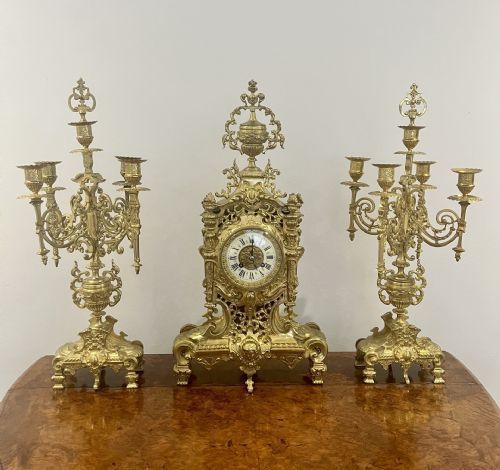
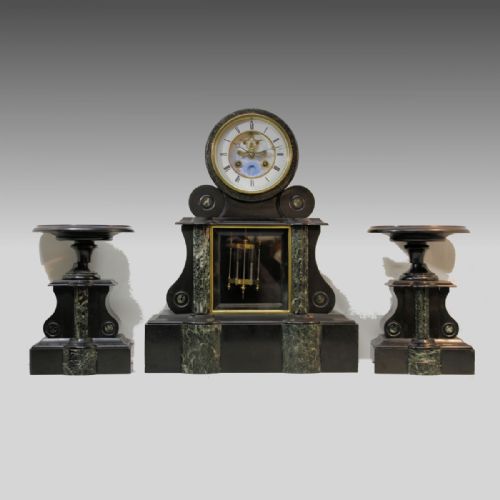
Metalwork forms the structural core of many sets, utilising cast brass, gilded bronze, or ormolu finished with gold leaf. Makers frequently combined these metal mounts with natural stone plinths including green onyx and pink marble.
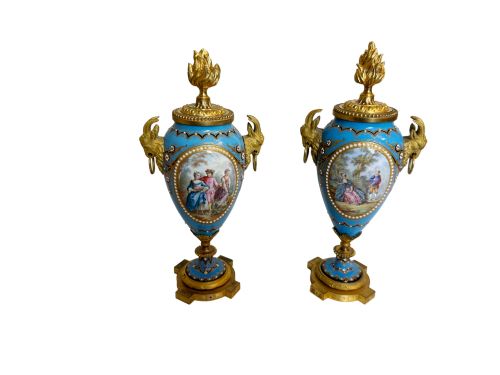
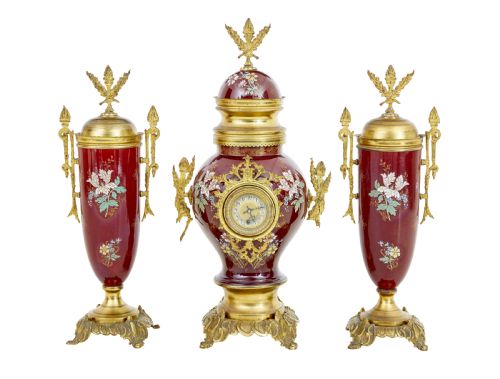
Decorative surfaces often incorporate hand-painted porcelain panels in the Sevres or Royal Vienna style, alongside vibrant enamel work and cloisonne. Glass elements appear as ruby glass, crystal, and decorated mantel lustres hung with glass drops.
Markers of quality
The sophistication of the casting and chiselling separates standard pieces from the finest work. High-end garnitures display crisp, deeply carved ornamentation on the ormolu or bronze mounts rather than soft, repetitive factory detailing.
The integration of the materials dictates overall value, seen in the weight of the marble or onyx bases and the quality of the porcelain painting. Complete sets retaining their original matching sidepieces and functioning clock movements command greater interest.
Finnigan Manchester·Meissen·Sevres·Royal Vienna
The Victorian Mantelpiece Garniture Glossary
- Garniture
- A set of ornamental objects designed to match and be displayed together. They typically comprise three pieces for a mantelpiece.
- Cassolette
- A decorative vase or box with a reversible lid that functions either as a vessel or a censer. They often feature in French clock sets.
- Ormolu
- Gilded bronze applied to furniture, clocks, and decorative objects. The technique involves coating metal with a mercury and gold amalgam.
- Mantel lustre
- A glass vase hung with crystal prisms that catch and reflect candlelight. Victorian examples often come in ruby or green glass.
- Portico clock
- A clock housed within a architectural frame supported by columns. They frequently form the centrepiece of a garnet set.
Victorian Mantelpiece Garniture: Frequently Asked Questions
What is included in a garniture set?
A standard Victorian garniture comprises a central mantel clock accompanied by two matching side pieces. These flanking objects take the form of urns, vases, candelabra, or cassolettes.
Together they create a balanced, symmetrical arrangement designed specifically for display on a fireplace mantel.
How do I date a Victorian garniture?
Dating relies on stylistic clues, materials, and mechanical signatures found on the clock movements. Mid-century pieces often favour ornate French Rococo revival motifs, while later examples incorporate neo-classical brass or green onyx.
Maker marks stamped on the movement backplates or ceramic bases also help narrow down the production decade.
Where were garnitures placed in a home?
Victorian homeowners positioned these sets prominently on the mantelpiece in formal reception rooms and drawing rooms. The central clock anchored the display, flanked by the matching side ornaments to create visual symmetry.
They functioned as high-status decorative statements rather than purely practical timekeepers.
How should I clean antique bronze and ormolu?
Maintenance requires gentle dusting with a soft, dry brush to prevent dirt buildup in the crevices of the cast metal. Avoid harsh commercial metal polishes, which can strip away the delicate original gilding.
Professional care is recommended if the surface requires deeper cleaning or restoration.