
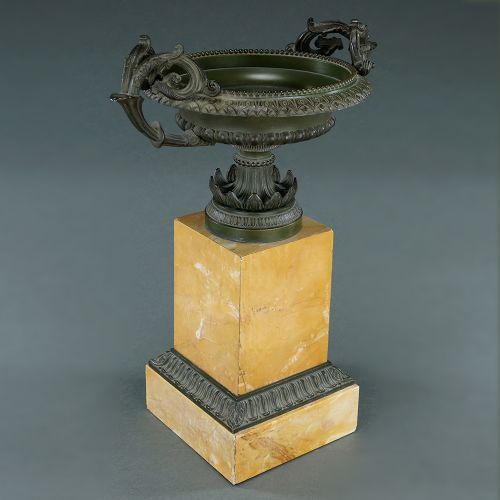
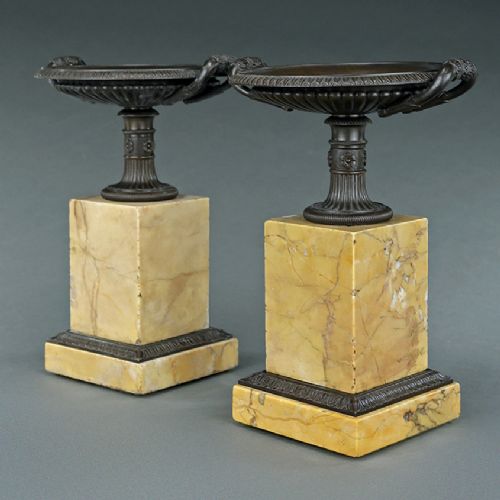
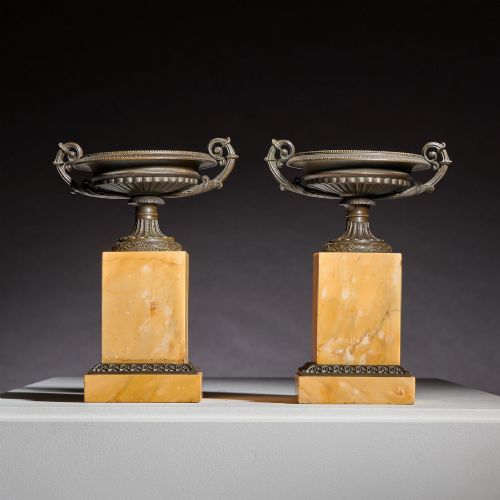
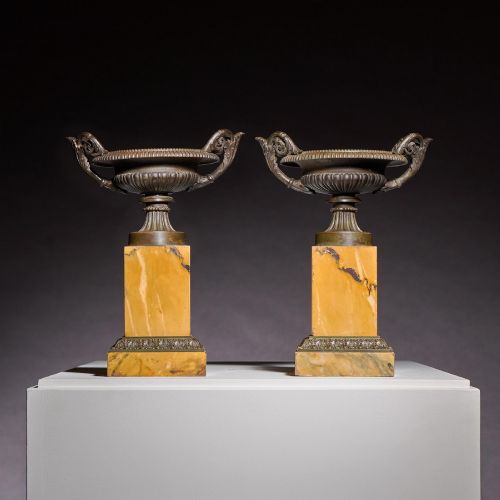


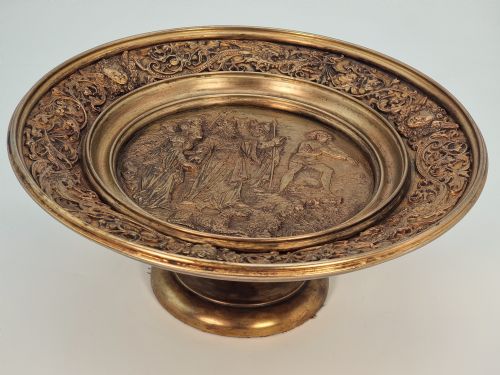


Classical Bronze Bowls
Classical bronze bowls and tazzas bring heavy metalwork and marble bases into a room, channelling antiquity through nineteenth-century hands.
Classical Bronze Bowls
Classical bronze bowls and tazzas emerge most frequently on this page as nineteenth-century French and Italian Grand Tour pieces, drawing on ancient forms for ornamental display. These objects take the shape of tazzas, centrepieces, jardinieres and lidded cups, designed purely for visual impact rather than service. Makers adopted styles ranging from French Empire and Neoclassical to Regency, Napoleon III and the Aesthetic Movement.
The heavy metalwork is routinely mounted on contrasting bases of Siena marble, rouge griotte marble or plain white marble, lifting the bronze from the surface. Many examples pair the dark metal with gilt bronze or ormolu highlights, enamel work, porcelain or inset minerals such as malachite and Blue John. These pieces served as scholarly souvenirs for travellers or decorative centrepieces for nineteenth-century drawing rooms.
How they were made
Foundries cast these vessels in bronze, sometimes applying a silvered finish or heavy silver plating over the metal. Ormolu and gilt bronze details were then added to accent handles, rims and borders.
Stonemasons turned and polished marble bases in Siena and rouge varieties to support the weight of the metal bowls. Artisans occasionally incorporated champleve enamel, cut glass, porcelain plaques or decorative stones like Blue John into the overall assembly.
Makers occasionally enlisted cherubs to hold up heavy bronze bowls, giving solemn classical motifs an unexpectedly cheeky lift.
What varies in quality
Quality rests in the crispness of the cast ornament and the ambition of the materials chosen to accompany the bronze. The finest pieces integrate richly coloured marbles, intricate enamel work or hardstones like malachite with precise, sharp chasing on the metal figures and handles.
Subtlety in proportions and the integration of the bowl with its stone base separate standard production items from exceptional Grand Tour souvenirs. The density of the bronze and the depth of the gilding or silvering determine the physical presence of the object.
The Classical Bronze Bowls Glossary
- Tazza
- A shallow bowl set upon a foot and stem, designed for display on a table or sideboard. This form originates from ancient drinking vessels but served entirely decorative purposes in the nineteenth century.
- Grand Tour
- A cultural journey undertaken by wealthy young Europeans through France and Italy to study classical antiquities. Souvenirs bought along the way included bronze reductions of ancient vessels and marble-mounted tazzas.
- Ormolu
- Gilt bronze produced by applying a mercury and gold amalgam to a bronze base and heating it to drive off the mercury. This technique creates a rich, durable golden surface.
Classical Bronze Bowls: Frequently Asked Questions
What is a tazza?
A tazza is a shallow ornamental bowl raised on a short stem and foot. Nineteenth-century makers used this ancient form to create decorative centrepieces for tables and cabinets.
These pieces were made for display rather than dining. They often incorporate classical figures, handles and relief decoration.
What is a Grand Tour souvenir?
A Grand Tour souvenir is an object purchased by travellers touring the cultural sites of Italy and France during the nineteenth century. These items were often miniature bronzes or marble-based tazzas modelled after ancient ruins.
They allowed collectors to bring classical antiquity home into their libraries and drawing rooms. The pieces bridge archaeology and nineteenth-century decorative arts.
Why are marble bases used?
Marble bases provide weight and a contrasting colour palette to the dark or gilt bronze bowls above. Materials like Siena marble and rouge griotte added a sense of geological richness.
This combination mimics the archaeological finds uncovered in excavations across the Mediterranean. The stone lifts the metalwork and grounds the composition visually.
How do I style a bronze tazza?
Bronze tazzas sit well on large dining tables, sideboards or library shelves as sculptural focal points. Their reflective metal surfaces and stone bases catch light and contrast against wood furniture.
They require no additional contents to work in a room, functioning best as standalone objects of nineteenth-century design.